

sping is a network diagnostic utility that extends the traditional ping command with detailed connectivity measurements and live visualisations. It helps users monitor network performance and investigate problems affecting local or remote destinations.
The application goes beyond measuring response times by providing information about the network path and surrounding connectivity. It can examine the local gateway and an external reference destination to help distinguish problems with a particular host from wider network outages.
sping is designed for interactive troubleshooting as well as automated monitoring. Its terminal interface offers several display modes, while structured output allows measurement results to be processed by scripts and other tools.
This is free and open source software.
Key Features
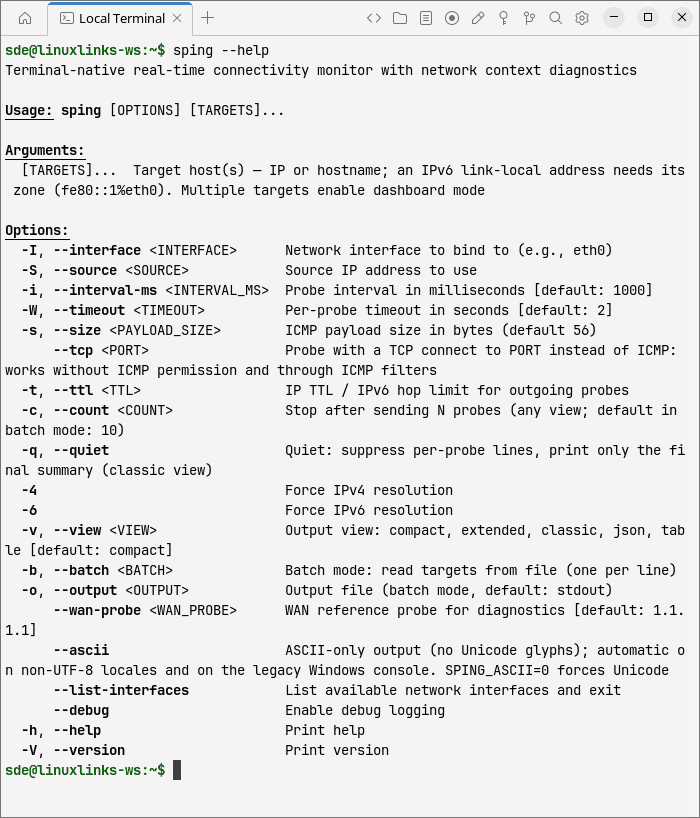
- ICMP echo monitoring with IPv4 and IPv6 support.
- TCP connection probes for destinations where ICMP traffic is blocked.
- Measure round-trip latency with minimum, average and maximum values.
- Calculate jitter, mean deviation and packet-loss statistics.
- Display latency percentiles and response-time distributions.
- Live pulse graph showing recent latency measurements and lost packets.
- Adaptive detection of unusual latency spikes.
- Connection quality scores with improving or degrading trend indicators.
- Track network outages and identify recovery events.
- Identify the network interface, source address and default gateway.
- Monitor gateway and external connectivity independently of the target.
- Correlate failures to suggest likely causes of connectivity problems.
- Display TTL values and estimated network hop counts.
- Compact, extended and traditional ping-style views.
- Multi-target dashboard for monitoring several destinations simultaneously.
- Batch monitoring using a file containing target addresses.
- Machine-readable JSON output for automated processing.
- Configurable probe intervals, timeouts and payload sizes.
- Automatic hostname re-resolution during extended monitoring.
- Cross-platform support – runs on Linux, macOS, and Windows.
Website: github.com/LambdaBytes/sping
Support:
Developer: Antonio Cotos
License: MIT License
sping is written in Rust. Learn Rust with our recommended free books and free tutorials.
Related Software
| Alternatives to ping | |
|---|---|
| pingnoo | Offers a graphical representation for traceroute and ping output (GUI) |
| hping3 | Supports TCP, UDP, ICMP and RAW-IP protocols with traceroute mode |
| gping | Ping but with a graph |
| GNOME Nettool | Performs ping, netstat, traceroute, port scans, lookup, and whois (GUI) |
| mtr | Combines 'traceroute' and 'ping' programs in a single network tool |
| pingtop | Ping multiple servers and show the result in a top like terminal UI |
| pingu | Command implementation in Go but with colorful output and pingu ascii art |
| 2ping | Bi-directional ping tool using 3-way pings (akin to TCP SYN, SYN/ACK, ACK) |
| BWPing | Measures bandwidth and response times between two hosts using ICMP |
| cnping | Minimal graphical IPv4 Ping / HTTP tool |
| fping | Send ICMP echo probes to network hosts |
| SmokePing | Measure, store and display latency, latency distribution and packet loss |
| tcping | ICMP ping but for TCP |
| alive | Periodic ping |
| ping3 | Python3 version of ICMP ping |
| echoping | Testing tool for network protocols |
| xping | Continuously probe multiple hosts using icmp-echo |
| omping | Test IPv4/IPv6 multicast connectivity on a LAN |
| Trippy | Network diagnostic tool combining the functionality of ping & traceroute |
| Echo | Simple GUI GTK4 utility to ping websites |
| pingstat | Multi-server ping logging |
| myping | Ping multiple hosts at the same time |
| mtr085 | Fork of mtr adding functionality such as Unicode histograms |
| mtr-gtk | GUI frontend |
| Ping Monitor | Displays real-time ping times (GUI) |
| split ping | See the direction of loss or latency |
| ring | ping rewritten in Rust |
 Explore our carefully curated directory of recommended free and open source software, covering every major software category. Explore our carefully curated directory of recommended free and open source software, covering every major software category.The directory forms part of our extensive collection of articles for Linux enthusiasts. It includes hundreds of detailed reviews, together with free and open source alternatives to proprietary software from companies such as Google, Microsoft, Apple, Adobe, IBM, Cisco, Oracle, and Autodesk. LinuxLinks also covers interesting projects worth exploring, Linux-compatible hardware, free programming books and tutorials, and much more. Know a useful free and open source Linux application that we haven’t covered? Tell us about it using our submission form. |
Please read our Comment Policy before commenting.