

pingstat is a command-line utility for collecting and examining network connectivity statistics across multiple servers. It stores ping measurements in SQLite databases, providing a historical record that can be useful when investigating recurring network problems.
Each monitored server has its own database, allowing measurements to be retained separately. Users can examine recorded latency and packet-loss information without having to search through lengthy terminal logs.
pingstat is designed for lightweight monitoring on Linux. It uses familiar command-line tools and can be scheduled to perform recurring checks, making it suitable for administrators who prefer a straightforward alternative to a larger monitoring platform.
This is free and open source software.
Key Features
- Monitor and record ping results for multiple servers.
- Maintain a separate SQLite database for each destination.
- Record minimum, average and maximum response times.
- Store mean deviation and packet-loss statistics.
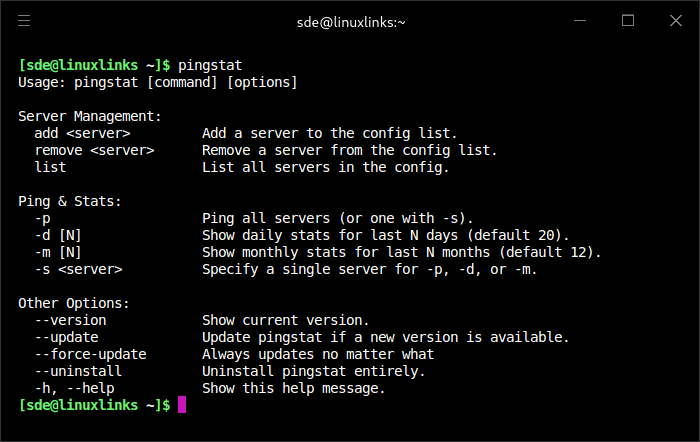
- Add, remove and list monitored servers through command-line controls.
- Review historical measurements using daily aggregation.
- Monthly summaries for examining longer-term network behaviour.
- Suitable for recurring execution through cron.
- Store monitoring information in user-writable databases.
- Lightweight command-line interface for accessing recorded statistics.
Website: codeberg.org/tomsh/pingstat
Support:
Developer: tomsh
License: MIT License
pingstat is written in Bash. Learn Bash with our recommended free books and free tutorials.
Related Software
| Alternatives to ping | |
|---|---|
| pingnoo | Offers a graphical representation for traceroute and ping output (GUI) |
| hping3 | Supports TCP, UDP, ICMP and RAW-IP protocols with traceroute mode |
| gping | Ping but with a graph |
| GNOME Nettool | Performs ping, netstat, traceroute, port scans, lookup, and whois (GUI) |
| mtr | Combines 'traceroute' and 'ping' programs in a single network tool |
| pingtop | Ping multiple servers and show the result in a top like terminal UI |
| pingu | Command implementation in Go but with colorful output and pingu ascii art |
| 2ping | Bi-directional ping tool using 3-way pings (akin to TCP SYN, SYN/ACK, ACK) |
| BWPing | Measures bandwidth and response times between two hosts using ICMP |
| cnping | Minimal graphical IPv4 Ping / HTTP tool |
| fping | Send ICMP echo probes to network hosts |
| SmokePing | Measure, store and display latency, latency distribution and packet loss |
| tcping | ICMP ping but for TCP |
| alive | Periodic ping |
| ping3 | Python3 version of ICMP ping |
| echoping | Testing tool for network protocols |
| xping | Continuously probe multiple hosts using icmp-echo |
| omping | Test IPv4/IPv6 multicast connectivity on a LAN |
| Trippy | Network diagnostic tool combining the functionality of ping & traceroute |
| Echo | Simple GUI GTK4 utility to ping websites |
| pingstat | Multi-server ping logging |
| myping | Ping multiple hosts at the same time |
| mtr085 | Fork of mtr adding functionality such as Unicode histograms |
| mtr-gtk | GUI frontend |
| Ping Monitor | Displays real-time ping times (GUI) |
| split ping | See the direction of loss or latency |
| ring | ping rewritten in Rust |
 LinuxLinks helps you discover the best free and open source software for Linux. Explore our extensive collection of recommended applications, including alternatives to popular proprietary software. We also publish software reviews, Linux tutorials, hardware reviews, free programming books and articles covering the wider open source community. Browse our Linux resources to discover more. Know a useful free and open source Linux application we haven't covered? Suggest a program for inclusion. Has your software been featured on LinuxLinks? Display one of our Featured on LinuxLinks badges on your website or GitHub README. |
Please read our Comment Policy before commenting.