

xping is a terminal utility for monitoring connectivity to several network hosts simultaneously. It uses ICMP echo requests and presents the results as compact character-based timelines.
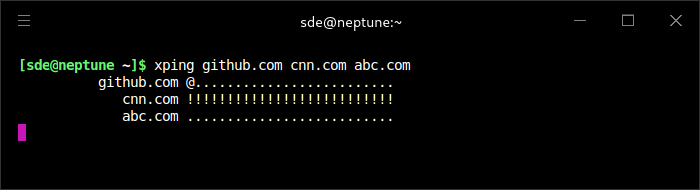
The application is designed to make intermittent network failures easy to recognise. Successful replies appear as dots, while unanswered probes are represented by question marks. This allows users to compare the connectivity history of different hosts at a glance.
xping is particularly useful when investigating unstable connections or monitoring several devices during maintenance. Its compact presentation provides an alternative to examining the individual output of multiple ping processes.
This is free and open source software.
Key Features
- Continuously probe multiple hosts using ICMP echo requests.
- Display successful replies as dots in a terminal timeline.
- Mark unanswered probes with question marks.
- Compare the recent availability of different destinations.
- Support IPv4 and IPv6 connectivity tests.
- Read target addresses from standard input.
- Configurable probe counts and monitoring options.
- HTTP client probing for testing web services.
- Optional encrypted connection support.
- Produce reports suitable for redirected output.
- Colourised results and different terminal display methods.
- Cross-platform support – runs on Linux, macOS, and FreeBSD.
Website: github.com/martintopholm/xping
Support:
Developer: Martin Topholm
License: Beerware License
xping is written in C. Learn C with our recommended free books and free tutorials.
Related Software
| Alternatives to ping | |
|---|---|
| pingnoo | Offers a graphical representation for traceroute and ping output (GUI) |
| hping3 | Supports TCP, UDP, ICMP and RAW-IP protocols with traceroute mode |
| gping | Ping but with a graph |
| GNOME Nettool | Performs ping, netstat, traceroute, port scans, lookup, and whois (GUI) |
| mtr | Combines 'traceroute' and 'ping' programs in a single network tool |
| pingtop | Ping multiple servers and show the result in a top like terminal UI |
| pingu | Command implementation in Go but with colorful output and pingu ascii art |
| 2ping | Bi-directional ping tool using 3-way pings (akin to TCP SYN, SYN/ACK, ACK) |
| BWPing | Measures bandwidth and response times between two hosts using ICMP |
| cnping | Minimal graphical IPv4 Ping / HTTP tool |
| fping | Send ICMP echo probes to network hosts |
| SmokePing | Measure, store and display latency, latency distribution and packet loss |
| tcping | ICMP ping but for TCP |
| alive | Periodic ping |
| ping3 | Python3 version of ICMP ping |
| echoping | Testing tool for network protocols |
| xping | Continuously probe multiple hosts using icmp-echo |
| omping | Test IPv4/IPv6 multicast connectivity on a LAN |
| Trippy | Network diagnostic tool combining the functionality of ping & traceroute |
| Echo | Simple GUI GTK4 utility to ping websites |
| pingstat | Multi-server ping logging |
| myping | Ping multiple hosts at the same time |
| mtr085 | Fork of mtr adding functionality such as Unicode histograms |
| mtr-gtk | GUI frontend |
| Ping Monitor | Displays real-time ping times (GUI) |
| split ping | See the direction of loss or latency |
| ring | ping rewritten in Rust |
 LinuxLinks helps you discover the best free and open source software for Linux. Explore our extensive collection of recommended applications, including alternatives to popular proprietary software. We also publish software reviews, Linux tutorials, hardware reviews, free programming books and articles covering the wider open source community. Browse our Linux resources to discover more. Know a useful free and open source Linux application we haven't covered? Suggest a program for inclusion. Has your software been featured on LinuxLinks? Display one of our Featured on LinuxLinks badges on your website or GitHub README. |
Please read our Comment Policy before commenting.