

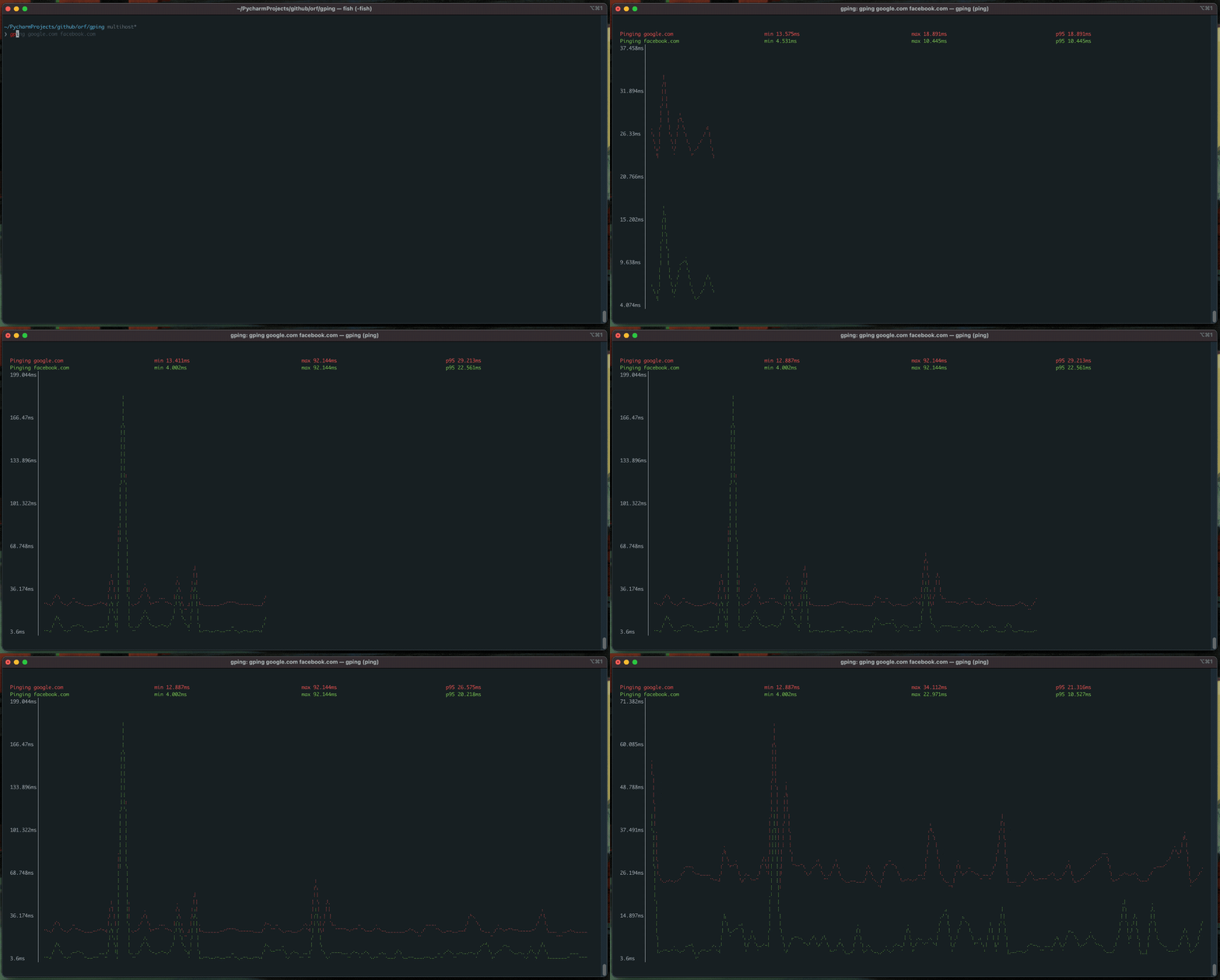
gping is a command-line utility that presents ping results as continuously updating graphs. It helps users observe changes in network latency without having to interpret a scrolling series of numerical results.
The application displays response times along a timeline, making spikes, unstable connections and differences between hosts easier to recognise. Multiple destinations can be monitored within the same terminal window.
gping can also graph how long external commands take to execute. This extends its usefulness beyond ordinary network monitoring, allowing developers and system administrators to investigate changes in command execution times.
This is free and open source software.
Key Features
- Display ping response times as scrolling terminal graphs.
- Monitor several destinations simultaneously.
- Compare latency patterns between different hosts.
- Graph execution times for external commands.
- Configurable graph colours for distinguishing monitored targets.
- Adjustable graph refresh and monitoring intervals.
- Automatically adapt the display to changing terminal dimensions.
- Visualise latency spikes and periods of unusually slow responses.
- Show elapsed time along the graph’s horizontal axis.
- Use the terminal interface without requiring a graphical desktop.
- Cross-platform support – runs on Linux, macOS, and Windows.
Website: github.com/orf/gping
Support:
Developer: Tom Forbes and contributors
License: MIT License
gping is written in Rust. Learn Rust with our recommended free books and free tutorials.
Related Software
| Alternatives to ping | |
|---|---|
| pingnoo | Offers a graphical representation for traceroute and ping output (GUI) |
| hping3 | Supports TCP, UDP, ICMP and RAW-IP protocols with traceroute mode |
| gping | Ping but with a graph |
| GNOME Nettool | Performs ping, netstat, traceroute, port scans, lookup, and whois (GUI) |
| mtr | Combines 'traceroute' and 'ping' programs in a single network tool |
| pingtop | Ping multiple servers and show the result in a top like terminal UI |
| pingu | Command implementation in Go but with colorful output and pingu ascii art |
| 2ping | Bi-directional ping tool using 3-way pings (akin to TCP SYN, SYN/ACK, ACK) |
| BWPing | Measures bandwidth and response times between two hosts using ICMP |
| cnping | Minimal graphical IPv4 Ping / HTTP tool |
| fping | Send ICMP echo probes to network hosts |
| SmokePing | Measure, store and display latency, latency distribution and packet loss |
| tcping | ICMP ping but for TCP |
| alive | Periodic ping |
| ping3 | Python3 version of ICMP ping |
| echoping | Testing tool for network protocols |
| xping | Continuously probe multiple hosts using icmp-echo |
| omping | Test IPv4/IPv6 multicast connectivity on a LAN |
| Trippy | Network diagnostic tool combining the functionality of ping & traceroute |
| Echo | Simple GUI GTK4 utility to ping websites |
| pingstat | Multi-server ping logging |
| myping | Ping multiple hosts at the same time |
| mtr085 | Fork of mtr adding functionality such as Unicode histograms |
| mtr-gtk | GUI frontend |
| Ping Monitor | Displays real-time ping times (GUI) |
| split ping | See the direction of loss or latency |
| ring | ping rewritten in Rust |
 LinuxLinks helps you discover the best free and open source software for Linux. Explore our extensive collection of recommended applications, including alternatives to popular proprietary software. We also publish software reviews, Linux tutorials, hardware reviews, free programming books and articles covering the wider open source community. Browse our Linux resources to discover more. Know a useful free and open source Linux application we haven't covered? Suggest a program for inclusion. Has your software been featured on LinuxLinks? Display one of our Featured on LinuxLinks badges on your website or GitHub README. |
Please read our Comment Policy before commenting.