
LinuxLinks has kindly given me the space to publish a semi-regular blog where I share my thoughts on open source, the Linux ecosystem, Windows, and other topics. It’s a place for my opinions and personal perspectives. As you might expect, everything I write here reflects my own views and prejudices.
There is a slightly odd test that some Linux enthusiasts seem to apply to new users. If a person cannot repair a broken package, make sense of a terminal error, or tell you which graphics session they are running, then perhaps Linux simply is not for them. Which, when you stop and think about it, is a frankly daft way to promote an operating system.
Most people do not want a relationship with their computer. They do not want to learn the ins and outs of their printer stack on a wet Tuesday evening. They want to write a letter, sort out a few photographs, watch a film, send an email, and get on with the rest of their day. Quite right too. Nobody proudly announces that their washing machine only works properly if they can interpret diagnostic codes and edit a configuration file. Yet when a Linux newcomer runs into trouble, someone will almost always pop up with three terminal commands and the faint air of “there you go, job done”. As if that settles the matter.
And the funny thing is that Linux can be wonderfully straightforward. In many cases, installing software from a graphical software centre is easier than rummaging around the web for Windows installers and then clicking through half a dozen prompts. Software updates can be handled centrally, without hunting down individual installers, and modern desktops already offer most of the things ordinary users need. KDE Plasma and GNOME have both put years into refining the experience. GNOME’s own design principles, for instance, explicitly aim to reduce user effort and avoid demanding specialist knowledge.
But the mood changes very quickly when something goes wrong. Suddenly the advice involves three different packaging formats, a distribution-specific command, a kernel parameter, and a mysterious configuration file tucked away somewhere under .config or /etc, or possibly both if you are especially unlucky. To someone who’s been using Linux for a decade, the fix might seem obvious. To someone who installed it last weekend, it’s just another problem they didn’t have yesterday.
I use Linux every day, and I still get caught out. Recently, fractional scaling on my 4K monitor left me with blurry screenshots. I’ve spent far too long trying to fix something that ought to be straightforward. And I’ve been using Linux for years.
We should separate power from needless complication. A capable terminal is a real strength, and no sensible person is suggesting we should get rid of it. I use the terminal constantly, often because it’s quicker than clicking through menus. But trouble starts when command-line workarounds become a substitute for actually fixing rough edges in the graphical experience. If plugging in an ordinary printer or changing an app permission means spending half an hour searching forums, something has gone wrong. And telling someone to learn the command line isn’t much of an answer. It is, if we are honest, passing the buck.
I’ve made my feelings fairly clear. But I’m interested in what LinuxLinks readers think. Just how much technical knowledge should someone need to use Linux comfortably?
Then there’s the old excuse that the user has brought the wrong expectations from Windows. I’ve heard this argument more times than I care to remember, and it doesn’t get any more convincing with repetition. Yes, Linux does things differently. Sometimes those differences are genuinely better. Other times, we’re using “different” as a polite excuse for an awkward interface, ropey documentation, or a feature that clearly needed a bit more work before release.
I’m not suggesting Linux should become a pale imitation of Windows. Heaven forbid. There are plenty of things about Windows that I’d rather Linux kept well away from. But being different doesn’t give us a free pass to make simple things unnecessarily difficult.
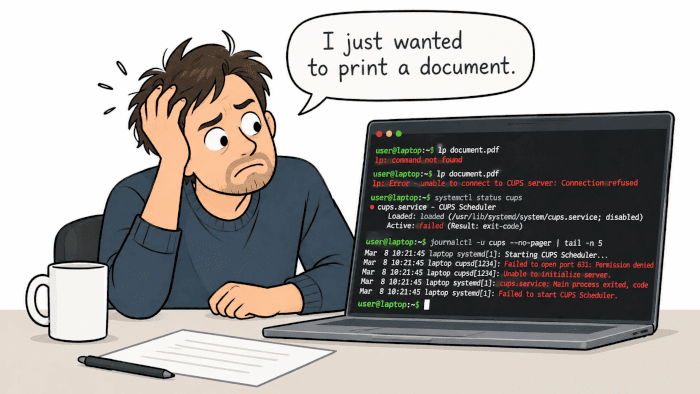
A computer should reward curiosity without demanding it. You should be free to tinker, experiment, break things and put them back together again. That’s one of the great pleasures of Linux. But you shouldn’t have to muck about with the plumbing just to print a document.
If Linux really wants to attract ordinary computer users, why does it still expect so many of them to think like system administrators?
Please read our Comment Policy before commenting.
The craziest rebuttal to all this has to be the people who openly say they don’t want non-experts using Linux. And they don’t care about having more users. Seriously? Since when did you need to pass some sort of technical competence test to use an operating system? It’s elitism, pure and simple. You’d think people who champion free software would be pleased to see more people using it, not trying to keep it as some sort of exclusive club.