
Glumpy is an open source Python library for scientific 2D/3D visualization that is both fast, scalable and beautiful. Glumpy offers a natural interface between NumPy and OpenGL.
This library generates high fidelity graphics with fireworks, galaxies, Voronoi diagrams, high frequency signals, surface elevation, Mandelbrot sets, Klein bottles, quiver plots, reaction diffusions, colormaps, smoke simulations and many more effects.
Glumpy uses external tools that are directly embedded within its repository.
Key Features
- 3 main packages:
- Application layer – opens a window and handles user events such as mouse and keyboard input.
- OpenGL layer – handles shader programs and syncs CPU/GPU data through the NumPy interface.
- Graphics layer – provides higher-level common objects such as text, collections, and widgets.
- Based on a tight and seamless integration with NumPy arrays.
- glumpy.gloo module provides an intuitive interface to modern OpenGL through buffers, textures, and programs.
- Hardware accelerated.
- Perform general General-Purpose Computation on Graphics Hardware (GPGPU) without using Cuda or OpenGL.
- More low-level than VisPy. The glumpy roadmap is to have a stable mid-level interface for OpenGL while VisPy targets high-level.
- Good range of examples are available which illustrate Glumpy’s capabilities.
- Antigrain rendering – high fidelity graphics.
Requirements:
- NumPy – the fundamental package for scientific computing with Python.
- PyOpenGL – cross platform Python binding to OpenGL and related APIs.
- cython – optimising static compiler for both the Python programming language and the extended Cython programming language.
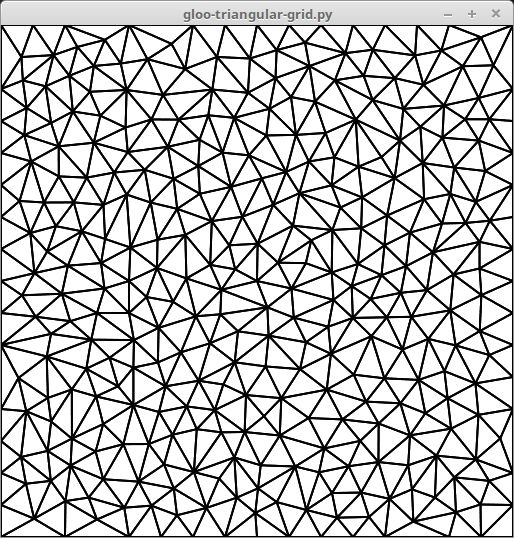
- triangle: a Python wrapper around Jonathan Richard Shewchuk’s two-dimensional quality mesh generator and delaunay triangulator library.
- A backend toolkit such as GLFW (the default), Qt, Pyglet, SDL2.0, GTK3, Wx3, and others.
VisPy is the sister project of glumpy. It’s a high-performance interactive 2D/3D data visualization library. VisPy leverages the computational power of modern Graphics Processing Units (GPUs) through the OpenGL library to display very large datasets.
Website: glumpy.github.io
Support: Documentation, GitHub Code Repository, Gitter, Mailing List
Developer: Nicolas P. Rougier
License: BSD License
Glumpy is written in Python. Learn Python with our recommended free books and free tutorials.
Related Software
| Python Visualization Packages | |
|---|---|
| matplotlib | Python 2D plotting library which produces publication quality figures |
| Diagrams | Draw the cloud system architecture in Python code |
| Bokeh | Elegant, concise construction of versatile graphics |
| Dash | Python framework for building analytical web applications |
| seaborn | Python visualization library based on matplotlib |
| Plotly | Interactive, browser-based graphing library for Python |
| VisPy | Visualize massive datasets in real time |
| Vega-Altair | Declarative Visualization in Python |
| plotnine | Grammar of graphics for Python |
| PyQtGraph | Python graphics and GUI library built on PyQt4 / PySide and numpy |
| bqplot | Interactive Plotting Framework for the Jupyter Notebook |
| Vaex | Fast visualization of big data |
| PyVista | 3D plotting and mesh analysis |
| folium | Visualize data in a Leaflet map |
| HoloViews | Make Data Analysis and Visualization Seamless |
| Datashader | Generates aggregate arrays and representations of them as images |
| yt | Multi-code Toolkit for Analyzing and Visualizing Volumetric Data |
| Glumpy | Intuitive interface between NumPy and modern OpenGL |
| GeoViews | Explore and visualize geographical, meteorological, and oceanographic datasets |
| Pygal | Dynamic SVG charting library |
| Glue | Multi-dimensional linked-data exploration |
Read our verdict in the software roundup.
 Explore our carefully curated directory of recommended free and open source software, covering every major software category. Explore our carefully curated directory of recommended free and open source software, covering every major software category.The directory forms part of our extensive collection of articles for Linux enthusiasts. It includes hundreds of detailed reviews, together with free and open source alternatives to proprietary software from companies such as Google, Microsoft, Apple, Adobe, IBM, Cisco, Oracle, and Autodesk. LinuxLinks also covers interesting projects worth exploring, Linux-compatible hardware, free programming books and tutorials, and much more. Know a useful free and open source Linux application that we haven’t covered? Tell us about it using our submission form. |
Please read our Comment Policy before commenting.