
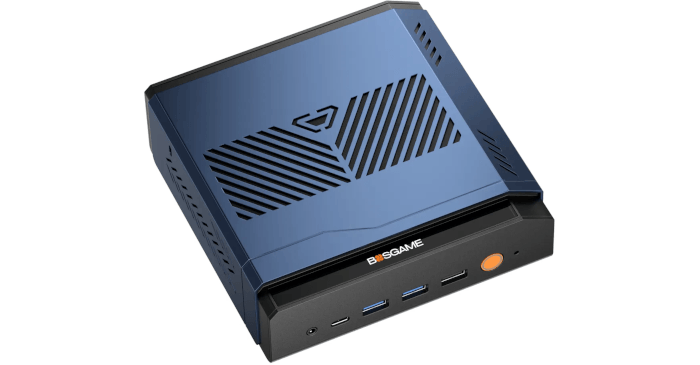
Why the VTA-439?
Gaming on Linux has changed enormously over the past few years. Proton, Mesa and better launcher support have opened up a huge catalogue of Windows games that can now be played with surprisingly little fuss. In this short series, I’m seeing what the BOSGAME VTA-439 can deliver as a compact Linux gaming machine.
The VTA-439 is an interesting system for this sort of testing. Its Ryzen AI 9 HX 470 combines Zen 5 and Zen 5c CPU cores with Radeon 890M integrated graphics. There is no discrete GPU doing the heavy lifting, so it gives me a good opportunity to see how far a modern AMD APU can be pushed at 1920×1080.
There is a Linux angle too. Gaming performance depends on Mesa, Vulkan and Proton, as well as how effectively the kernel schedules work across the HX 470’s mixed Zen 5 and Zen 5c cores. I’m interested in more than a headline FPS figure. What matters is whether the game feels smooth and how much image quality has to be sacrificed to get there.
Shadow of the Tomb Raider
I’m starting with Shadow of the Tomb Raider: Definitive Edition. It remains a demanding AAA title, but it is particularly useful for testing because it includes a repeatable built-in benchmark and offers a wide range of graphics presets.
I’m running the Epic Games version under CachyOS at 1920×1080. The tests use DirectX 12, TAA, 100% resolution scaling, ray tracing disabled and V-Sync disabled. I use the game’s built-in benchmark for the average FPS figures and MangoHud to capture the frame-time data used for the 1% lows.
Shadow of the Tomb Raider is proprietary commercial software, which is unusual territory for LinuxLinks. I’m using it here purely as a benchmark to assess Linux gaming performance on the VTA-439, rather than as a software recommendation. I also didn’t buy the game for this testing: the Definitive Edition was previously given away by the Epic Games Store, so it was already in my library.
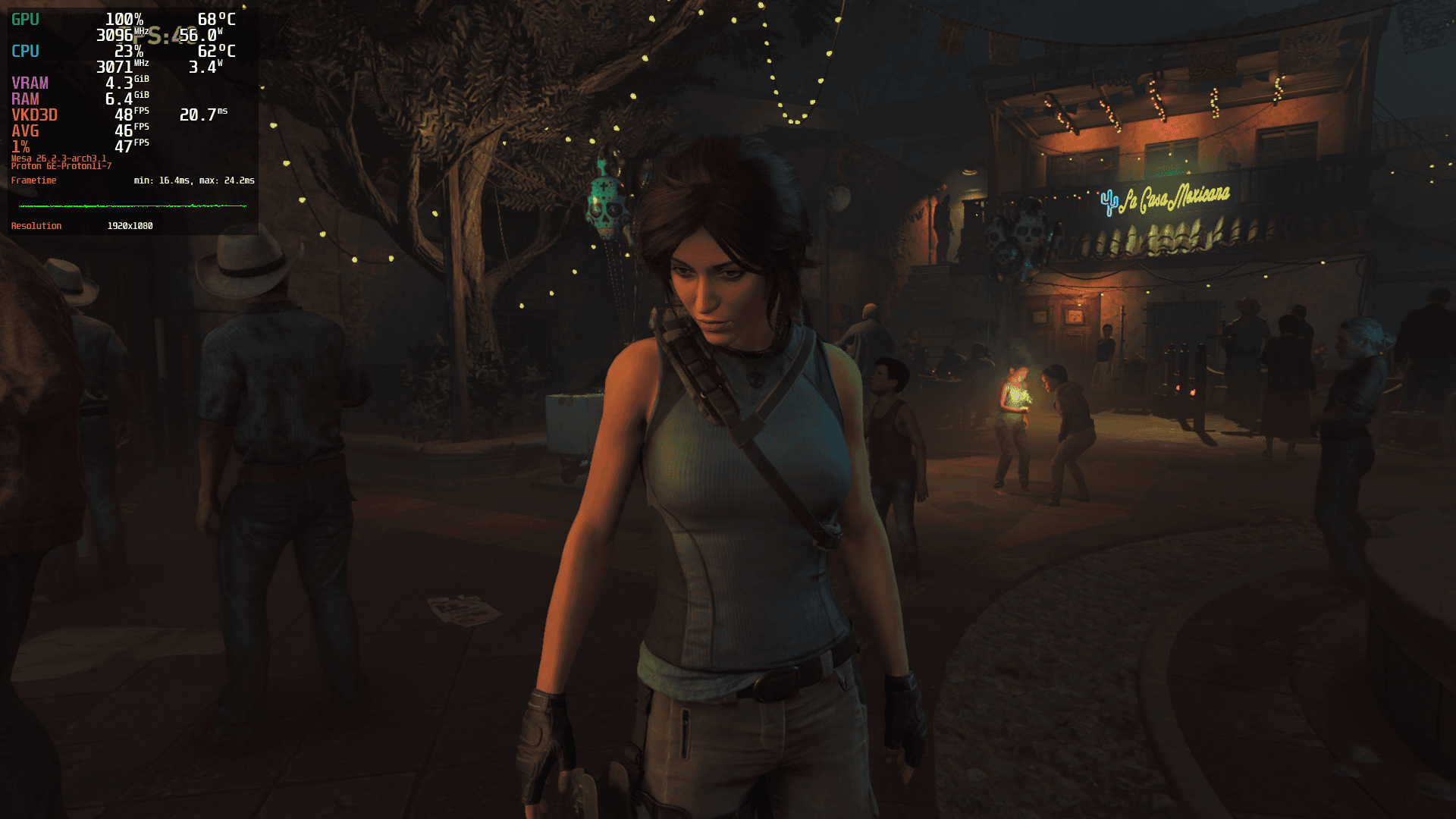
For the Windows version, which is the relevant comparison for the Epic Games release running through Proton, the minimum graphics hardware is an NVIDIA GeForce GTX 660, GTX 1050 or AMD Radeon HD 7770. The recommended specification moves up to a GeForce GTX 1060 6GB or Radeon RX 480 8GB.
That makes the Radeon 890M an interesting proposition. Those recommended GPUs are dedicated graphics cards with their own video memory, whereas the 890M is integrated into the processor and shares system memory. It is a useful reminder of just how far integrated graphics have progressed.
Performance
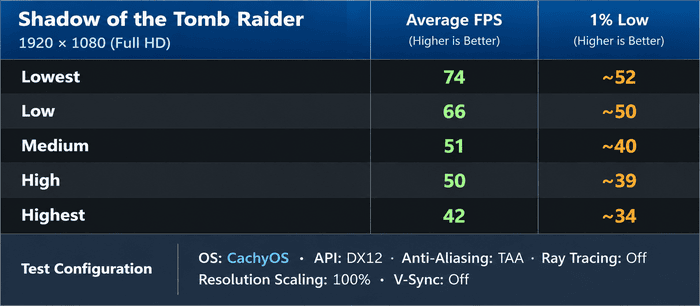
The table shows performance across the game’s five main quality presets. Average FPS gives a useful overall indication of performance, but it does not tell the whole story. The 1% low represents performance during the slowest 1% of the benchmark run and helps expose short-lived dips or uneven frame delivery that can disappear inside an average.
The results are encouraging. Lowest reaches 74 FPS with a 1% low of around 52 FPS, while Low averages 66 FPS with a 1% low of about 50 FPS. Both presets deliver comfortably smooth gameplay at 1080p.
Medium averages 51 FPS with a 1% low of around 40 FPS. More interestingly, High is almost identical at 50 FPS with a 1% low of about 39 FPS. There is therefore very little performance penalty from moving from Medium to High, which makes High the most attractive preset for me.
Low remains the better choice if staying closer to 60 FPS is the priority, but High gives a better balance between visual quality and performance. Even Highest remains usable, averaging 42 FPS with a 1% low of around 34 FPS. It is less fluid, but still perfectly playable for this type of single-player game.
Overall, Shadow of the Tomb Raider: Definitive Edition runs very well on the VTA-439 at native 1080p. The Radeon 890M gives me enough headroom to choose between smoother gameplay and better visuals rather than forcing every setting down to its minimum.
CachyOS vs Windows
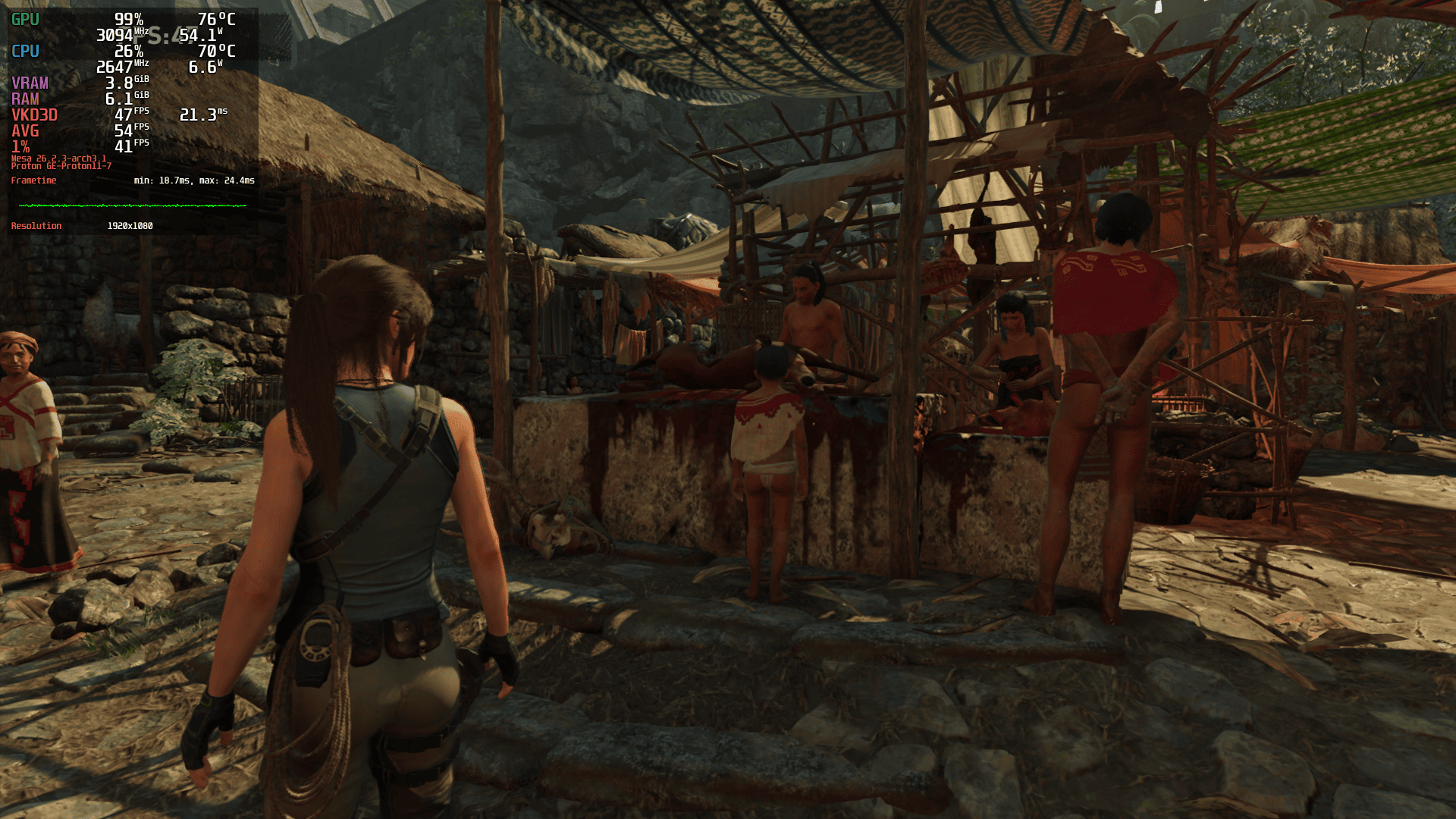
It is also useful to compare CachyOS with Windows on the same VTA-439. In my testing, Linux was faster at every preset.
| Preset | CachyOS | Windows | Linux advantage |
|---|---|---|---|
| Lowest | 74 FPS | 64 FPS | +10 FPS |
| Low | 66 FPS | 55 FPS | +11 FPS |
| Medium | 51 FPS | 48 FPS | +3 FPS |
| High | 50 FPS | 42 FPS | +8 FPS |
| Highest | 42 FPS | 35 FPS | +7 FPS |
The difference is substantial in places. CachyOS is around 16% faster at Lowest and roughly 19-20% faster at Low, High and Highest. Medium is the exception, where the gap narrows to only 3 FPS.
The High result is particularly interesting. CachyOS reaches 50 FPS compared with 42 FPS under Windows, while Highest under CachyOS matches the 42 FPS produced by High under Windows. In that case, Linux effectively lets me move up a quality preset without giving up performance.
I would not take this as evidence that Linux is inherently faster than Windows for gaming. This is one game on one machine, and the result is influenced by the graphics driver stack, Proton, VKD3D-Proton and the game itself. But for Shadow of the Tomb Raider on the VTA-439, CachyOS delivered better performance at every preset I tested.
Discrete GPU context
The Radeon 890M performs well for integrated graphics, but it is worth putting those results into perspective. A reasonably powerful discrete GPU still operates in a completely different league.
On Linux, my GeForce RTX 3060 Ti system produced 163 FPS at Lowest, 154 FPS at Low, 148 FPS at Medium, 147 FPS at High and 141 FPS at Highest.
| Preset | Radeon 890M | GeForce RTX 3060 Ti | 3060 Ti advantage |
|---|---|---|---|
| Lowest | 74 FPS | 163 FPS | 2.20x |
| Low | 66 FPS | 154 FPS | 2.33x |
| Medium | 51 FPS | 148 FPS | 2.90x |
| High | 50 FPS | 147 FPS | 2.94x |
| Highest | 42 FPS | 141 FPS | 3.36x |
The RTX 3060 Ti figures are there for context rather than as a strict GPU-for-GPU comparison, as they come from a separate system. Even so, they highlight how quickly the gap opens as image quality rises. The Radeon 890M falls from 74 FPS at Lowest to 42 FPS at Highest, while the RTX 3060 Ti only drops from 163 FPS to 141 FPS.
That difference is hardly surprising. The dedicated card has far more graphics throughput and its own high-bandwidth video memory, whereas the Radeon 890M shares system memory with the CPU. The comparison simply puts the 890M in its proper place: it is a very capable integrated GPU, but it is not a replacement for a decent discrete graphics card.
Summary
Shadow of the Tomb Raider: Definitive Edition shows the Radeon 890M in a good light. The VTA-439 has enough graphics performance to make 1080p gaming practical without having to fall back to the lowest quality settings.
For me, High is the sweet spot. It offers better image quality than the lower presets while giving away almost nothing to Medium in performance. The results also show that Linux is certainly not holding the VTA-439 back here. In this game, CachyOS was consistently faster than Windows on the same machine.
The RTX 3060 Ti comparison keeps things in perspective, but it does not detract from the main result. For integrated graphics, the Radeon 890M delivers a very convincing 1080p gaming experience.
Complete list of articles in this series:
| BOSGAME VTA-439 Mini PC | |
|---|---|
| Introduction | Introduction to the series and interrogation of the machine |
| Benchmarks | Benchmarking the BOSGAME VTA-439 Mini PC |
| Power | Testing and comparing the power consumption |
| Easy Diffusion | Local Stable Diffusion package with a browser-based GUI |
| BIOS | Explore the machine's BIOS |
| Noise | How quiet is this mini PC? |
| NPU | Running LLMs on the Ryzen AI 9 HX 470 NPU |
| VirtualBox | Run VirtualBox on the Ryzen AI 9 HX 470's Zen 5 Cores |
| Gaming with the Radeon 890M | |
| Shadow of the Tomb Raider | Comparing graphics presets and frame rates |
Please read our Comment Policy before commenting.