
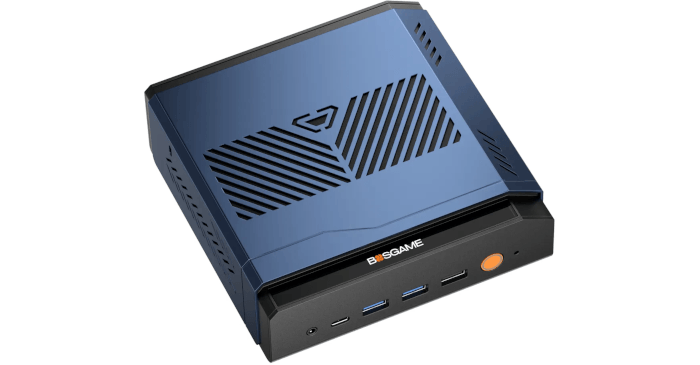
Why the VTA-439?
I’ve been putting the BOSGAME VTA-439 through a series of gaming tests to see how far its Radeon 890M integrated graphics can go under Linux. Some games demand considerable compromises in graphical quality, while others run surprisingly well at 1920×1080.
The VTA-439 is powered by AMD’s Ryzen AI 9 HX 470, a 12-core processor combining Zen 5 and Zen 5c cores. Its Radeon 890M uses shared system memory rather than dedicated video memory, making it interesting to see how it performs in games originally developed with more powerful graphics hardware in mind.
This time I’m testing World War Z, comparing four graphics presets under CachyOS. I’ve also repeated the benchmarks under Windows 11 on the same machine and included results from my GeForce RTX 3060 Ti desktop running Kubuntu 26.04 LTS.
World War Z
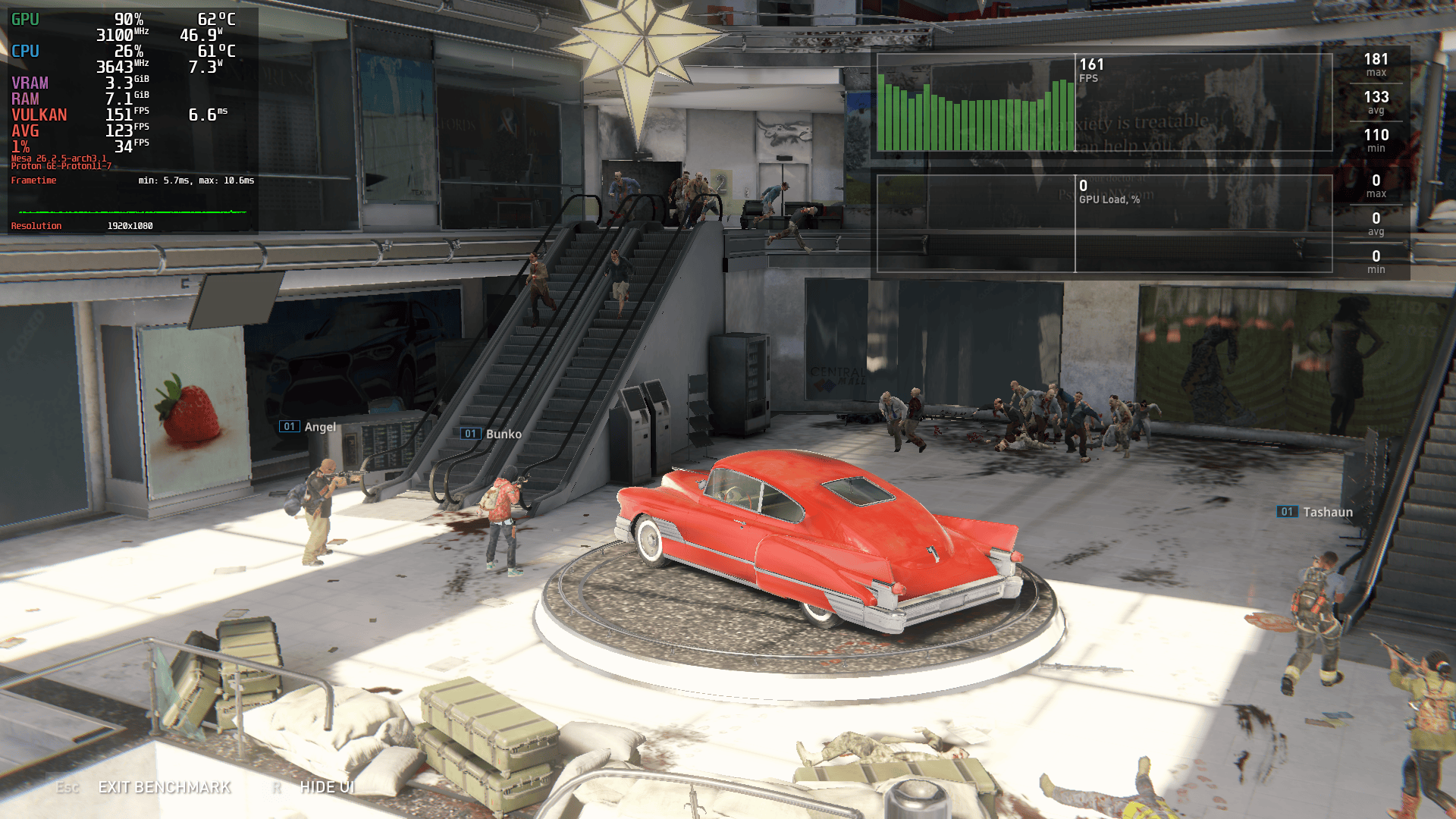
World War Z is a cooperative third-person shooter in which players face enormous hordes of zombies. The sheer number of enemies appearing on screen makes it an interesting test of gaming performance.
I’m running the Epic Games version under CachyOS using Heroic and Proton.
I’m comparing four graphics presets: Low, Medium, High and Ultra. All benchmarks are conducted at 1920×1080 using the game’s built-in benchmarking tool. The results report both average and minimum FPS, rather than 1% lows.
Performance
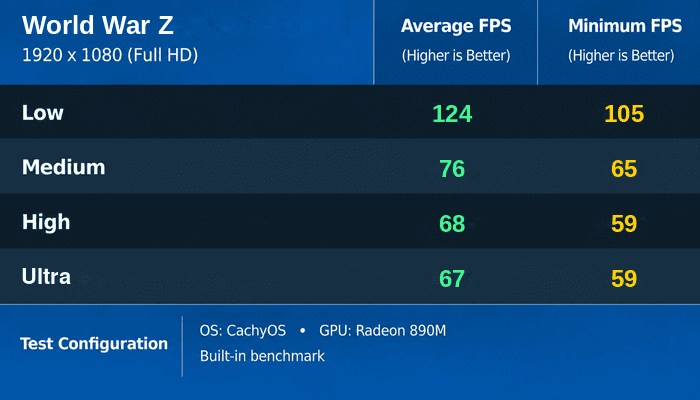
The Radeon 890M gets off to an excellent start. At Low, the VTA-439 averages 124 FPS, with a minimum of 105 FPS. That’s an impressive result for integrated graphics, providing plenty of headroom above 60 FPS.
Moving to Medium brings the average down to 76 FPS, with a minimum of 65 FPS. That’s a sizeable reduction of almost 39% in average performance, but both figures remain above 60 FPS.
High averages 68 FPS, with a minimum of 59 FPS. That’s a relatively modest drop from Medium, although the minimum now dips just below 60 FPS.
Ultra produces perhaps the most interesting result. It averages 67 FPS, just one frame behind High, while the minimum remains unchanged at 59 FPS. Moving from High to Ultra therefore has virtually no performance penalty in this benchmark.
Based on these results, I’d choose Ultra. It delivers the highest graphics preset while maintaining an average comfortably above 60 FPS. The built-in benchmark doesn’t establish how every mission will perform, but it makes a strong case for starting with Ultra at 1080p.
CachyOS vs Windows 11
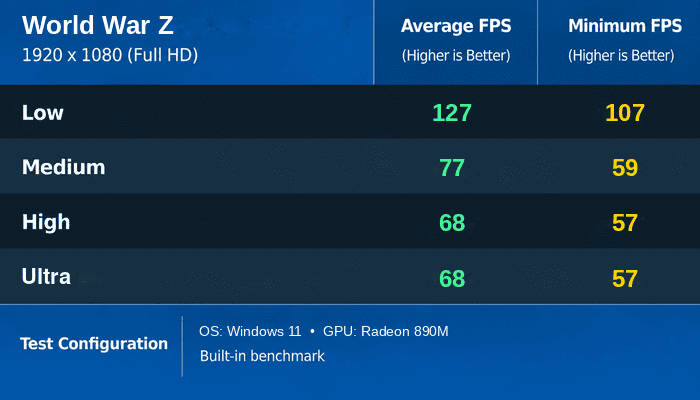
Windows 11 and CachyOS deliver remarkably similar results. Windows has a slight advantage at Low, averaging 127 FPS against 124 FPS, but the difference narrows to just one frame at Medium. High is tied at 68 FPS, while Ultra differs by only one frame.
The minimum FPS results are similarly close, with CachyOS ahead at Medium, High and Ultra. I wouldn’t attach much significance to such small differences, but these benchmarks offer no compelling performance reason to favour Windows for this game.
Discrete GPU context
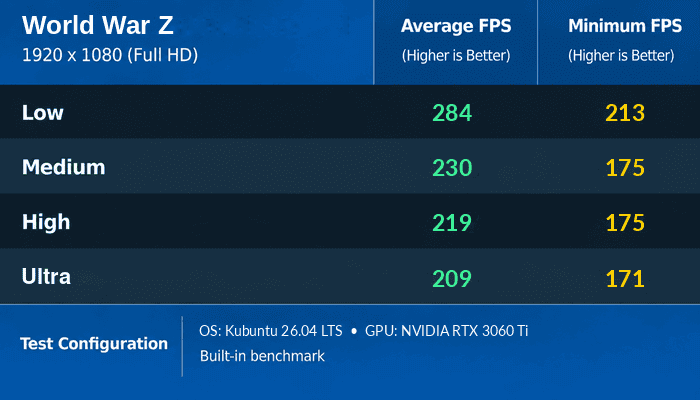
My GeForce RTX 3060 Ti desktop running Kubuntu 26.04 LTS shows what a system with a dedicated graphics card can deliver. It’s a different system, so this isn’t a strictly controlled GPU-only comparison, but the results provide useful context.
At Low, the RTX 3060 Ti desktop averages 284 FPS, with a minimum of 213 FPS. Medium still produces 230 FPS, while High averages 219 FPS. Even Ultra manages 209 FPS, with a minimum of 171 FPS.
The RTX 3060 Ti desktop delivers around 2.3 times the VTA-439’s average frame rate at Low, increasing to approximately 3.1 times at Ultra. The advantage is substantial, although that’s hardly surprising given the difference in hardware.
What interests me more is that the desktop retains excellent performance across all four presets. Moving from Low to Ultra reduces its average frame rate by around 26%, compared with approximately 46% on the VTA-439.
The desktop clearly offers considerably more performance headroom, particularly for higher refresh rate gaming. Nevertheless, the VTA-439’s 67 FPS average at Ultra is an impressive showing for integrated graphics at 1080p.
Summary
World War Z turns out to be an excellent match for the BOSGAME VTA-439’s Radeon 890M integrated graphics in these benchmarks.
Low offers ample headroom, averaging 124 FPS, but Ultra is the more appealing result: 67 FPS on average, with a minimum of 59 FPS. With almost identical performance at High, there’s little incentive to choose that preset instead.
CachyOS also matches Windows 11 remarkably closely, with differences small enough to be of little practical consequence in these tests.
Naturally, the RTX 3060 Ti desktop is considerably faster, but that doesn’t detract from the VTA-439’s achievement. Unlike some of the more demanding games I’ve tested in this series, World War Z delivers encouraging benchmark results without significant compromises in graphical quality.
Ultra at 1920×1080 would be my starting point for playing on the VTA-439 under CachyOS.
Complete list of articles in this series:
| BOSGAME VTA-439 Mini PC | |
|---|---|
| Introduction | Introduction to the series and interrogation of the machine |
| Benchmarks | Benchmarking the BOSGAME VTA-439 Mini PC |
| Power | Testing and comparing the power consumption |
| Easy Diffusion | Local Stable Diffusion package with a browser-based GUI |
| BIOS | Explore the machine's BIOS |
| Noise | How quiet is this mini PC? |
| NPU | Running LLMs on the Ryzen AI 9 HX 470 NPU |
| VirtualBox | Run VirtualBox on the Ryzen AI 9 HX 470's Zen 5 Cores |
| Lemonade Server | Local AI server on the BOSGAME VTA-439 |
| Gaming with the Radeon 890M | |
| Shadow of the Tomb Raider | Comparing graphics presets and frame rates |
| Tiny Tina’s Wonderlands | How well does this demanding shooter perform? |
| The Callisto Protocol | Pushing the integrated GPU with a demanding title |
| Deus Ex: Mankind Divided | Performance across the graphics presets |
| World War Z | Comparing Linux and Windows gaming performance |
Please read our Comment Policy before commenting.