
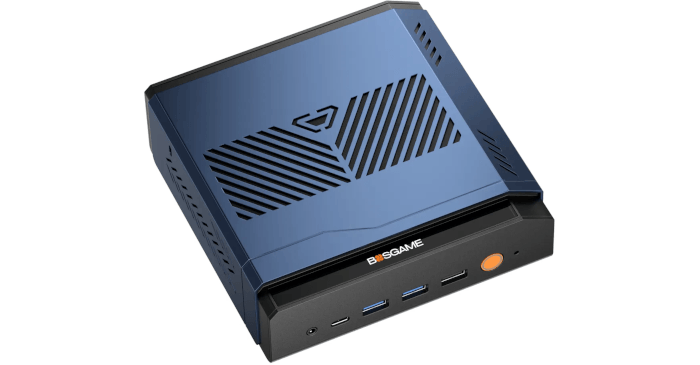
Why the VTA-439?
I’ve been finding out how well the BOSGAME VTA-439 handles gaming under Linux. Its Radeon 890M integrated graphics have their limits, but it’s always interesting to see what a small machine without a dedicated graphics card can manage. The Callisto Protocol looked like a good way to give it a harder time.
The VTA-439 uses AMD’s Ryzen AI 9 HX 470 processor, with a mixture of Zen 5 and Zen 5c CPU cores. Its Radeon 890M shares system memory, so I’m keeping expectations realistic: 1920×1080, a willingness to turn down the settings, and no assumption that every game will run smoothly.
For this test, I worked through all four graphics presets under CachyOS, then compared the results with Windows 11 on the same machine. I’ve also included results from my RTX 3060 Ti desktop to show what a dedicated graphics card brings to the game.
The Callisto Protocol
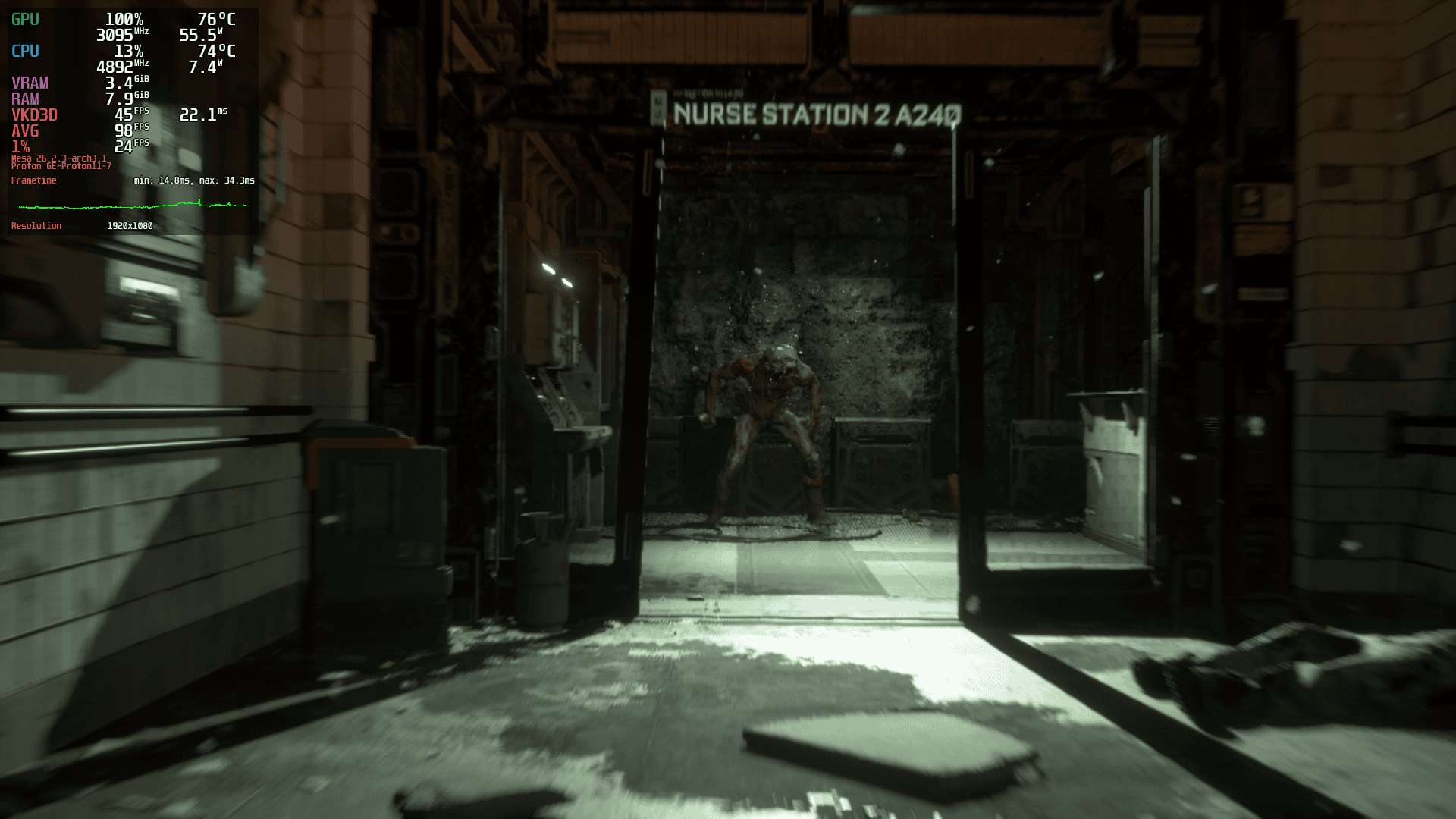
I’m running the Epic Games version under CachyOS using Heroic and Proton.
There are four graphics presets: Low, Medium, High and Ultra. All tests use DirectX 12 at 1920×1080 with 100% resolution scaling. V-Sync and FSR are disabled. That leaves the Radeon 890M rendering at native 1080p, without upscaling to help it along.
I use the built-in benchmark for the average FPS and calculate the 1% low from the frame-time data. As the results show, it’s worth looking at both. A healthy average can hide some much slower moments.
Performance
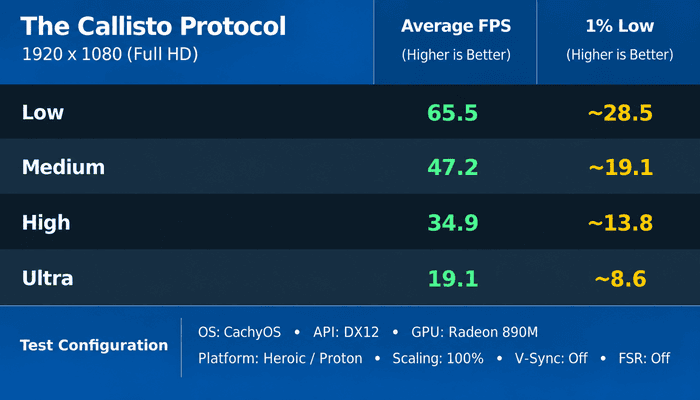
Low gets off to a reasonable start, averaging 65.5 FPS. I’d be happy with that figure from integrated graphics at native 1080p if it weren’t for the 28.5 FPS 1% low. There’s enough performance here to clear 60 FPS on average, but not to keep frame delivery consistently smooth.
Moving to Medium brings the average down to 47.2 FPS and the 1% low to 19.1 FPS. That’s a sizeable drop, and I wouldn’t choose it over Low on the strength of these results.
High averages 34.9 FPS with a 13.8 FPS 1% low. Ultra is a step too far, managing just 19.1 FPS on average and an 8.6 FPS 1% low. Neither is a setting I’d use at native 1080p.
Low is the clear choice, then, although it still involves compromises. FSR would be worth trying next to see whether it can improve matters without giving up too much image quality. These native-resolution tests don’t tell us how much it would help, particularly with the slower frames.
CachyOS vs Windows 11
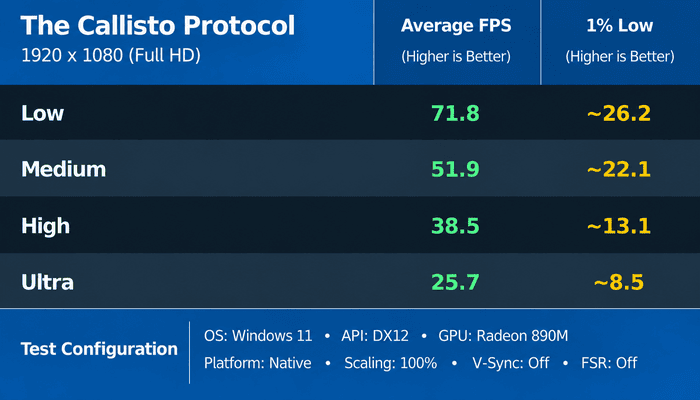
Windows 11 takes the lead in average FPS at every preset. Low rises from 65.5 to 71.8 FPS, Medium from 47.2 to 51.9 FPS, and High from 34.9 to 38.5 FPS. That’s roughly a 10% improvement across the three settings.
Ultra produces the biggest difference, with Windows reaching 25.7 FPS against 19.1 FPS under CachyOS. The Windows result is almost 35% higher, although I’d still leave Ultra alone on either operating system.
The 1% lows are more mixed. At Low, CachyOS records 28.5 FPS against 26.2 FPS under Windows. Windows does better at Medium, returning 22.1 FPS against 19.1 FPS. CachyOS has a small lead at High, with 13.8 FPS against 13.1 FPS, while Ultra is virtually identical at 8.6 and 8.5 FPS.
I wouldn’t read much into the smallest differences without more runs. Windows has a clear advantage in average frame rate, but it doesn’t solve the weak 1% lows. I’d still choose Low whichever operating system I was using.
Discrete GPU context
My GeForce RTX 3060 Ti desktop, running Kubuntu 26.04 LTS, has a much easier time. It’s a different system, so this isn’t a direct GPU-only comparison, but the results show how much more room there is to turn up the settings.
It averages 128.8 FPS at Low, 124.5 FPS at Medium and 119.2 FPS at High. Even Ultra manages 87.9 FPS. The 1% lows are much stronger too, ranging from 85.8 FPS at Low to 39.6 FPS at Ultra.
The most interesting part is how little performance the desktop loses between Low and High. Its average falls by only about 7%, compared with almost 47% on the VTA-439.
That also explains why the gap between the two systems grows so quickly. The RTX 3060 Ti desktop is just under twice as fast at Low, around 2.6 times faster at Medium, 3.4 times faster at High and 4.6 times faster at Ultra. The Radeon 890M can put up a respectable average at Low, but turning up the detail soon asks too much of it.
Summary
The Callisto Protocol is a tough game for the VTA-439. Getting a 65.5 FPS average at native 1080p from its integrated graphics is encouraging, but the 28.5 FPS 1% low takes some of the shine off that result. This isn’t consistently smooth 60 FPS gaming.
I’d stick with Low under CachyOS. Medium gives up too much performance, and I wouldn’t recommend High or Ultra at native resolution. Before settling on those compromises, though, I’d want to try FSR and see whether it offers a better balance.
Windows 11 gives the averages a useful lift, but the mixed 1% low results mean it isn’t an outright win for smoothness. Switching operating systems doesn’t change my choice of preset.
The RTX 3060 Ti desktop is comfortably ahead, as expected. What stands out is how much better it holds up as the settings increase. The VTA-439 needs careful settings choices to get this game running reasonably; the desktop lets you enjoy more of the visual detail without such a large performance penalty.
Complete list of articles in this series:
| BOSGAME VTA-439 Mini PC | |
|---|---|
| Introduction | Introduction to the series and interrogation of the machine |
| Benchmarks | Benchmarking the BOSGAME VTA-439 Mini PC |
| Power | Testing and comparing the power consumption |
| Easy Diffusion | Local Stable Diffusion package with a browser-based GUI |
| BIOS | Explore the machine's BIOS |
| Noise | How quiet is this mini PC? |
| NPU | Running LLMs on the Ryzen AI 9 HX 470 NPU |
| VirtualBox | Run VirtualBox on the Ryzen AI 9 HX 470's Zen 5 Cores |
| Gaming with the Radeon 890M | |
| Shadow of the Tomb Raider | Comparing graphics presets and frame rates |
| Tiny Tina’s Wonderlands | How well does this demanding shooter perform? |
| The Callisto Protocol | Pushing the integrated GPU with a demanding title |
Please read our Comment Policy before commenting.