
Last Updated on July 15, 2026
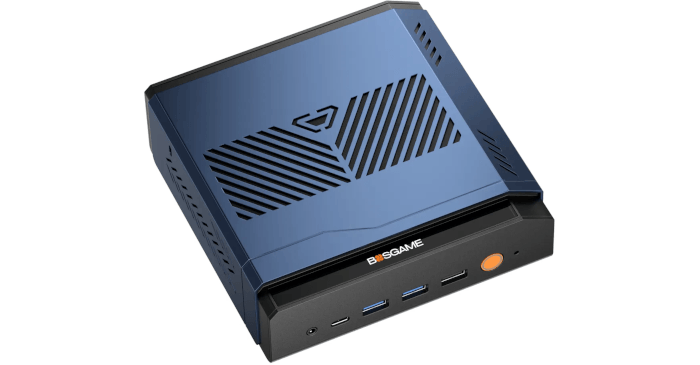
This is a series looking at the BOSGAME VTA-439 Ryzen AI 9 HX 470 mini PC running Linux. In this series, I put the BOSGAME mini PC through its paces from a Linux perspective, comparing it with other systems, including desktops, to see how it performs in real-world Linux use.
The BOSGAME VTA-439 is a recent addition to BOSGAME’s growing range of AI-focused mini PCs. It’s built around AMD’s Ryzen AI 9 HX 470 processor, a 12-core, 24-thread chip with integrated Radeon 890M graphics and a CPU Mark of 37,457. The review unit comes with 32GB of DDR5 5600MT/s RAM and a 1TB PCIe 4.0 SSD, giving the system a strong hardware base for everyday desktop use, heavy multitasking, and more demanding Linux workloads.
For this article in the series, I look at the performance of Easy Diffusion on the VTA-439.
Easy Diffusion is a local Stable Diffusion package with a browser-based GUI. The premise is straightforward: install it, open the local web interface, enter a prompt, and generate images on your own machine rather than relying on an online service. It bundles the required components and provides a user-friendly interface, making local image generation far easier to set up.
For beginners and casual users, Easy Diffusion is one of the friendlier ways to run Stable Diffusion locally without having to deal with Python environments, command-line installation, CUDA/ROCm configuration, or manual dependency management.
Anyone who’s used Easy Diffusion will know that generating images on a CPU is extremely slow. The chart below shows how long it takes to generate a 512×512 image using the CPU with the default settings in Easy Diffusion v3.5.14.
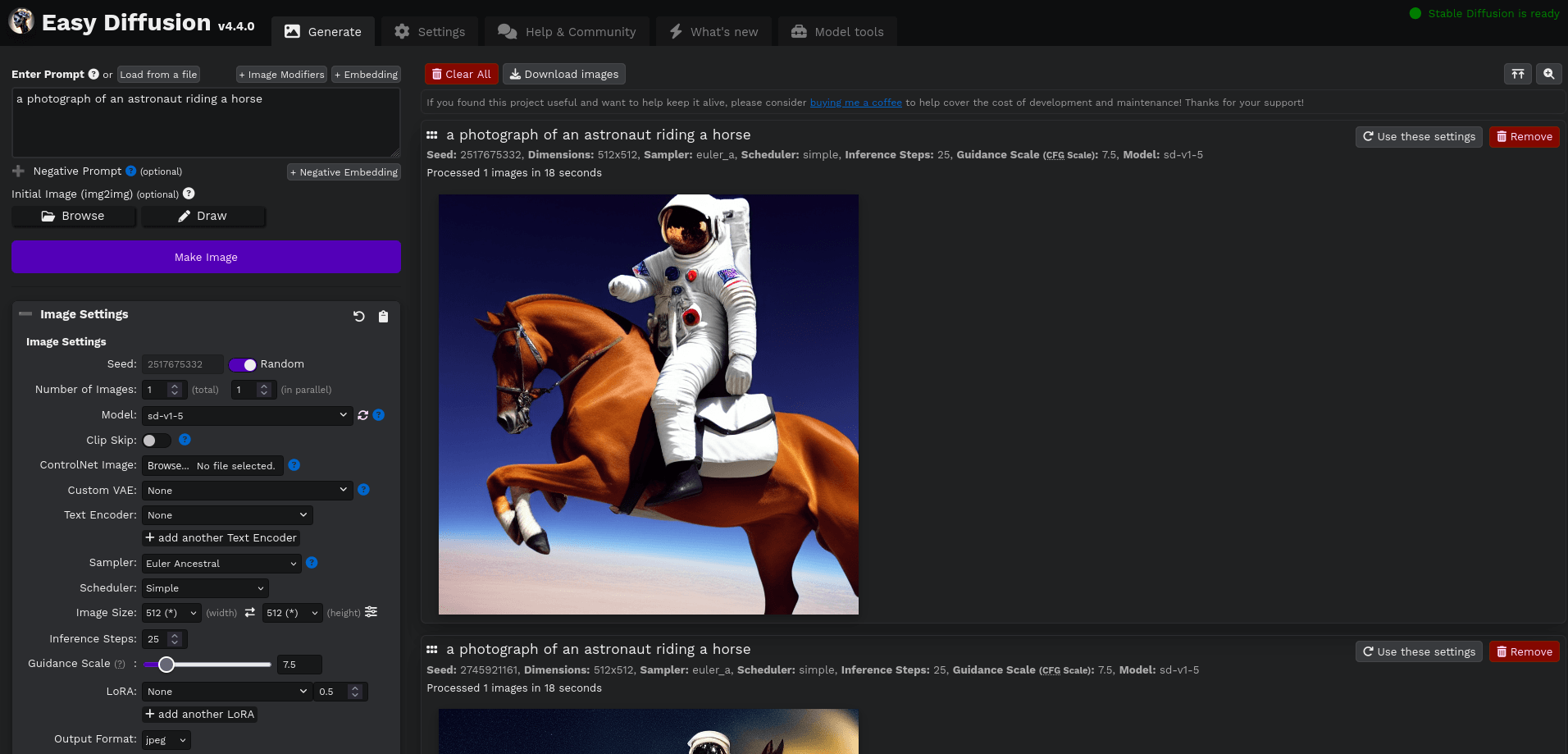
Dimensions: 512×512
Sampler: euler_a
Scheduler: simple
Inference Steps: 25
Guidance Scale (CFG Scale): 7.5
Model: sd-v1-5
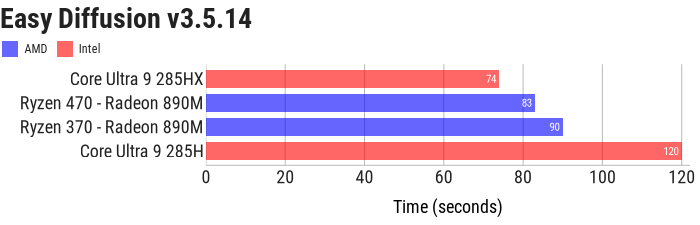
All four processors sit well above the level of a typical budget mini PC. They offer responsive desktop performance, strong results in compile and productivity workloads, and ample multi-threaded performance for demanding Linux tasks. Yet even with this level of CPU power, generating a single image with a modest number of inference steps remains painfully slow when relying on the CPU alone.
This type of software really benefits from GPU acceleration. Easy Diffusion has recently added support for the Radeon 890M, and the improvement is dramatic. I ran the same test on the Radeon 890M in both the Ryzen AI 9 HX 370-based BOSGAME M6 and the Ryzen AI 9 HX 470-based BOSGAME VTA-439. Both processors use the same 890M iGPU design, but the HX 470 runs it at a higher clock speed.
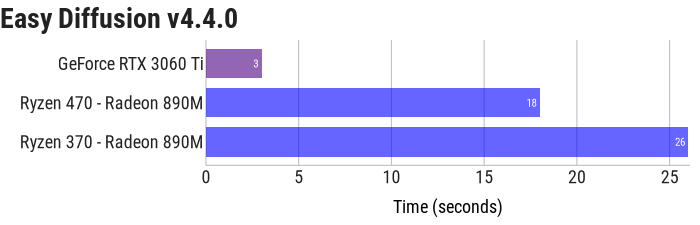
The Radeon 890M in the BOSGAME VTA-439 generates an image in 18 seconds. That’s a decent uplift compared to the Radeon 890M in the Ryzen AI 9 HX 370. They both sit well behind a mid-range dedicated graphics card, but utterly outclass even a 24-core CPU in this workload.
Complete list of articles in this series:
| BOSGAME VTA-439 Mini PC | |
|---|---|
| Introduction | Introduction to the series and interrogation of the machine |
| Benchmarks | Benchmarking the BOSGAME VTA-439 Mini PC |
| Power | Testing and comparing the power consumption |
| Easy Diffusion | Local Stable Diffusion package with a browser-based GUI |
| BIOS | Explore the machine's BIOS |
| Noise | How quiet is this mini PC? |
| NPU | Running LLMs on the Ryzen AI 9 HX 470 NPU |
Please read our Comment Policy before commenting.