
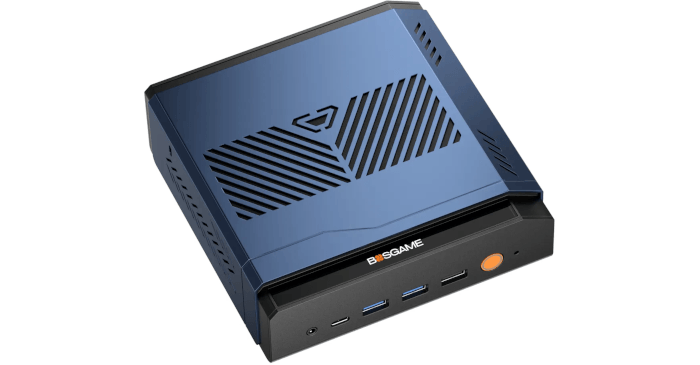
This is a new series looking at the BOSGAME VTA-439 mini PC running Linux. In this series, I’ll put this mini PC through its paces from a Linux perspective, comparing it with other systems, including desktops, to show how it really stacks up.
The BOSGAME VTA-439 is one of the latest additions to BOSGAME’s range of AI-focused mini PCs. This mini PC is based on the AMD Ryzen AI 9 HX 470 processor with integrated AMD Radeon 890M graphics. The processor has 12 cores and 24 threads and achieves a CPU Mark score of 37,378 in PassMark’s benchmark. The machine comes with 32GB of DDR5-5600 RAM and a 1TB PCIe 4.0 SSD, which should be sufficient for most use cases. The machine currently retails for £781.00.
For this article in the series, I’ve benchmarked the BOSGAME VTA-439 using a range of tests, most of them run with the Phoronix Test Suite. I’ve compared its results against eleven other systems. The comparison group also includes a couple of desktop processors.
The results also include a small form factor mini workstationa small form factor mini workstation with the Core Ultra 9 285HX processor. This mini workstation sits in a much higher price bracket than all the other machines. Its inclusion provides a useful upper-end comparison point, showing what a more expensive, workstation-class compact system with 24 cores can deliver against smaller and cheaper mini PCs. The Intel N100 machine is included as a useful low-cost baseline. It shows what an inexpensive mini PC can deliver, making it easier to assess how much extra performance the higher-spec systems provide, and whether the added speed, responsiveness, and headroom justify their higher price.
Each system is tested with the same software stack and configured as consistently as possible to ensure fair comparisons. Power management features are disabled during benchmarking, and where the BIOS offers a Power Limit mode, Performance Mode is selected. The VTA-439 has such a mode in its BIOS. I also apply every reasonable performance-enhancing measure: the performance governor is used for all tests, background processes are kept to a minimum, and no Wayland session is running except where required for graphics benchmarks.
I begin with benchmarks that concentrate specifically on processor performance.
$ phoronix-test-suite benchmark smallpt
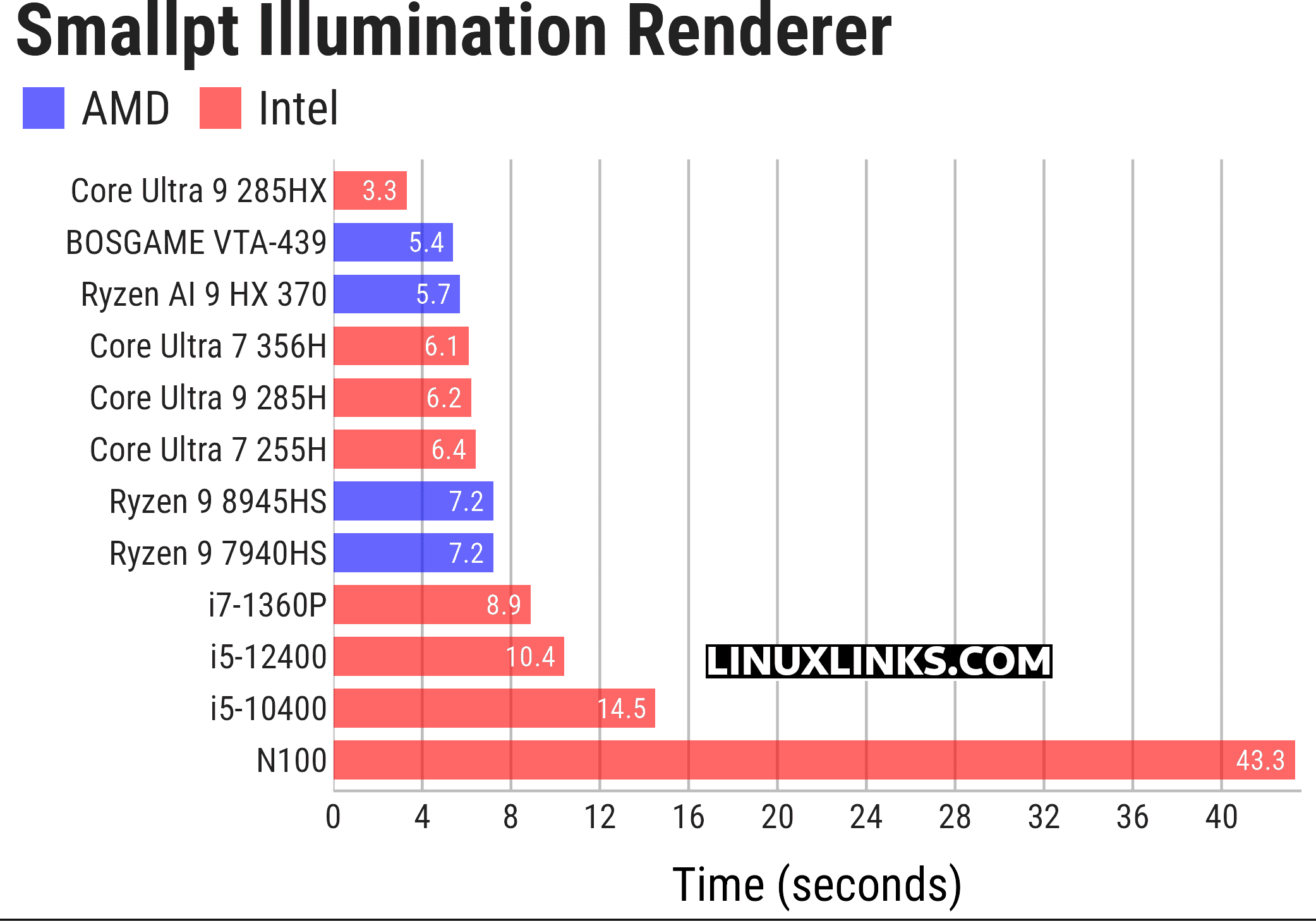
Smallpt is a C++ global illumination renderer written in fewer than 100 lines of code. It performs unbiased Monte Carlo path tracing and supports multi-threading via OpenMP. As this benchmark can use all CPU cores, processors with more cores complete the test considerably quicker.
In this CPU rendering benchmark, lower is better.
The BOSGAME VTA-439 makes an excellent start in Smallpt. With a time of 5.4 seconds, the Ryzen AI 9 HX 470 sits second in the chart, only beaten by the Core Ultra 9 285HX system. That Intel machine is much quicker at 3.3 seconds, but it’s also in a very different price class, costing roughly twice as much as the VTA-439. Viewed from a value perspective, the VTA-439 looks very strong: it delivers around two-thirds of the 285HX’s performance in this workload for about half the outlay.
The comparison with the Ryzen AI 9 HX 370 is also interesting. The HX 470 is only 0.3 seconds faster, so this isn’t a dramatic generational leap in Smallpt, but it is enough to move the VTA-439 ahead of the previous high-end AMD mini PC in the group. It also edges clear of Intel’s Core Ultra 7 356H and Core Ultra 9 285H systems, both of which finish just over the 6 second mark.
The N100 result provides the clearest sense of scale. At 43.3 seconds, the inexpensive Intel system takes more than eight times as long as the VTA-439 to complete the same render. That doesn’t make the N100 useless for light desktop duties, but it shows just how wide the gap is once a workload can exploit modern high-performance cores and many threads.
$ phoronix-test-suite benchmark compress-pbzip2
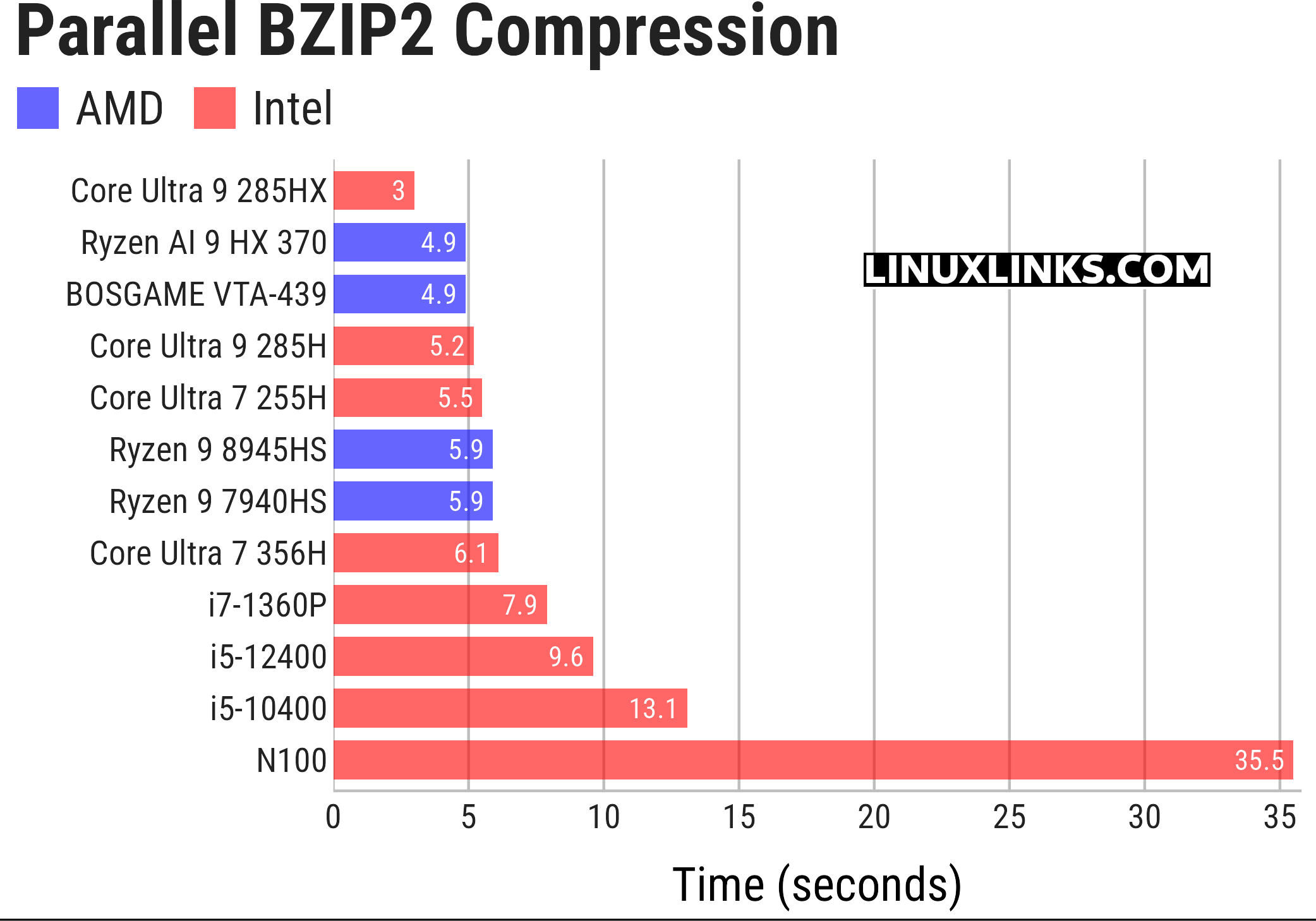
pbzip2 is a parallel implementation of the bzip2 block-sorting file compressor that uses pthreads and achieves near-linear speedup on SMP machines. This test measures the time needed to compress a file (a .tar package of the Linux kernel source code) using BZIP2 compression. Like the smallpt benchmark, this test can use all available CPU cores.
The BOSGAME VTA-439 performs very well here, completing the test in 4.9 seconds. That puts the Ryzen AI 9 HX 470 level with the Ryzen AI 9 HX 370 and ahead of the Core Ultra 9 285H, Core Ultra 7 255H, Ryzen 9 8945HS, and Ryzen 9 7940HS systems.
The Core Ultra 9 285HX remains comfortably faster at 3.0 seconds, but that system costs roughly twice as much as the VTA-439. On that basis, the VTA-439’s result is strong: it doesn’t match the workstation-class 285HX, but it gets close enough to make the price/performance comparison very favourable.
The HX 370 result is worth noting. The HX 470 doesn’t move ahead in this workload, as both AMD systems finish at 4.9 seconds. So for pbzip2 compression, there’s no visible gain over the previous high-end AMD Ryzen AI chip in this particular test. The HX 470 is more of a refreshed successor: slightly higher CPU boost, faster 890M graphics clock, and higher AI TOPS.
The N100 again shows the other end of the scale. At 35.5 seconds, it takes more than seven times as long as the VTA-439, which underlines how unsuitable it is for heavier multi-threaded compression work.
$ phoronix-test-suite benchmark openssl
OpenSSL is an open-source cryptography toolkit best known for implementing TLS and the older SSL protocols. This test profile makes use of the built-in “openssl speed” benchmarking capabilities.
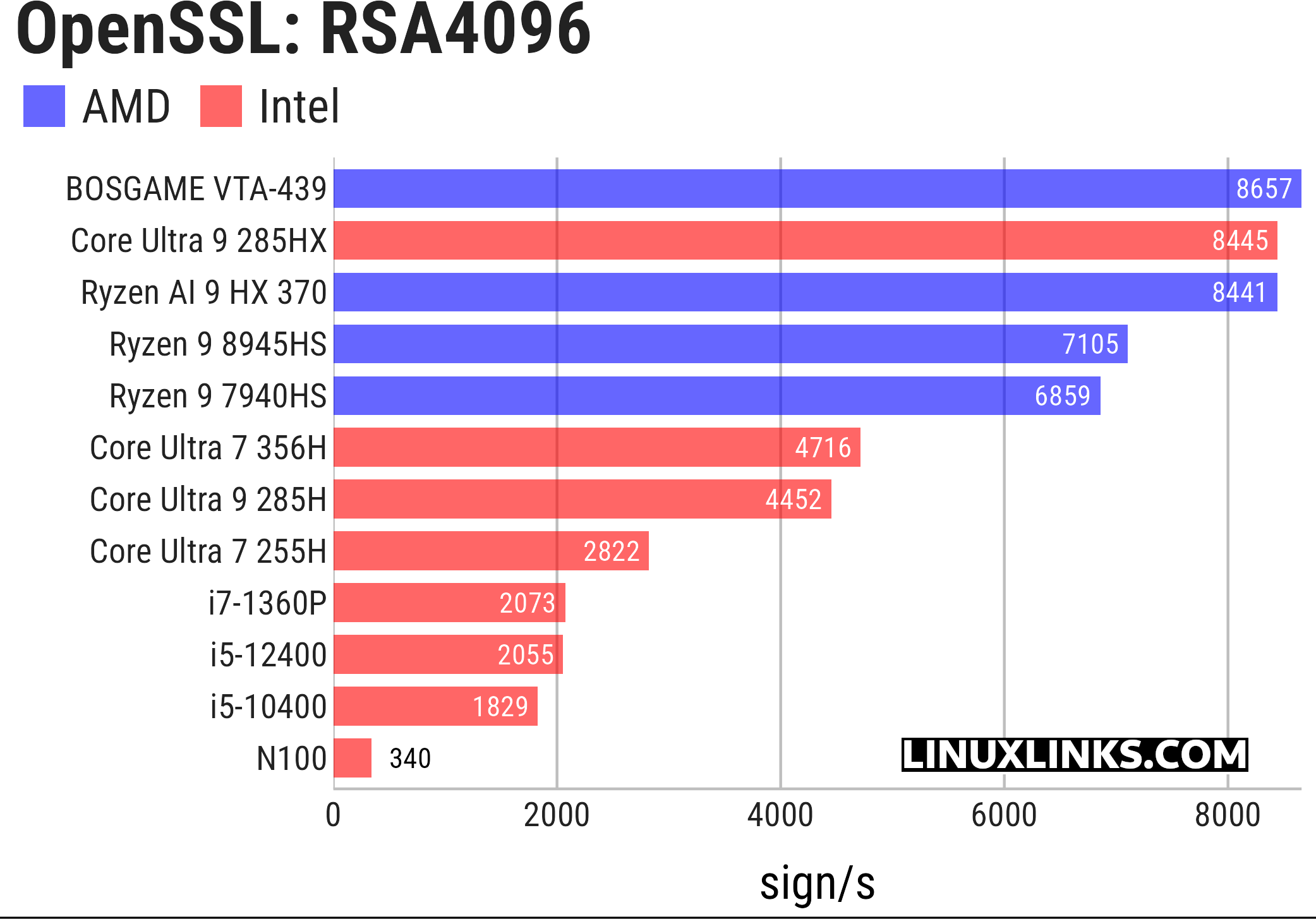
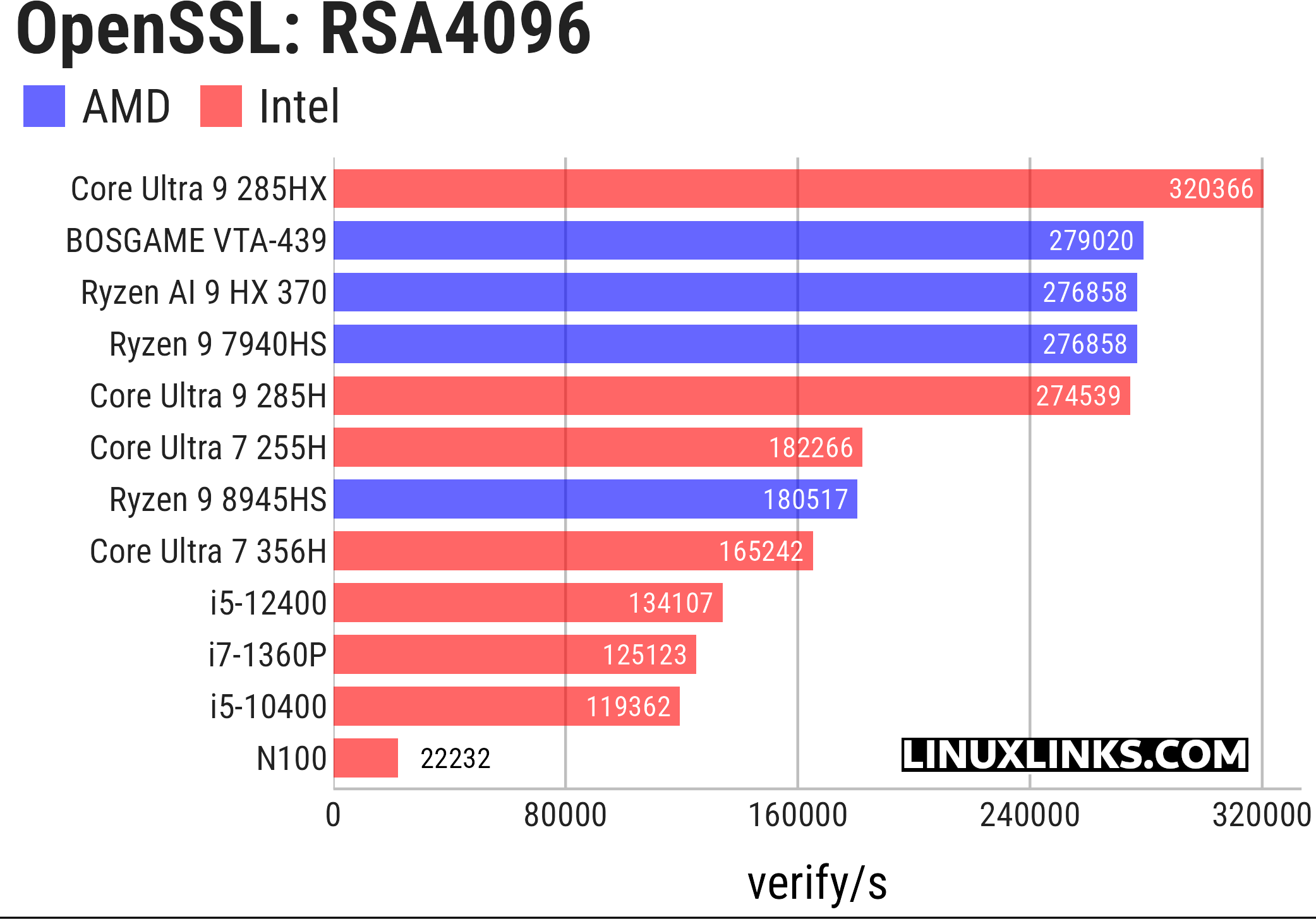
There are various algorithms that can be used for this benchmark. I focused on the RSA-4096 algorithm, since it serves as a good representative example for the other options. This benchmark includes two charts: one for signing speeds and another for verification speeds.
The BOSGAME VTA-439 performs very well in the OpenSSL RSA4096 tests. It tops the signing chart with 8,657 sign/s, narrowly ahead of both the Core Ultra 9 285HX and the Ryzen AI 9 HX 370. The advantage over the HX 370 is small, so this looks like an incremental uplift rather than a dramatic generational jump.
Verification tells a slightly different story. The Core Ultra 9 285HX leads clearly, but the VTA-439 still places strongly with 279,020 verify/s, just ahead of the HX 370 and Ryzen 9 7940HS. Overall, the HX 470 delivers excellent cryptographic performance, especially in signing, while the N100 is comprehensively outclassed in both tests.
$ phoronix-test-suite benchmark coremark
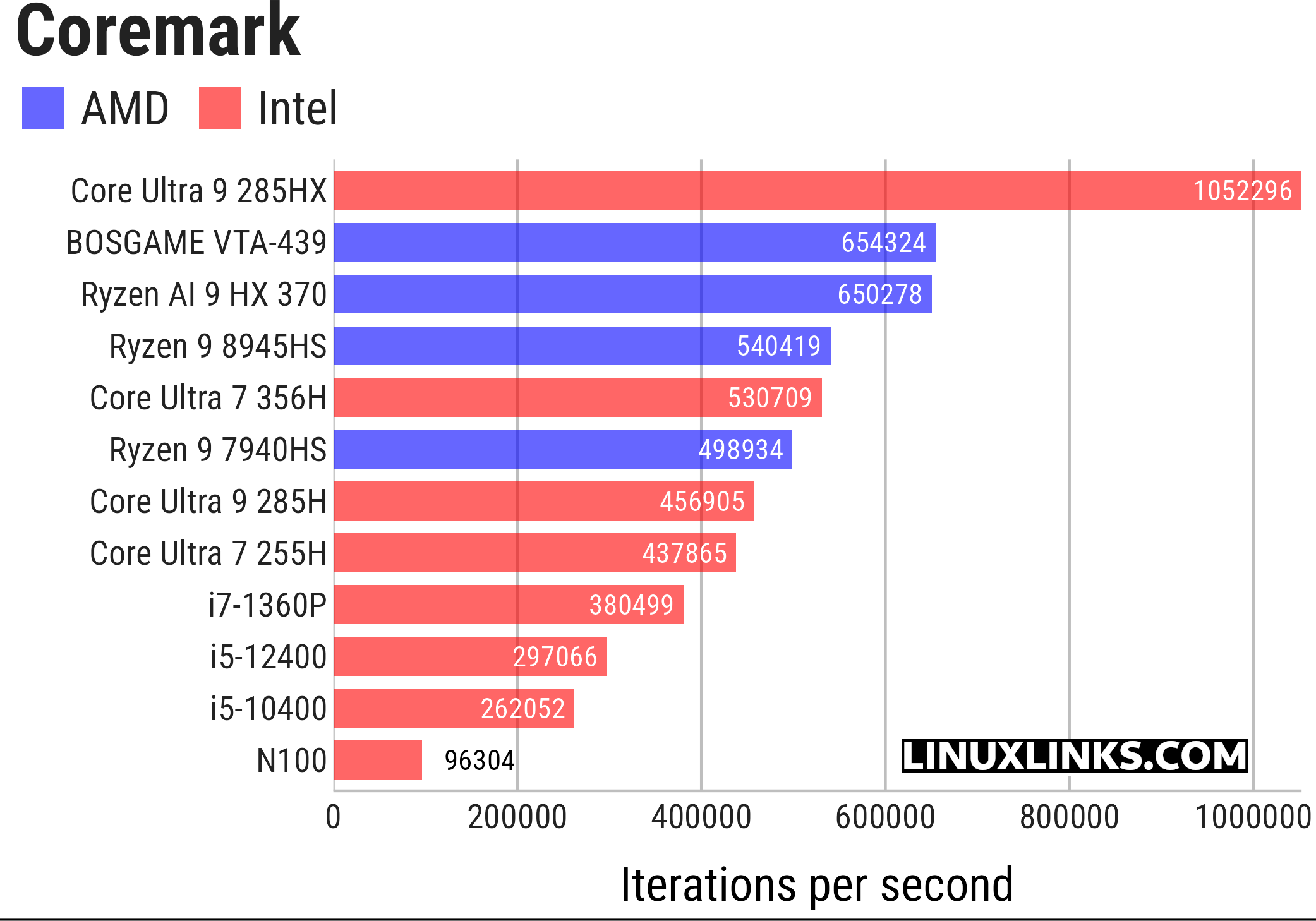
CoreMark is a benchmark that measures the performance of central processing units (CPU) used in embedded systems. It’s built around list processing, matrix manipulation, state-machine logic, and CRC, so it mostly stresses integer execution, branches, cache behavior, compiler output, and how well the CPU sustains clocks under load.
CoreMark shows the BOSGAME VTA-439 in a strong second place with 654,324 iterations/s, almost identical to the Ryzen AI 9 HX 370 at 650,278. That’s only a tiny uplift, so this benchmark again suggests the HX 470 is a refinement rather than a major step forward.
The Core Ultra 9 285HX is well ahead at 1,052,296, but among the compact AMD systems the VTA-439 is the fastest here. It’s about 21% faster than the Ryzen 9 8945HS and 31% faster than the Ryzen 9 7940HS, which is a solid generational improvement over the older Ryzen mobile chips.
One point worth noting is that the Core Ultra 7 356H is Intel’s latest-generation Core Ultra CPU in this comparison, yet it still trails the VTA-439 by a sizeable margin. The VTA-439 is about 23% faster in CoreMark. That leaves AMD’s Ryzen AI chips looking particularly strong in this integer-heavy CPU benchmark.
$ phoronix-test-suite benchmark crafty
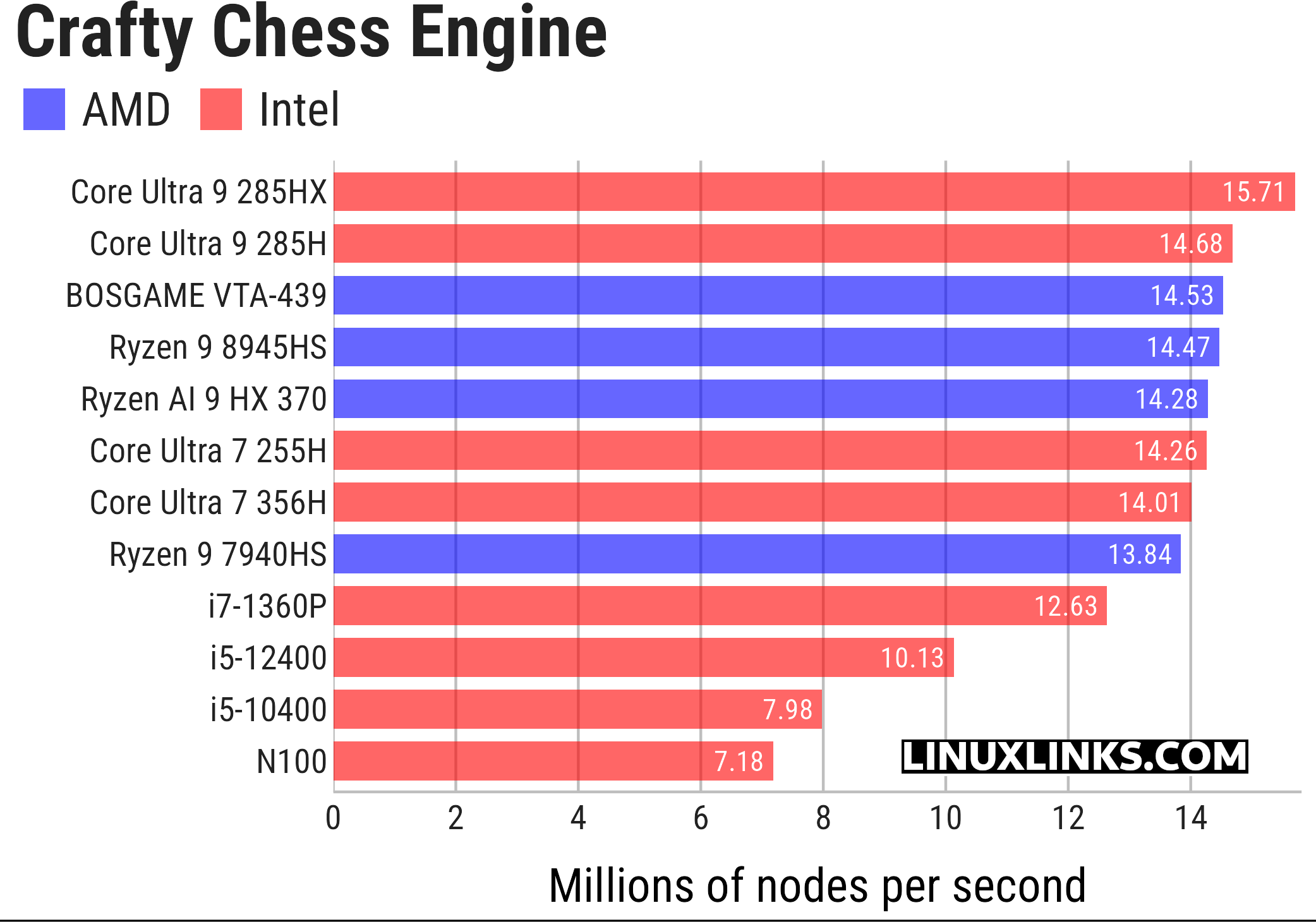
Crafty is a chess program directly derived from Cray Blitz, winner of the 1983 and 1986 World Computer Chess Championships. Crafty is a single-core benchmark, so it doesn’t reward CPUs simply for having more cores.
Single-core performance matters so much for desktop software because a lot of what makes a computer feel fast still depends on one main thread doing work quickly. Most desktop workloads aren’t perfectly parallel. Even on a 16-core or 24-core CPU, many tasks still have a “critical path” where one thread has to finish before the next step can happen. Faster single-core performance reduces waiting at each stage.
Pages in this article:
Page 1 – Introduction / Processor
Page 2 – Graphics
Page 3 – Memory
Page 4 – Disk and Summary
Complete list of articles in this series:
| BOSGAME VTA-439 Mini PC | |
|---|---|
| Introduction | Introduction to the series and interrogation of the machine |
| Benchmarks | Benchmarking the BOSGAME VTA-439 Mini PC |
| Power | Testing and comparing the power consumption |
| Easy Diffusion | Local Stable Diffusion package with a browser-based GUI |
| BIOS | Explore the machine's BIOS |
| Noise | How quiet is this mini PC? |
| NPU | Running LLMs on the Ryzen AI 9 HX 470 NPU |
Please read our Comment Policy before commenting.