

Apertis is a Debian-based operating system and development infrastructure designed for industrial embedded devices.
Originally created for automotive systems, the platform is now suitable for products including infotainment systems, industrial equipment, consumer electronics, and fixed-function devices.
The platform combines a Linux distribution with development tools, automated build infrastructure, testing services, software-update facilities, and compliance reporting.
This is free and open source software.
Key Features
- Targets industrial embedded systems requiring long-term stability, security, and maintainability.
- Supports x86-64, ARM64, and ARM32 architectures.
- Based on Debian while integrating and testing packages specifically for embedded use cases.
- Uses the Weston Wayland compositor with support for desktop, kiosk, and custom graphical interfaces.
- Provides SDK images and cross-compilation tools for building, testing, and integrating applications.
- Offers reproducible package and image builds using GitLab CI and Open Build Service.
- Provides signed over-the-air and offline system updates with automatic rollback facilities.
- Uses automated hardware testing to detect regressions across supported devices.
- Generates Software Bills of Materials covering package versions, licensing, copyright information, and security analysis.
- Supports application isolation and system security technologies including AppArmor, Flatpak, and OP-TEE.
- Supports OCI containers through Podman.
- Can build target images without software covered by selected licence families, including GPLv3, where product requirements demand it.
- Provides tools and documentation for customising images and adding support for new hardware.
| Working state: | Active |
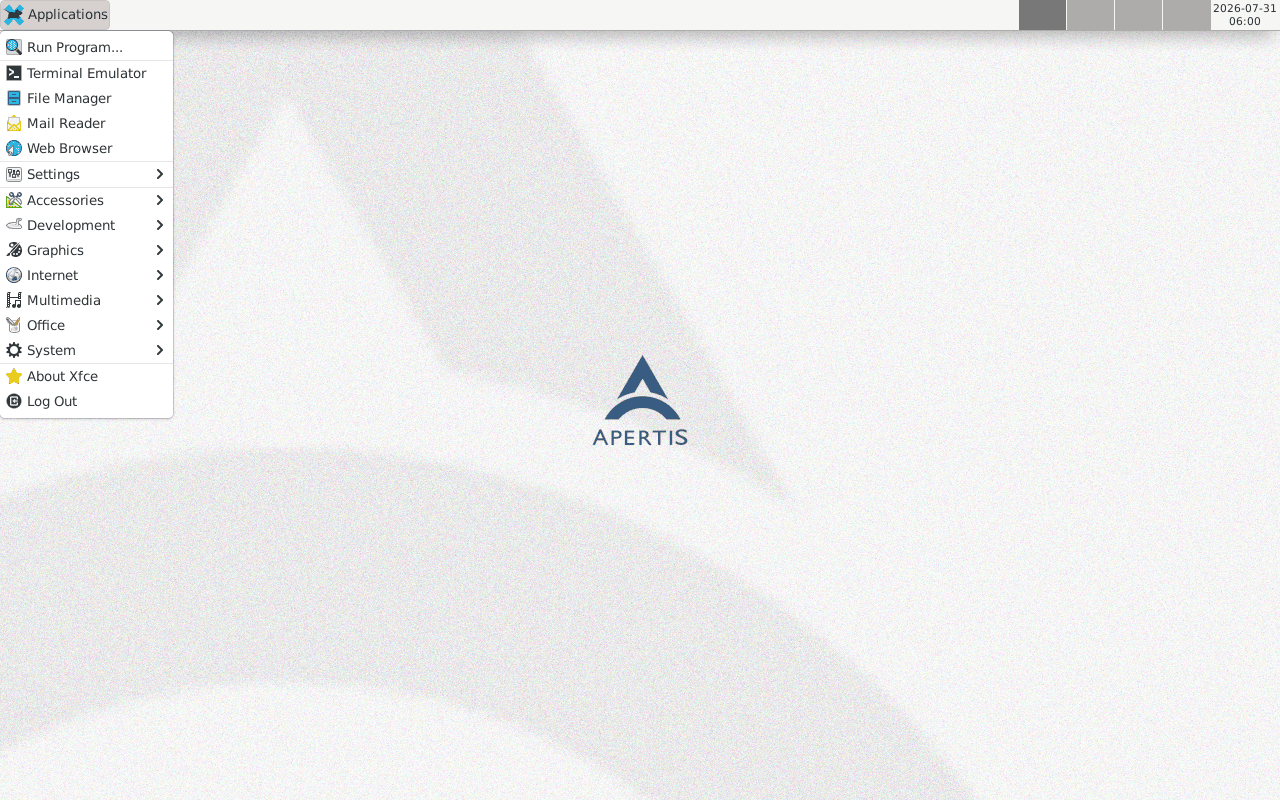
| Desktop: | Xfce |
| Init Software: | systemd |
| Package Management: | APT |
| Release Model: | Fixed |
| Platforms: | aarch64, armhf, x86_64 |
| Home Page: | www.apertis.org |
| Developer: | Collabora Limited |
| This article is part of our Big List of Active Linux Distributions and Open Source Operating Systems. |
What's a Linux distribution ("distro")? |
| A distro provides the user with a desktop environment, preloaded applications, and ways to update and maintain the system. Each distro makes different choices, deciding which open source projects to install and provides custom written programs. They can have different philosophies. Some distros are intended for desktop computers, some for servers without a graphical interface, and others for special uses. Because Linux is an open source operating system, combinations of software vary between Linux distros. |
Please read our Comment Policy before commenting.