

Sururu Linux is a Brazilian Debian-based distribution designed for teaching Linux system administration, containers and Kubernetes. Developed in Alagoas, Brazil, it provides a ready-to-use learning environment with the Xfce desktop and a collection of infrastructure management tools.
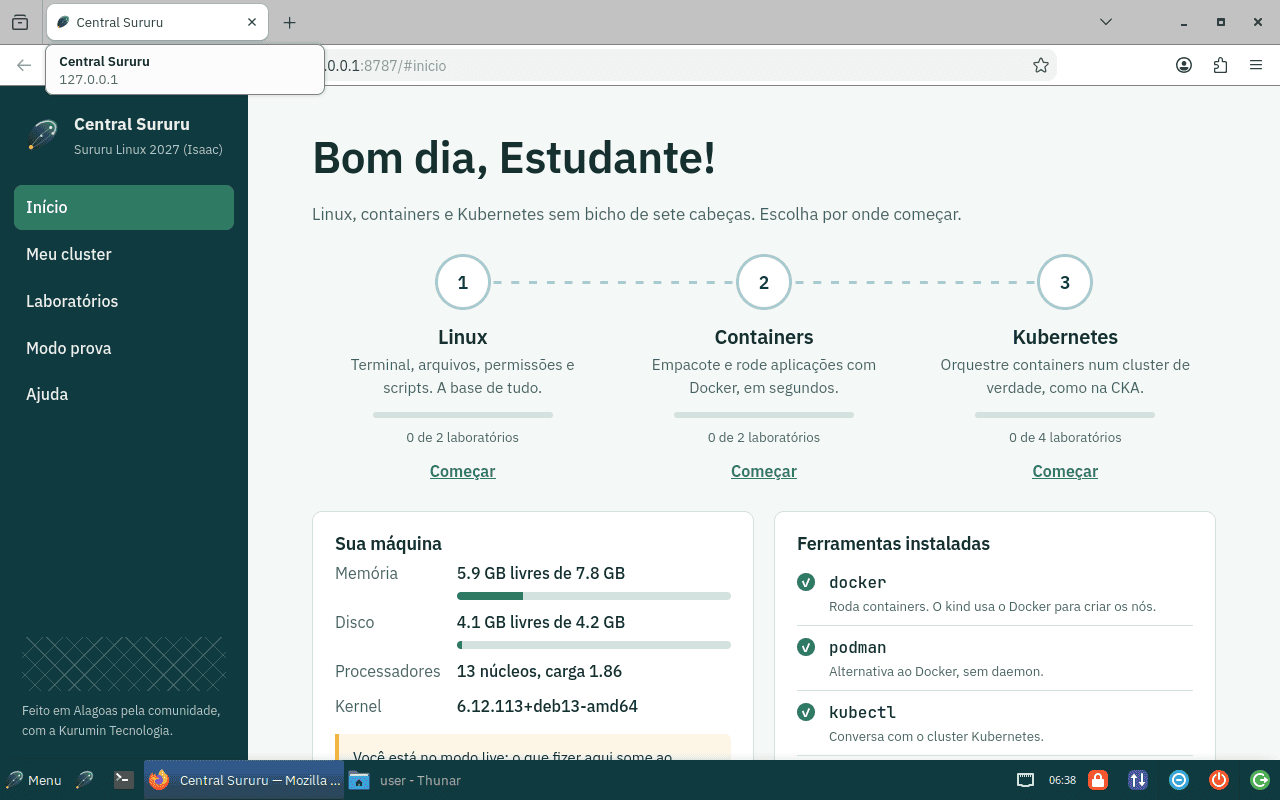
The distribution includes Central Sururu, a locally hosted educational interface that allows users to create and manage Kubernetes clusters using kind (Kubernetes in Docker). It provides guided exercises covering Linux commands, container management and Kubernetes administration. Exercises use practical scenarios based on everyday Brazilian life, with automatic validation of completed tasks and feedback when errors are detected.
Sururu Linux is intended for students, teachers and people preparing for Linux and Kubernetes certifications. It can run from a USB drive without installation, making it suitable for classroom environments. The interface and learning materials are in Brazilian Portuguese, with keyboard and regional settings configured accordingly.
| Working state: | Active |
| Desktop: | Xfce |
| Init Software: | systemd |
| Package Management: | APT |
| Release Model: | Fixed |
| Platforms: | x86_64 |
| Home Page: | sururu.kurumintecnologia.com.br |
| Developer: | Tácio Souza de Oliveira / Kurumin Tecnologia |
| This article is part of our Big List of Active Linux Distributions and Open Source Operating Systems. |
What's a Linux distribution ("distro")? |
| A distro provides the user with a desktop environment, preloaded applications, and ways to update and maintain the system. Each distro makes different choices, deciding which open source projects to install and provides custom written programs. They can have different philosophies. Some distros are intended for desktop computers, some for servers without a graphical interface, and others for special uses. Because Linux is an open source operating system, combinations of software vary between Linux distros. |
Please read our Comment Policy before commenting.