
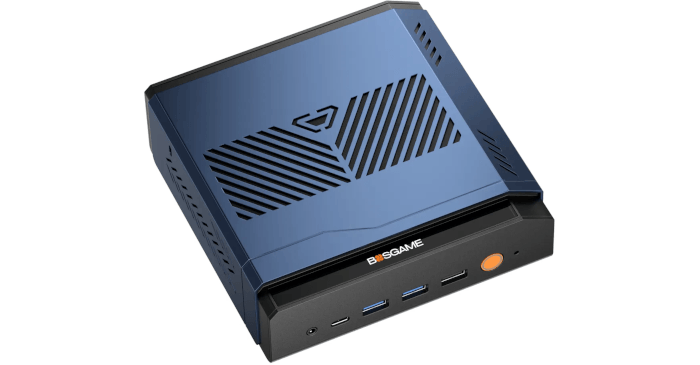
Why the VTA-439?
Gaming on Linux has changed dramatically over the past few years. Proton, Mesa and improved launcher support mean a substantial catalogue of Windows games is now accessible without keeping a separate Windows installation purely for gaming.
The BOSGAME VTA-439 is an interesting machine for seeing how far that progress extends to integrated graphics. Its Ryzen AI 9 HX 470 combines Zen 5 and Zen 5c CPU cores with Radeon 890M graphics. There is no discrete GPU in the system, so everything here is being rendered by AMD’s integrated GPU using shared system memory.
I’m testing at 1920×1080 because that remains a sensible target for this class of hardware. I’m less interested in whether a game simply launches than in how much visual quality I have to surrender to obtain good frame rates and reasonably consistent frame delivery.
Tiny Tina’s Wonderlands
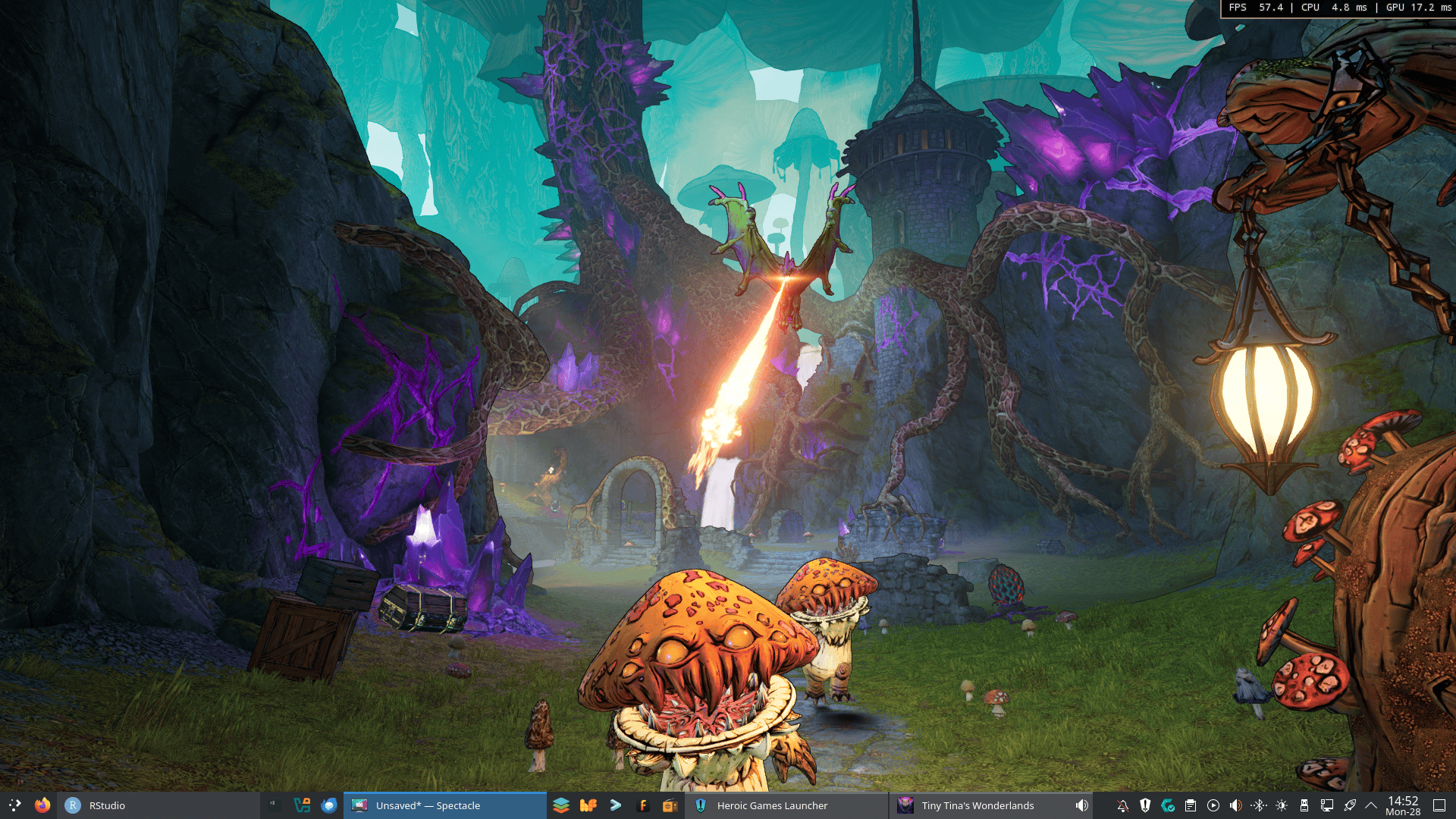
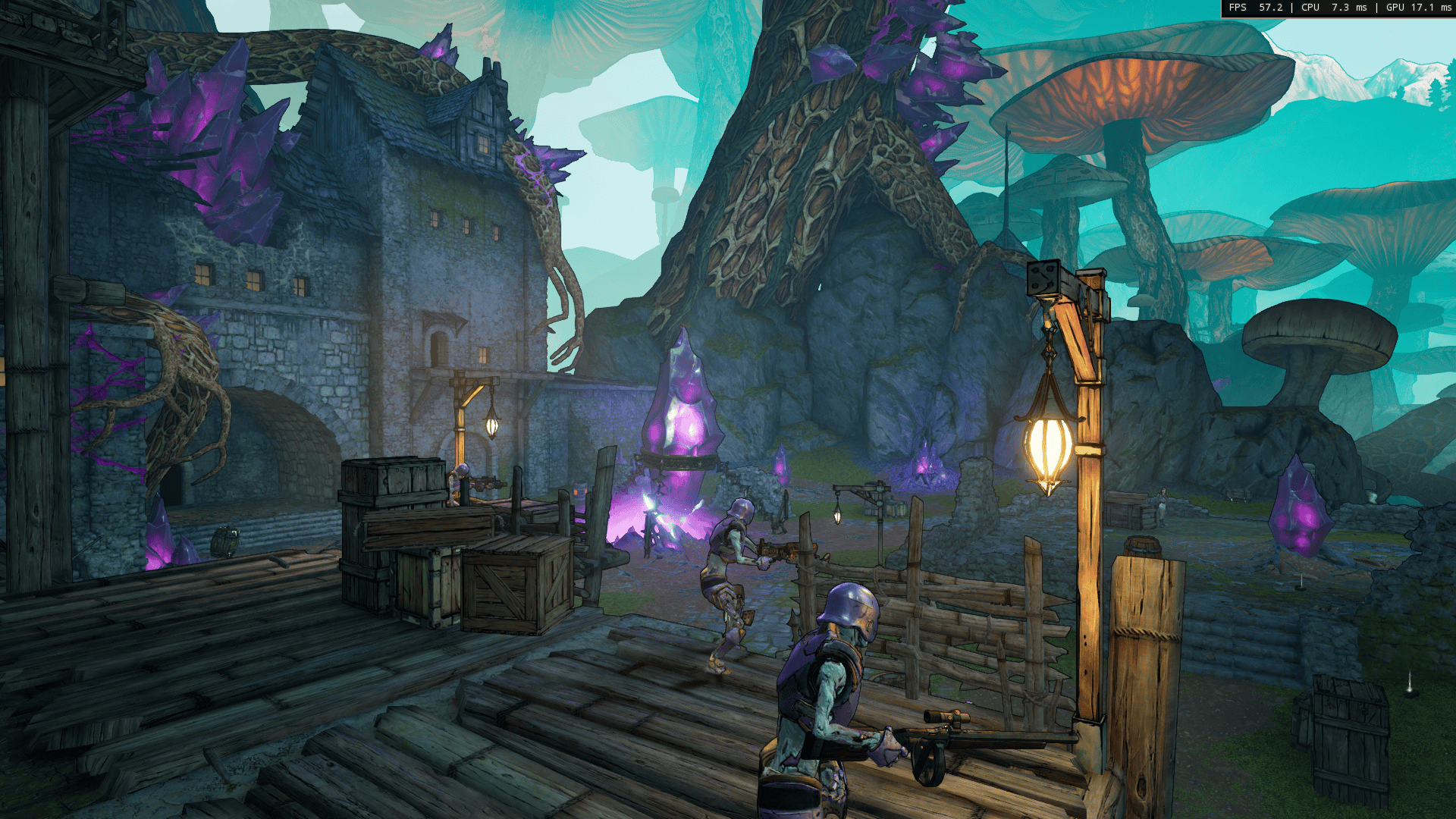
Tiny Tina’s Wonderlands is a tougher test for the Radeon 890M than Shadow of the Tomb Raider. I’m running the Epic Games version under CachyOS using Heroic and Proton.
All six presets use DirectX 12 at 1920×1080 with 100% scaling. V-Sync and FSR are disabled, and the frame rate is uncapped. The presets alter several graphics settings, so this is a straight comparison of the game’s own quality levels.
The built-in benchmark supplies the average FPS figure. I calculate the 1% low from the frame-time data to give a better indication of performance during the slower parts of each run.
Performance
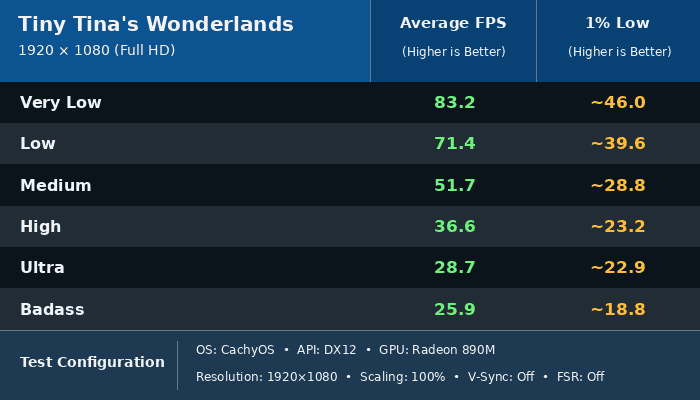
The Radeon 890M handles the lower presets well. Very Low averages 83.2 FPS and Low still manages 71.4 FPS, with 1% lows of roughly 46 and 40 FPS respectively.
Medium is the turning point. Performance drops to 51.7 FPS with a 28.8 FPS 1% low. That’s still quite respectable for integrated graphics at native 1080p.
High falls to 36.6 FPS, while Ultra and Badass manage 28.7 and 25.9 FPS. At that point the accompanying 1% lows, particularly Badass at 18.8 FPS, make the experience considerably less attractive.
Low is the sweet spot if smoothness is the priority. Medium is also a realistic option if I’m prepared to exchange some performance for better image quality. High and above are better candidates for FSR or a lower render resolution.
CachyOS vs Windows 11
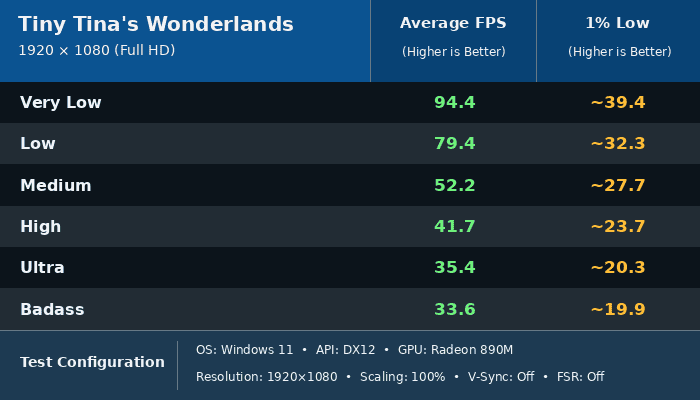
Windows 11 is faster in average FPS at every preset, but the advantage isn’t consistent.
At Very Low it leads 94.4 to 83.2 FPS, while Low is 79.4 versus 71.4 FPS. Medium is essentially tied at 52.2 and 51.7 FPS.
The Windows advantage becomes more noticeable higher up the scale. High reaches 41.7 FPS against 36.6 under CachyOS, Ultra 35.4 against 28.7, and Badass 33.6 against 25.9.
The 1% lows are more interesting. CachyOS is ahead at Very Low, Low, Medium and Ultra, and virtually tied at High. Windows therefore delivers higher headline frame rates, but CachyOS remains very competitive when looking at the slower frames.
Discrete GPU context
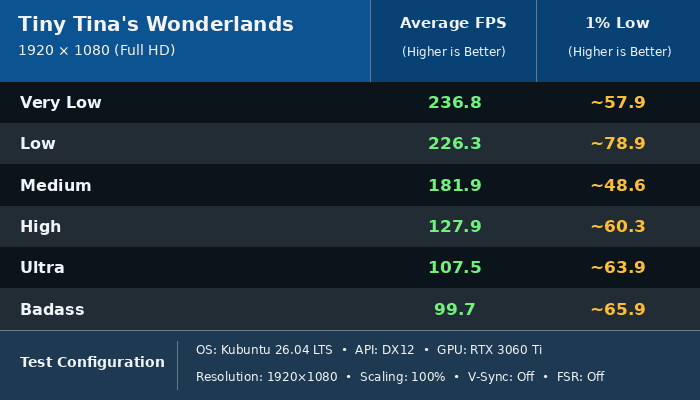
My RTX 3060 Ti system under Kubuntu 26.04 LTS shows just how much more headroom a discrete GPU provides.
It averages 236.8 FPS at Very Low, 181.9 FPS at Medium and 127.9 FPS at High. Even Ultra remains above 100 FPS, with Badass only just dipping below it at 99.7 FPS.
The gap also grows as quality increases. The RTX 3060 Ti is about 2.8 times faster than the Radeon 890M at Very Low, rising to almost 3.9 times faster at Badass. That’s a good illustration of where integrated graphics begin to run out of resources.
The 1% low figures on the RTX 3060 Ti are less consistent than the averages, so I wouldn’t read too much into their preset-to-preset pattern.
Summary
Tiny Tina’s Wonderlands is very playable on the Radeon 890M at native 1080p, provided I choose the settings sensibly.
Under CachyOS, Low delivers 71.4 FPS and Medium 51.7 FPS, making those the two presets I’d concentrate on. High is still usable, but Ultra and Badass push the integrated GPU beyond the point where I’d want to play without upscaling.
Windows produces higher average frame rates, particularly at the heavier presets, although CachyOS often records better 1% lows. The RTX 3060 Ti comparison meanwhile shows that the Radeon 890M is strongest at lighter workloads – the performance gap widens steadily as the graphical demands increase.
Complete list of articles in this series:
| BOSGAME VTA-439 Mini PC | |
|---|---|
| Introduction | Introduction to the series and interrogation of the machine |
| Benchmarks | Benchmarking the BOSGAME VTA-439 Mini PC |
| Power | Testing and comparing the power consumption |
| Easy Diffusion | Local Stable Diffusion package with a browser-based GUI |
| BIOS | Explore the machine's BIOS |
| Noise | How quiet is this mini PC? |
| NPU | Running LLMs on the Ryzen AI 9 HX 470 NPU |
| VirtualBox | Run VirtualBox on the Ryzen AI 9 HX 470's Zen 5 Cores |
| Gaming with the Radeon 890M | |
| Shadow of the Tomb Raider | Comparing graphics presets and frame rates |
| Tiny Tina’s Wonderlands | How well does this demanding shooter perform? |
Please read our Comment Policy before commenting.