

PINCE is a graphical front-end for the GNU Project Debugger (GDB) which adds an extensive collection of debugging and reverse engineering tools.
The software is focused particularly on analysing games, although its functionality is useful for many other reverse engineering tasks. Its name is a recursive acronym for PINCE Is Not Cheat Engine, and the project provides many facilities familiar to users of memory analysis and game debugging tools.
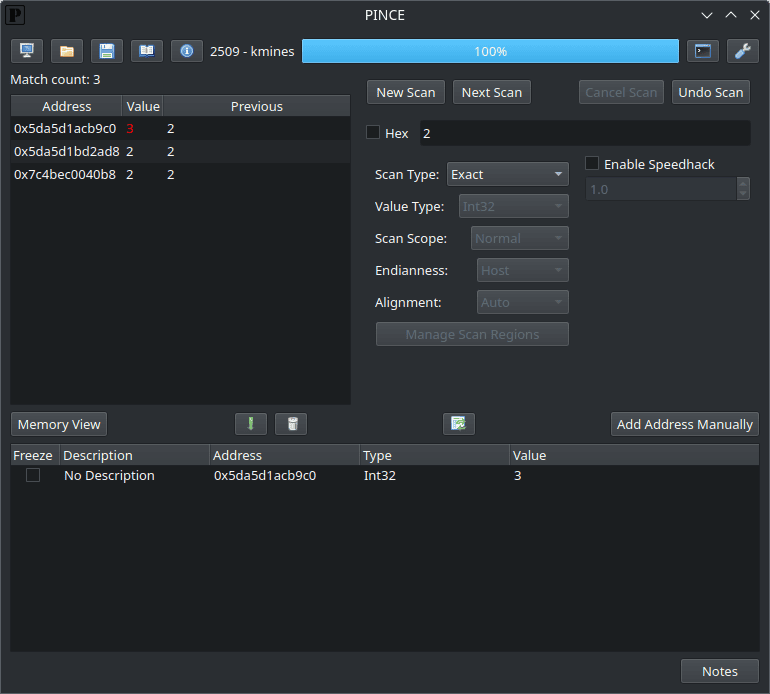
PINCE can scan process memory and search for pointers, values and instructions. Values can be inspected, modified and frozen, while its address table supports organising and manipulating groups of memory locations. Sessions can be saved and restored, including address tables, bookmarks, structures and notes.
The Memory View provides assembly and disassembly functionality together with bookmarks, instruction searches, memory maps and function searches. Users can modify registers, restore changed instructions and inspect the call stack. Keystone is used for assembling instructions dynamically.
Debugging facilities include breakpoints, watchpoints, stepping, tracing and breakpoint conditions. PINCE can track which instructions access a particular address and can follow addresses calculated from register expressions. Its collision detection helps prevent invalid combinations of hardware breakpoints.
There are also facilities for dissecting Mono and IL2CPP applications, finding class instances, invoking methods and exporting discovered classes as structures. Native shared-object injection and DLL injection into applications running through Wine or Proton are supported.
PINCE provides a reusable Python library called libpince and includes a GDB console for direct access to the underlying debugger. Pre-built AppImages are available for users.
This is free and open source software.
Key Features
- Graphical front-end for GDB.
- Memory and pointer scanning.
- Variable inspection and modification.
- Memory value locking.
- Address tables with session support.
- Assembler and disassembler facilities.
- Memory region and function browsing.
- Breakpoints and watchpoints.
- Breakpoint and watchpoint tracking.
- Execution tracing.
- Call stack inspection.
- Register modification.
- Code injection.
- Mono and IL2CPP dissection.
- Wine and Proton support for selected functionality.
- Reusable libpince Python library.
- Integrated GDB console.
Website: github.com/korcankaraokcu/PINCE
Support:
Developer: Korcan Karaokçu
License: GNU General Public License v3.0
PINCE is written in Python. Learn Python with our recommended free books and free tutorials.
Related Software
| Debuggers | |
|---|---|
| LLDB | Next generation, high-performance debugger |
| Ghidra | Software reverse engineering framework |
| Delve | Source level debugger for the Go programming language |
| GDB | The GNU Debugger |
| Valgrind | A memory debugger and profiler |
| Radare2 | Portable reversing framework |
| BugStalker | Rust debugger |
| Xdebug | Extension for PHP to aid debugging and development |
| Seer | GUI frontend to GDB |
| iaito | Graphical interface for radare2 |
| React Native Debugger | Standalone app for debugging React Native apps |
| KDbg | Graphical user interface to GDB |
| strace | Diagnostic, debugging and instructional userspace utility |
| rr | Record-and-replay debugger |
| drgn | Programmable debugger that puts scripting at the centre |
| cgdb | Lightweight console frontend to the GNU debugger |
| PuDB | Console-based visual debugger for Python |
| nnd | Partially inspired by RemedyBG |
| bashdb | Source-code debugger for bash; follows the GDB command syntax |
| Sysprof | Profile an application or entire system |
| crash | Linux kernel crash analysis utility |
| Nemiver | Standalone graphical debugger for GNOME |
Read our verdict in the software roundup.
 Explore our carefully curated directory of recommended free and open source software, covering every major software category. Explore our carefully curated directory of recommended free and open source software, covering every major software category.The directory forms part of our extensive collection of articles for Linux enthusiasts. It includes hundreds of detailed reviews, together with free and open source alternatives to proprietary software from companies such as Google, Microsoft, Apple, Adobe, IBM, Cisco, Oracle, and Autodesk. LinuxLinks also covers interesting projects worth exploring, Linux-compatible hardware, free programming books and tutorials, and much more. Know a useful free and open source Linux application that we haven’t covered? Tell us about it using our submission form. |
Please read our Comment Policy before commenting.