

edb is a graphical debugger for AArch32, x86 and x86-64 applications. The project was inspired by OllyDbg and provides a traditional low-level debugging environment centred around disassembly, registers, memory and process state.
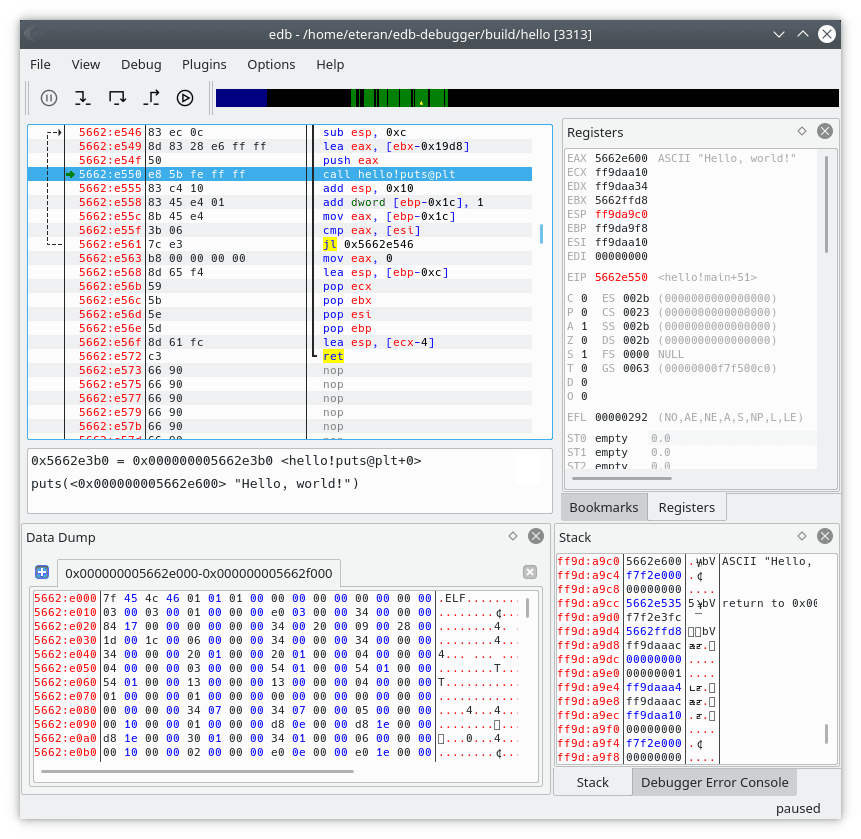
The main interface presents the information needed when investigating a running executable at machine-code level. Users can examine disassembled instructions, registers, stack contents and memory while controlling program execution with breakpoints and stepping commands.
edb is useful both for conventional debugging and reverse engineering. The disassembly-oriented interface lends itself to examining binaries when source code is unavailable, while its memory and register views make it possible to inspect program state directly as execution progresses.
The debugger uses Capstone for disassembly and Qt for its graphical interface. Its architecture also supports plugins, allowing additional debugging and analysis functionality to be added without putting everything into the core application. Optional Graphviz integration is available for functionality which benefits from graph visualisation.
Users can build edb with either GCC or Clang. Current development supports modern Qt 5 and Qt 6 releases, and recent work has included compatibility improvements for newer versions of Qt and Capstone.
edb has been under development for many years and has a substantial user base. It remains one of the more established free graphical low-level debuggers available for Linux.
This is free and open source software.
Key Features
- Graphical low-level debugging environment.
- AArch32, x86 and x86-64 architecture support.
- Disassembly of executable code.
- Register inspection.
- Stack inspection.
- Memory inspection and editing.
- Software and hardware breakpoints.
- Single stepping and execution control.
- Process and thread inspection.
- Plugin architecture.
- Capstone disassembly engine integration.
- Optional Graphviz integration.
- Qt graphical interface.
- Qt 5 and Qt 6 support.
Website: github.com/eteran/edb-debugger
Support:
Developer: Evan Teran
License: GNU General Public License v2.0
edb is written in C++. Learn C++ with our recommended free books and free tutorials.
Related Software
| Debuggers | |
|---|---|
| LLDB | Next generation, high-performance debugger |
| Ghidra | Software reverse engineering framework |
| Delve | Source level debugger for the Go programming language |
| GDB | The GNU Debugger |
| Valgrind | A memory debugger and profiler |
| Radare2 | Portable reversing framework |
| BugStalker | Rust debugger |
| Xdebug | Extension for PHP to aid debugging and development |
| Seer | GUI frontend to GDB |
| iaito | Graphical interface for radare2 |
| KDbg | Graphical user interface to GDB |
| strace | Diagnostic, debugging and instructional userspace utility |
| rr | Record-and-replay debugger |
| gf | Lightweight GDB interface with source, stack and memory views |
| drgn | Programmable debugger that puts scripting at the centre |
| cgdb | Lightweight console frontend to the GNU debugger |
| PuDB | Console-based visual debugger for Python |
| nnd | Partially inspired by RemedyBG |
| bashdb | Source-code debugger for bash; follows the GDB command syntax |
| PINCE | Memory scanning, process manipulation and reverse engineering |
| edb | Low-level debugging with disassembly and register inspection |
| Sysprof | Profile an application or entire system |
| crash | Linux kernel crash analysis utility |
Read our verdict in the software roundup.
 LinuxLinks helps you discover the best free and open source software for Linux. Explore our extensive collection of recommended applications, including alternatives to popular proprietary software. We also publish software reviews, Linux tutorials, hardware reviews, free programming books and articles covering the wider open source community. Browse our Linux resources to discover more. Know a useful free and open source Linux application we haven't covered? Suggest a program for inclusion. Has your software been featured on LinuxLinks? Display one of our Featured on LinuxLinks badges on your website or GitHub README. |
Please read our Comment Policy before commenting.