
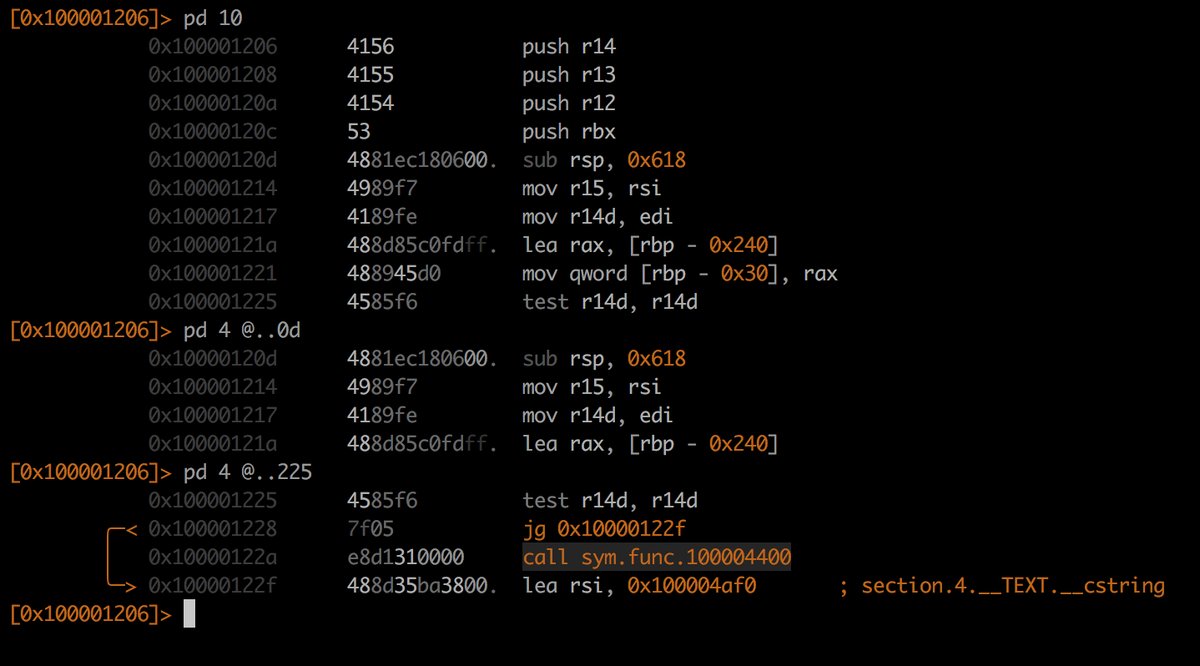
Radare2 is a command-line framework for reverse engineering, binary analysis and debugging. Originally developed as a hexadecimal editor for forensic work, it has grown into an extensive collection of tools for examining and modifying executable code.
The framework supports numerous processor architectures and binary formats. It combines disassembly, code analysis, debugging and binary patching, allowing developers and security researchers to investigate applications without access to their source code.
Radare2 is highly scriptable and provides libraries that can be incorporated into other tools. Although its command-line interface has a considerable learning curve, it offers considerable flexibility for automated analysis and advanced reverse engineering.
This is free and open source software.
Key Features
- Disassemble and assemble instructions for numerous processor architectures.
- Analyse executable files to identify functions, references, strings and control-flow relationships.
- Debug local programs and connect to remote debugging targets, including GDB-compatible servers.
- Inspect registers, memory, stack information and program execution at instruction level.
- Edit executable files and patch individual instructions or data within binaries.
- Examine executable formats including ELF, PE, Mach-O and other binary structures.
- Perform forensic analysis of binary files and inspect embedded data.
- Automate reverse engineering tasks using its embedded JavaScript interpreter or r2pipe interfaces.
- Extend analysis capabilities through plugins managed with r2pm.
- Integrate with decompilers and external analysis tools, including Ghidra-based components.
- Provide interactive visual modes for examining disassembly, graphs and binary data.
Website: rada.re/n
Support:
Developer: pancake and contributors
License: GNU Lesser General Public License v3.0
Radare2 is written in C. Learn C with our recommended free books and free tutorials.
Related Software
| Digital Forensics Tools | |
|---|---|
| GRR Rapid Response | Remote live forensics for incident response |
| Radare2 | Portable reversing framework |
| The Sleuth Kit | Collection of tools for forensic analysis |
| MemProcFS | View physical memory as files in a virtual file system |
| Autopsy Forensic Browser | Graphical interface to SleuthKit |
| iaito | Official graphical interface for radare2 |
| Chainsaw | Fast forensic triage and threat hunting tool for Windows artefacts |
| Velociraptor | Endpoint visibility and collection tool |
| Timesketch | Collaborative forensic timeline analysis |
| Plaso | Python-based digital forensics framework |
| Volatility | Advanced memory forensics framework |
| UAC | Collect forensic artefacts from Linux and other Unix-like systems |
| IPED | Process, index and analyse large collections of digital evidence |
| guymager | Forensic imaging tool based on Qt |
| Dissect | Access and query evidence across disk images and file systems |
| dcfldd | Enhanced version of dd for forensics and security |
| rdd | Forensic copy program |
| Jomon | Network forensics and passive sniffer |
| Mozilla InvestiGator | Real-time digital forensics and investigation platform |
Read our verdict in the software roundup.
| Debuggers | |
|---|---|
| LLDB | Next generation, high-performance debugger |
| Ghidra | Software reverse engineering framework |
| Delve | Source level debugger for the Go programming language |
| GDB | The GNU Debugger |
| Valgrind | A memory debugger and profiler |
| Radare2 | Portable reversing framework |
| BugStalker | Rust debugger |
| Xdebug | Extension for PHP to aid debugging and development |
| Seer | GUI frontend to GDB |
| iaito | Graphical interface for radare2 |
| React Native Debugger | Standalone app for debugging React Native apps |
| KDbg | Graphical user interface to GDB |
| strace | Diagnostic, debugging and instructional userspace utility |
| rr | Record-and-replay debugger |
| drgn | Programmable debugger that puts scripting at the centre |
| cgdb | Lightweight console frontend to the GNU debugger |
| PuDB | Console-based visual debugger for Python |
| nnd | Partially inspired by RemedyBG |
| bashdb | Source-code debugger for bash; follows the GDB command syntax |
| Sysprof | Profile an application or entire system |
| crash | Linux kernel crash analysis utility |
| Nemiver | Standalone graphical debugger for GNOME |
Read our verdict in the software roundup.
| Binary Analysis Tools | |
|---|---|
| Ghidra | Software reverse engineering framework |
| Radare2 | Portable reversing framework |
| Cutter | Graphical reverse engineering platform |
| Capstone | Lightweight multi-architecture disassembly framework |
| Detect it Easy | File inspection utility |
| ImHex | Analyze binary data |
| Miasm | Reverse engineering framework for analysing and emulating binaries |
| Reko | General-purpose decompiler for machine-code binaries |
| capa | Command line malware analysis tool |
| binwalk | Search a given binary image for embedded files |
| FLOSS | FLARE Obfuscated String Solver |
| unblob | Extraction suite for working with unknown binary blobs |
| Rizin | UNIX-like reverse engineering framework |
| REDasm | Cross-platform disassembler with an extensible graphical interface |
| Pharos | Framework for automated static analysis of binary programs |
| LIEF | Work with executable and binary formats |
| RetDec | Retargetable machine-code decompiler |
| knife | Static binary triage, disassembly and vulnerability analysis toolkit |
Read our verdict in the software roundup.
 LinuxLinks helps you discover the best free and open source software for Linux. Explore our extensive collection of recommended applications, including alternatives to popular proprietary software. We also publish software reviews, Linux tutorials, hardware reviews, free programming books and articles covering the wider open source community. Browse our Linux resources to discover more. Know a useful free and open source Linux application we haven't covered? Suggest a program for inclusion. Has your software been featured on LinuxLinks? Display one of our Featured on LinuxLinks badges on your website or GitHub README. |
Please read our Comment Policy before commenting.