
A linter is a tool used in software development to analyze source code for potential errors, stylistic issues, and adherence to coding standards. It essentially acts as a static code analyzer, examining the code without actually executing it. Linters help developers catch issues early in the development cycle, improving code quality and maintainability
Linters are useful tools for maintaining code quality and consistency in your Go applications. They analyze code for potential issues, enforce coding standards, and help catch errors before they are pushed into production. Linters are not necessarily a quick fix, can be a distraction, and it’s not inconceivable that they may not be helpful with old, large code bases.
This article picks some useful tools to help you fix Go code.
Here’s our verdict captured in a legendary LinuxLinks-style ratings chart. Only free and open source software is eligible for inclusion here.
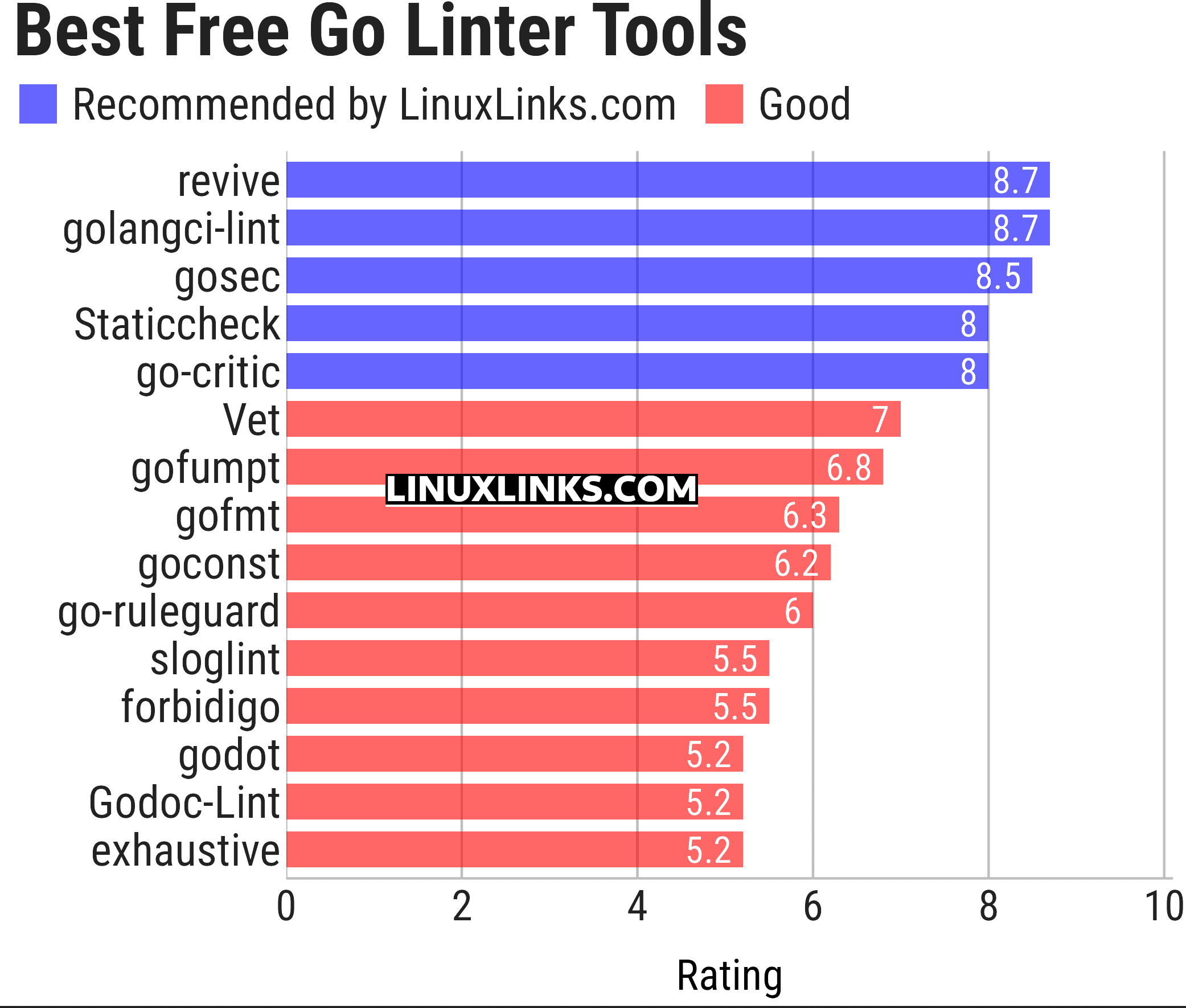
Click the links in the table below to learn more about each tool.
| Go Linters | |
|---|---|
| revive | Designed as a drop-in replacement for golint |
| golangci-lint | Fast Go linters runner |
| gosec | Security scanner for Go projects |
| Staticcheck | Advanced Go linter |
| go-critic | Opinionated Go source code linter |
| Vet | Examines Go source code and reports suspicious constructs |
| gofumpt | Stricter gofmt |
| gofmt | Formats Go programs |
| goconst | Find repeated Go literals that could be replaced with constants |
| go-ruleguard | Analysis-based Go linter that runs dynamically loaded rules |
| sloglint | Enforce consistent structured logging conventions in Go |
| forbidigo | Go linter for forbidding identifiers |
| godot | Keep source code comments consistent |
| Godoc-Lint | Enforce consistent documentation comments in Go code |
| exhaustive | Check Go switch statements for missing enum cases |
This article has been updated to reflect the changes outlined in our recent announcement.
 Explore our carefully curated directory of recommended free and open source software, covering every major software category. Explore our carefully curated directory of recommended free and open source software, covering every major software category.The directory forms part of our extensive collection of articles for Linux enthusiasts. It includes hundreds of detailed reviews, together with free and open source alternatives to proprietary software from companies such as Google, Microsoft, Apple, Adobe, IBM, Cisco, Oracle, and Autodesk. LinuxLinks also covers interesting projects worth exploring, Linux-compatible hardware, free programming books and tutorials, and much more. Know a useful free and open source Linux application that we haven’t covered? Tell us about it using our submission form. |
Please read our Comment Policy before commenting.