

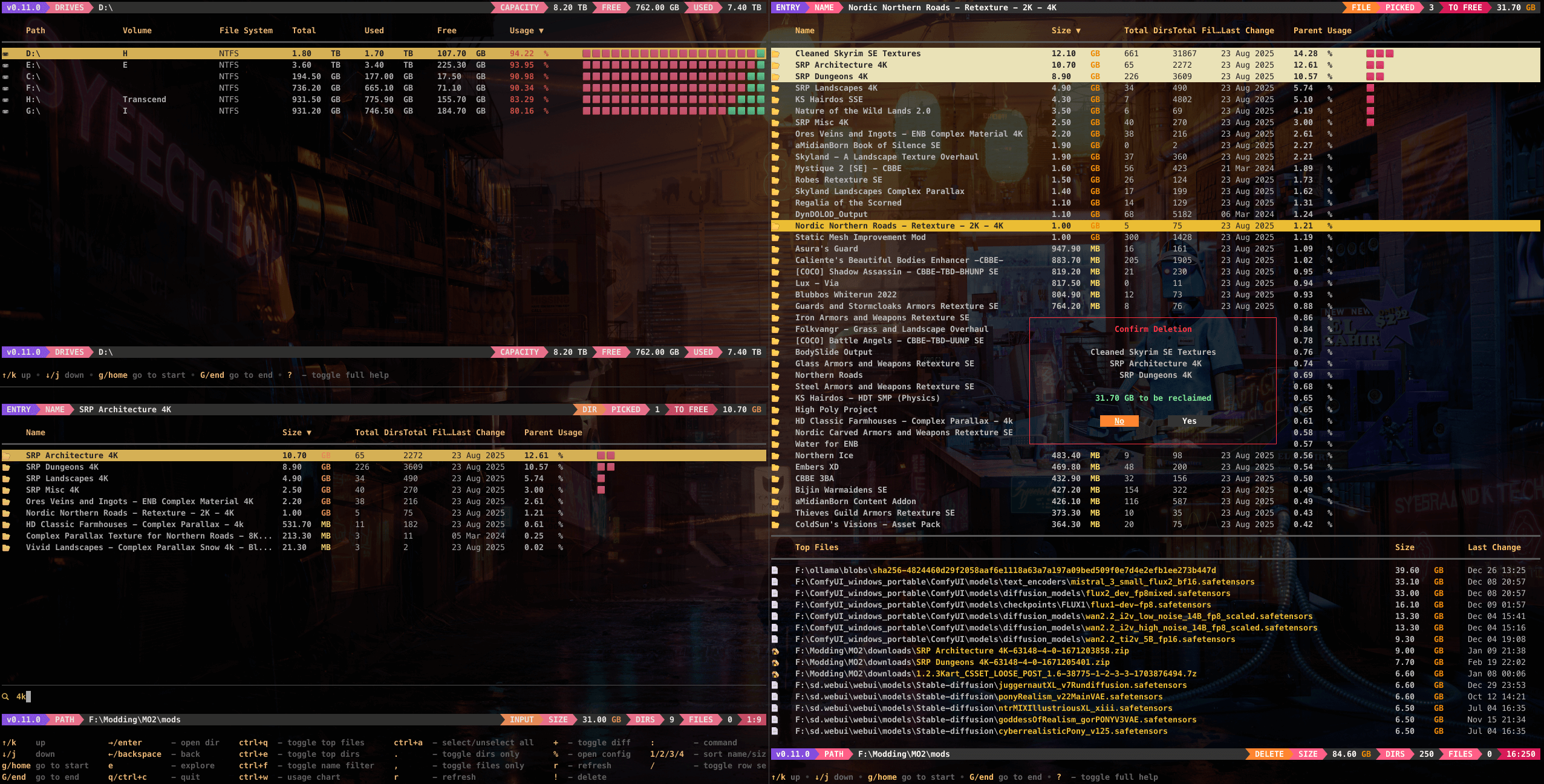
NoxDir is a terminal application for examining filesystem usage and identifying files and directories that consume large amounts of storage. It provides a keyboard-driven interface for navigating directory structures and comparing the space occupied by different entries.
The application can detect mounted drives and volumes, allowing users to select the storage location they want to examine. It displays directory usage information in an interactive view rather than requiring users to interpret conventional du output.
NoxDir offers several filtering options that help narrow the results. Users can exclude directories, hide empty entries and specify size boundaries to concentrate on files of particular interest. This is useful when working with large directory trees containing many small files or temporary directories.
The interface supports configurable colours and display styles, making it adaptable to different terminal environments.
This is free and open source software.
Key Features
- Interactive terminal interface for visualising filesystem usage.
- Automatically detects mounted drives and storage volumes.
- Navigate directory structures using keyboard controls.
- Displays storage consumption through size metrics and visual indicators.
- Scan a predefined root directory.
- Exclude selected directories from scans.
- Option to hide empty directories from the results.
- Show or exclude hidden files and directories.
- Filter files using configurable minimum and maximum size boundaries.
- Customisable colour schemes through configuration files.
- Simplified display mode with reduced use of graphical terminal characters.
- Manage the application’s cached information.
- Cross-platform support – runs on Linux, macOS, and Windows.
Website: github.com/crumbyte/noxdir
Support:
Developer: crumbyte
License: MIT License
NoxDir is written in Go. Learn Go with our recommended free books and free tutorials.
Related Software
| du alternatives | Programming Language | License |
|---|---|---|
| dust | Rust | Apache License 2.0 |
| duf | Go | MIT License |
| Duc | C | GNU Lesser General Public License v3 |
| Ncdu | C | GNU GPL v2.0 License |
| gdu | Go | MIT License |
| cull | Go | MIT License |
| dua | Rust | MIT License |
| erdtree | Rust | MIT License |
| pdu | Rust | Apache License 2.0 |
| vizex | Python | MIT License |
| godu | Go | MIT License |
| dutree | Rust | GNU General Public License v3 |
| space | Rust | MIT License |
| darya | Rust | GNU General Public License v3.0 |
| diskus | Rust | MIT License or Apache License 2.0 |
| NoxDir | Go | MIT License |
| mcdu | Rust | MIT License |
| dirstat-rs | Rust | MIT License |
| diskonaut | Rust | MIT License |
| bonsai | C++ | GNU General Public License v3.0 |
| diskard | Rust | MIT License or Apache License 2.0 |
| cdu | Perl | GNU General Public License v2.0 |
| tdu | Go | GNU General Public License v2 |
| duviz | Python | MIT License |
| dut | C | GNU General Public License v3.0 |
| whalespotter | Rust | MIT License |
| sn | Rust | BSD 3-Clause “New” or “Revised” License |
Read our verdict in the software roundup.
 LinuxLinks helps you discover the best free and open source software for Linux. Explore our extensive collection of recommended applications, including alternatives to popular proprietary software. We also publish software reviews, Linux tutorials, hardware reviews, free programming books and articles covering the wider open source community. Browse our Linux resources to discover more. Know a useful free and open source Linux application we haven't covered? Suggest a program for inclusion. Has your software been featured on LinuxLinks? Display one of our Featured on LinuxLinks badges on your website or GitHub README. |
Please read our Comment Policy before commenting.