
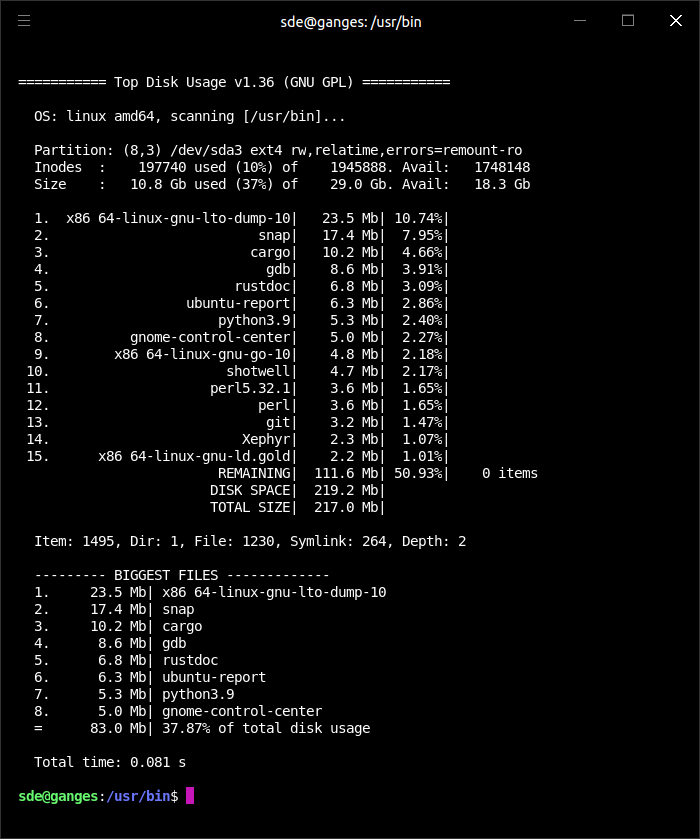
tdu (Top Disk Usage) is a command-line utility for identifying the files and directories consuming the most disk space. It examines a specified directory tree and produces a summary highlighting the largest storage consumers.
The application is designed for users who want a compact report rather than an interactive disk browser. Its output focuses on the biggest files and directories, making it easier to identify where further investigation may be worthwhile.
tdu uses an approach comparable to the du -skx command and provides options for controlling the amount of information displayed. Users can adjust the number of large files listed, inspect top-level directories and request information about unusually deep paths.
The utility also reports several types of filesystem entries and scanning problems. Results can be exported using Ncdu’s JSON format, allowing the collected information to be examined with compatible tools.
This is free and open source software.
Key Features
- Recursive analysis of disk usage under a specified directory.
- Display a sorted list of the largest files and directories.
- Configure the number of large files included in reports.
- Set the number of top-level directory entries displayed.
- Identify the deepest and longest paths encountered during scanning.
- Report empty directories.
- Display directories that could not be accessed because of permission restrictions.
- Report filesystem status errors.
- Include information about device files, sockets and named pipes.
- Display sizes using human-readable units or kilobytes.
- Export scan results in Ncdu-compatible JSON format.
- Cross-platform support – runs on Linux and Windows.
Website: github.com/josephpaul0/tdu
Support:
Developer: Joseph Paul
License: GNU General Public License v2.0
tdu is written in Go. Learn Go with our recommended free books and free tutorials.
Related Software
| du alternatives | Programming Language | License |
|---|---|---|
| dust | Rust | Apache License 2.0 |
| duf | Go | MIT License |
| Duc | C | GNU Lesser General Public License v3 |
| Ncdu | C | GNU GPL v2.0 License |
| gdu | Go | MIT License |
| cull | Go | MIT License |
| dua | Rust | MIT License |
| erdtree | Rust | MIT License |
| pdu | Rust | Apache License 2.0 |
| vizex | Python | MIT License |
| godu | Go | MIT License |
| dutree | Rust | GNU General Public License v3 |
| space | Rust | MIT License |
| darya | Rust | GNU General Public License v3.0 |
| diskus | Rust | MIT License or Apache License 2.0 |
| NoxDir | Go | MIT License |
| mcdu | Rust | MIT License |
| dirstat-rs | Rust | MIT License |
| diskonaut | Rust | MIT License |
| bonsai | C++ | GNU General Public License v3.0 |
| diskard | Rust | MIT License or Apache License 2.0 |
| cdu | Perl | GNU General Public License v2.0 |
| tdu | Go | GNU General Public License v2 |
| duviz | Python | MIT License |
| dut | C | GNU General Public License v3.0 |
| whalespotter | Rust | MIT License |
| sn | Rust | BSD 3-Clause “New” or “Revised” License |
Read our verdict in the software roundup.
 LinuxLinks helps you discover the best free and open source software for Linux. Explore our extensive collection of recommended applications, including alternatives to popular proprietary software. We also publish software reviews, Linux tutorials, hardware reviews, free programming books and articles covering the wider open source community. Browse our Linux resources to discover more. Know a useful free and open source Linux application we haven't covered? Suggest a program for inclusion. Has your software been featured on LinuxLinks? Display one of our Featured on LinuxLinks badges on your website or GitHub README. |
Please read our Comment Policy before commenting.