

WikidPad is an open source, Python-based wiki-like notebook for storing thoughts, ideas, todo lists, contacts, and other notes with wiki-like linking between pages.
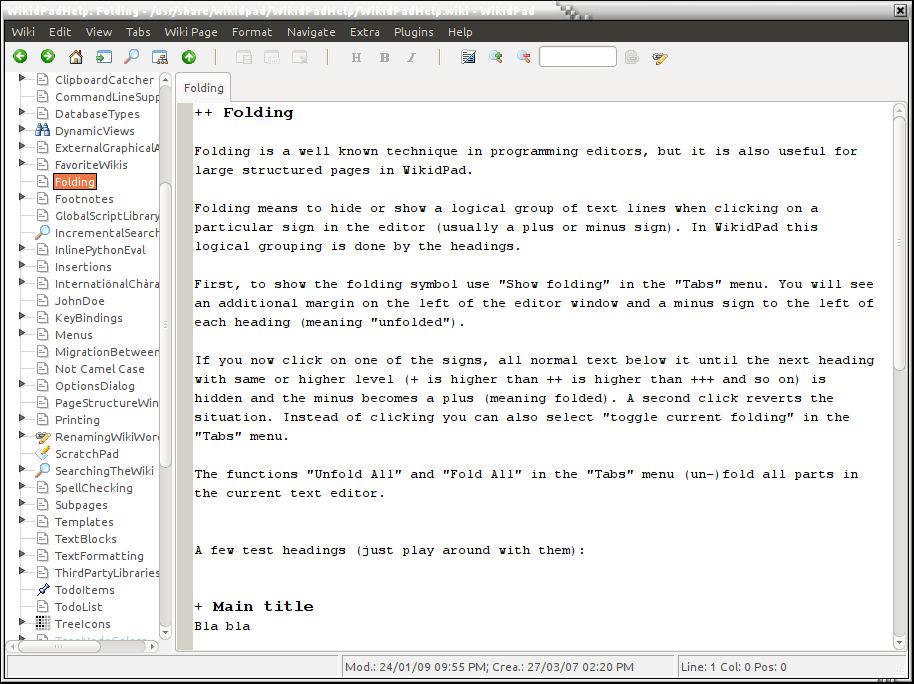
The WikidPad system uses a database to tie together individual text documents that the user creates into a wiki-like notepad. Wiki-links can be created by writing a word in CamelCase or enclosing a word or words with single brackets, allowing easy ways to create a mini-wiki on a certain subject easily. Single wiki pages and complete wikis can be exported to HTML.
Key Features
- WikiWord auto-completion.
- WikiWord navigation.
- On the fly WikiWord linking.
- Easy WikiWord navigation.
- Tree/Outline view.
- Dynamic views – performs attribute based searches and shows nodes that match those searches.
- To-do lists.
- Incremental search.
- Search and Replace.
- Wikis can be exported to HTML.
- Extensible with Python scripting.
- Can be used as portable software on a USB stick.
- Store notes in plain text or a SQLite database.
- Autosave – saves around 5-15 seconds of idle time, on navigation to a new wiki word, and on shutdown.
- Keybindings – many of which can be changed.
- Spell checking.
- Plugins:
- Graphviz – graph visualization software.
- MimeTex – Latex formula renderer.
- Ploticus – Charting and graphing software.
Website: wikidpad.sourceforge.net
Support: FAQ
Developer: Michael Butscher
License: Three-clause BSD
WikidPad is written in Python. Learn Python with our recommended free books and free tutorials.
Related Software
| Desktop Wiki GUI Notes Apps | |
|---|---|
| Zim Desktop Wiki | Brings the concept of a wiki to your desktop |
| logseq | Privacy-first platform for knowledge management and collaboration |
| AppFlowy | Bring projects, wikis, and teams together with AI. |
| Trilium Notes | Hierarchical note taking application |
| SiYuan | Privacy-first personal knowledge management and note-taking app |
| SilverBullet | Note-taking application optimized for people with a hacker mindset |
| Tangent | Designed to let you write the way you think |
| MyTetra | Smart manager for information collecting |
| OutWiker | Cross-platform note-taking app with a tree-based structure |
| WikidPad | Wiki-like notebook for storing your thoughts, ideas, todo lists |
| Reor | AI note-taking app |
Read our verdict in the software roundup.
| Tools for Novelists | |
|---|---|
| FocusWriter | Distraction-free writing environment with goals and statistics |
| Ren'Py | Engine for creating visual novels and interactive stories |
| novelWriter | Structured plain-text editor for novels and long-form fiction |
| CherryTree | Hierarchical notes for research, characters and story planning |
| Zettlr | Markdown writing environment for long-form projects |
| oStorybook | Novel planning and writing suite with scenes and timelines |
| Twine | Visual tool for creating branching and interactive stories |
| Manuskript | Novel-writing environment built around structured planning |
| Quoll Writer | Novel-writing workspace with chapters, assets and goals |
| Joplin | Note-taking application useful for research and story planning |
| Hammer | Offline-first story editor with scenes, notes and references |
| Bibisco | Novel-writing environment focused on characters and structure |
| Story Architect | Bring characters, scenes and screenplays together in one workspace |
| WareWoolf | Minimalist fiction-writing environment with planning tools |
| Scriptorium | Plan, write and publish novels and other manuscripts |
| Cheese Paper | A comfortable writing environment for lengthy prose |
| Skribisto | Writing studio with corkboard, sessions and rich export support |
| novelibre | Novel organiser integrated with LibreOffice and OpenOffice |
| Scrivus | Plan and write your novel while keeping everything on your own computer |
| NovProg | Tracks and graphs writing progress against project goals |
Read our verdict in the software roundup.
 Explore our carefully curated directory of recommended free and open source software, covering every major software category. The directory forms part of our extensive collection of articles for Linux enthusiasts. It includes hundreds of detailed reviews, together with free and open source alternatives to proprietary software from companies such as Google, Microsoft, Apple, Adobe, IBM, Cisco, Oracle, and Autodesk. LinuxLinks also covers interesting projects worth exploring, Linux-compatible hardware, free programming books and tutorials, and much more. Know a useful free and open source Linux application that we haven’t covered? Tell us about it using our submission form. |