

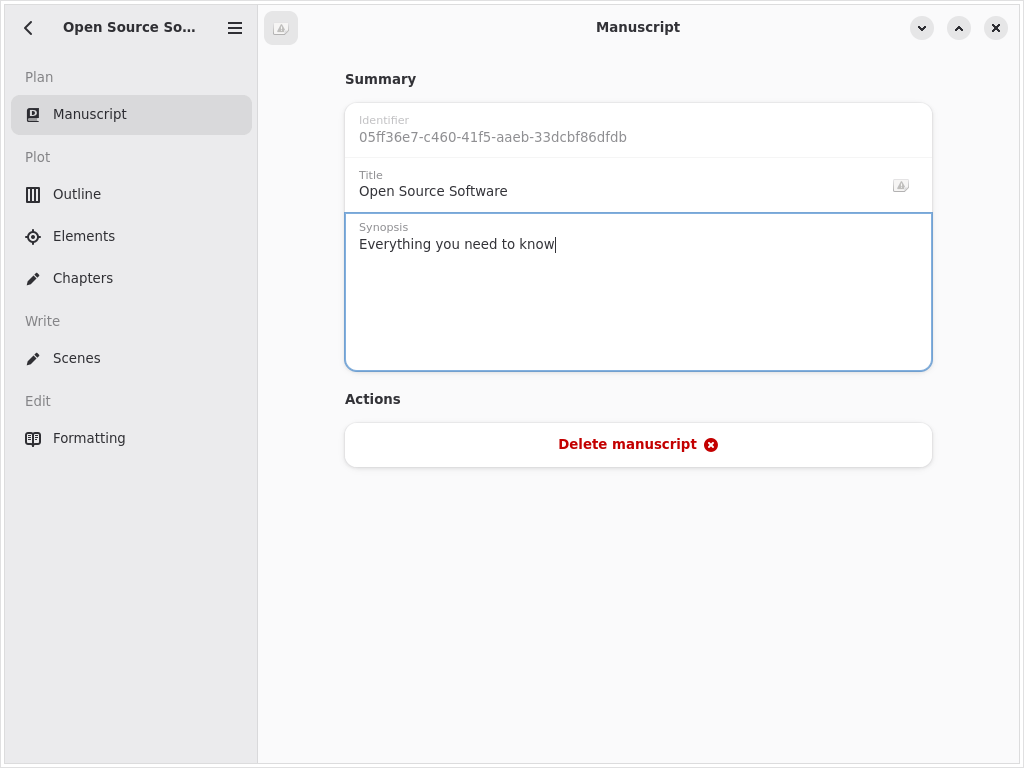
Scriptorium combines manuscript planning, writing and publishing in a single desktop application. Rather than treating a book as one large document, it lets the writer work with individual scenes while maintaining the structure that connects them.
Planning and writing feed into a publishing stage where the assembled manuscript can be previewed before output. The underlying project data uses ordinary text-based formats, which also supports its approach to tracking changes to scenes.
This is free and open source software.
Key Features
- Create and maintain the list of scenes that form a manuscript.
- Write individual scenes using a text-focused editor.
- Organise scenes into chapters and rearrange the structure of a book.
- Maintain story elements for characters, places, props and other recurring material.
- Associate story elements with the scenes in which they are relevant.
- Use an overview to inspect and reorganise the structure of the manuscript.
- Preview the assembled book and adjust its appearance before publication.
- Publish completed manuscripts as EPUB files.
- Switch between light and dark interface modes.
- Track versions of scenes through a Git-backed history.
- Store project information using text-based YAML and HTML files rather than a proprietary binary document format.
Website: github.com/cgueret/Scriptorium
Support:
Developer: Christophe Gueret
License: GNU General Public License v3.0
Scriptorium is written in Python. Learn Python with our recommended free books and free tutorials.
Related Software
| Tools for Novelists | |
|---|---|
| FocusWriter | Distraction-free writing environment with goals and statistics |
| Ren'Py | Engine for creating visual novels and interactive stories |
| novelWriter | Structured plain-text editor for novels and long-form fiction |
| CherryTree | Hierarchical notes for research, characters and story planning |
| Zettlr | Markdown writing environment for long-form projects |
| oStorybook | Novel planning and writing suite with scenes and timelines |
| Twine | Visual tool for creating branching and interactive stories |
| Manuskript | Novel-writing environment built around structured planning |
| Quoll Writer | Novel-writing workspace with chapters, assets and goals |
| Joplin | Note-taking application useful for research and story planning |
| Hammer | Offline-first story editor with scenes, notes and references |
| Bibisco | Novel-writing environment focused on characters and structure |
| Story Architect | Bring characters, scenes and screenplays together in one workspace |
| WareWoolf | Minimalist fiction-writing environment with planning tools |
| Scriptorium | Plan, write and publish novels and other manuscripts |
| Cheese Paper | A comfortable writing environment for lengthy prose |
| Skribisto | Writing studio with corkboard, sessions and rich export support |
| novelibre | Novel organiser integrated with LibreOffice and OpenOffice |
| Scrivus | Plan and write your novel while keeping everything on your own computer |
| NovProg | Tracks and graphs writing progress against project goals |
Read our verdict in the software roundup.
 Explore our carefully curated directory of recommended free and open source software, covering every major software category. The directory forms part of our extensive collection of articles for Linux enthusiasts. It includes hundreds of detailed reviews, together with free and open source alternatives to proprietary software from companies such as Google, Microsoft, Apple, Adobe, IBM, Cisco, Oracle, and Autodesk. LinuxLinks also covers interesting projects worth exploring, Linux-compatible hardware, free programming books and tutorials, and much more. Know a useful free and open source Linux application that we haven’t covered? Tell us about it using our submission form. |
Please read our Comment Policy before commenting.