

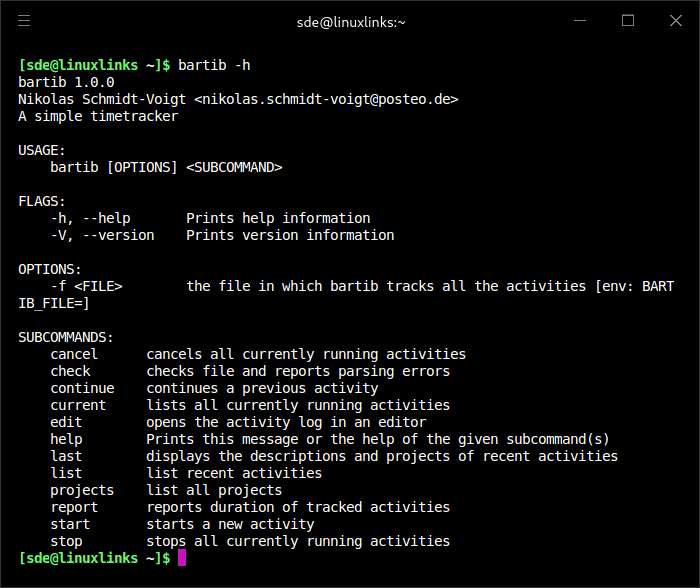
Bartib is a command-line time tracker that stores activity records in a human-readable plaintext file. It is designed to make recording working hours straightforward without depending on a database server or online account.
You can start tracking an activity by providing a description and an optional project name. When you begin another activity, Bartib automatically stops the previous one, making it easier to account for a day spent switching between different tasks.
The application can resume earlier activities, list recorded sessions and generate reports showing how time has been distributed between projects and tasks. Reports can be restricted to selected dates or periods, allowing you to review an individual working day or a longer project.
Bartib’s plaintext storage is particularly useful if you want to edit records manually, inspect them with ordinary command-line tools or keep them under version control. The application includes commands for editing and validating its activity log.
This is free and open source software.
Key Features
- Start and stop tracking activities with optional project names.
- Automatically stop the current activity when another begins.
- Resume recently recorded tasks without re-entering their descriptions.
- Generate reports summarising time spent on projects and activities.
- List recorded sessions for specific dates or time periods.
- Store activity records in a human-readable plaintext format.
- Edit time entries manually or through the application’s edit command.
- Validate activity logs to identify formatting or parsing errors.
- Supports configurable log file locations and shell completion.
- Offers an optional build feature for recording timestamps with second-level precision.
Website: github.com/nikolassv/bartib
Support:
Developer: Nikolas Schmidt-Voigt
License: GNU General Public License v3.0
Bartib is written in Rust. Learn Rust with our recommended free books and free tutorials
Related Software
| Terminal-Based Time Tracking | |
|---|---|
| doing | A CLI for a What Was I Doing system |
| Timewarrior | Records time and associates blocks of time with tags |
| Watson | Superb CLI to track your time |
| timetrap | Command line time tracker written in Ruby |
| timetrace | CLI to track working time supporting tags |
| arttime | Intriguing clock, timer, time manager with text art |
| tiempo | Stores entries as UTC |
| utt | Ultimate Time Tracker written in the Python programming language |
| Tock | Simple timetracker |
| Bartib | Simple timetracker |
| Timet | Time tracking gem with time reports |
| WorkTUImer | Keyboard-driven TUI for time-tracking |
| harsh | Habit tracking for geeks |
| arbtt | Automatic rule-base time tracker |
| Zeit | Track time spent on tasks and projects. |
| hours | No-frills time tracking |
| MyTimer | Geeky timer for terminal lovers |
| ctt | Time tracking for geeks |
| timr | TUI to organize your time |
| habitctl | Track and examine your habits |
| Tomat | Pomodoro timer |
| tmpo | Minimal CLI time tracker for developers |
| Productivity Timer | Pomodoro timer application for keyboard addicts and terminal fans |
| DevChron | TUI Pomodoro timer |
| Tmux Pomodoro Plus | Incorporate the Pomodoro technique |
| Y.A.c.H.T. | Habit tracker |
| timetracking | Simple utility to keep track of time |
| Timer-CLI | Very simple Python CLI tool to start a countdown timer |
| Taskmaster | Keep track of time worked and a simple todo list. |
| pomoru | Minimalist Pomodoro TUI |
| pom | Pomodoro timer |
| MatteriaTrack | Mystical Final Fantasy-themed CLI time tracker |
| fokus | Minimalist focus timer and stopwatch with daily logging |
| dijo | Scriptable, curses-based, digital habit tracker |
| Dayplan | Plan and track your time |
| cations | Build and maintain good habits through incremental progress |
Read our verdict in the software roundup.
 Explore our carefully curated directory of recommended free and open source software, covering every major software category. The directory forms part of our extensive collection of articles for Linux enthusiasts. It includes hundreds of detailed reviews, together with free and open source alternatives to proprietary software from companies such as Google, Microsoft, Apple, Adobe, IBM, Cisco, Oracle, and Autodesk. LinuxLinks also covers interesting projects worth exploring, Linux-compatible hardware, free programming books and tutorials, and much more. Know a useful free and open source Linux application that we haven’t covered? Tell us about it using our submission form. |
Please read our Comment Policy before commenting.