

dijo is a terminal-based habit tracker for recording recurring activities and examining personal progress. It uses a modal interface with keyboard controls inspired by Vim, making it particularly suitable for users already comfortable with terminal-based editors.
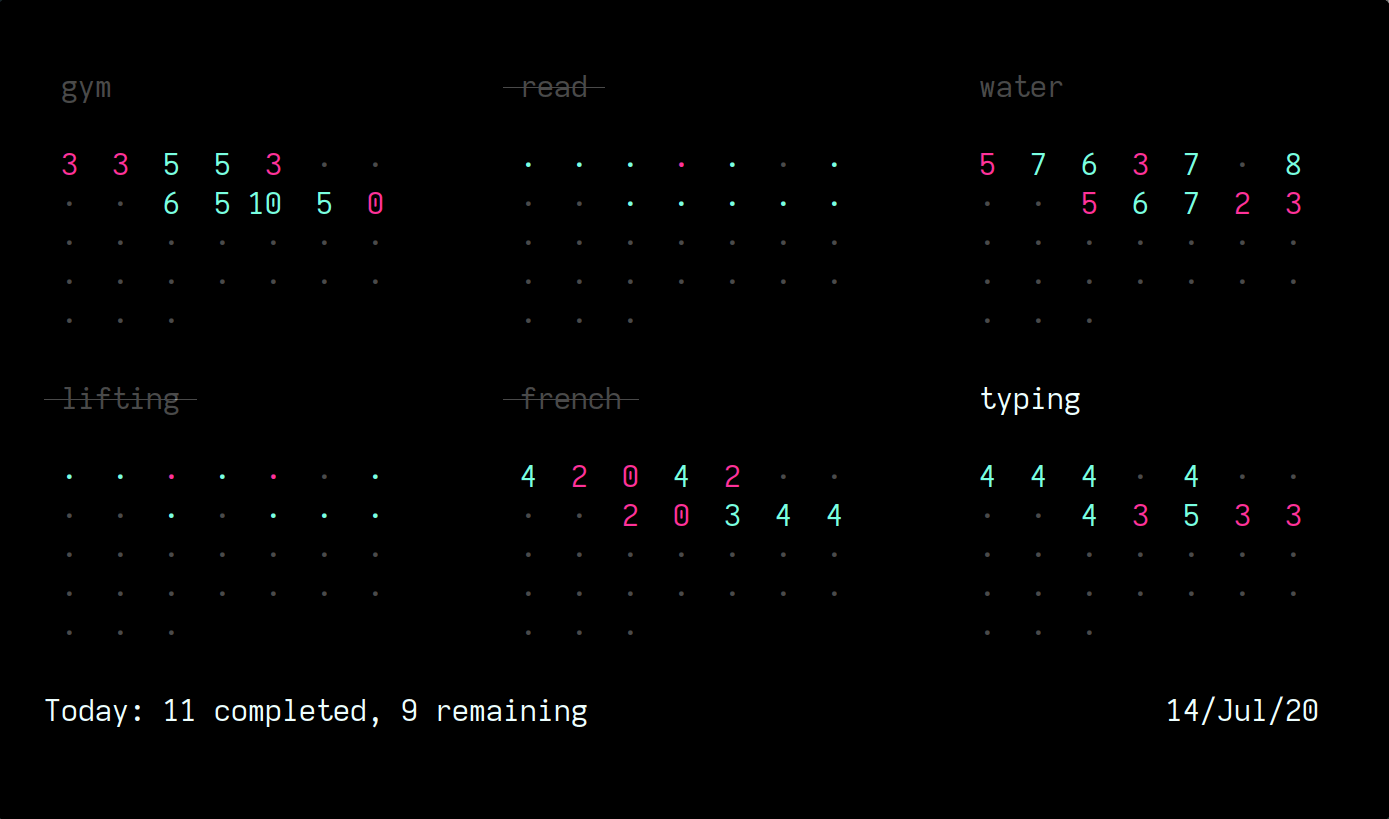
The application displays a calendar-style view of tracked habits, allowing users to examine their completion history and identify patterns over time. Its interface includes separate modes for navigating records and viewing statistical information.
Habits are managed through an interactive command mode. Users can create or remove activities and navigate between dates without switching to a graphical application.
A distinctive feature of dijo is its scripting support. The application can be connected to external programs so that selected activities are recorded automatically. This is useful for tracking actions that already produce information elsewhere, such as Git commits.
This is free and open source software.
Key Features
- Track recurring habits using a terminal-based interface.
- Display completion records in a calendar-style layout.
- Navigate between dates using Vim-style movement keys.
- Provide separate modes for examining daily and weekly information.
- Use an interactive command mode for managing habits.
- Add and remove tracked activities using commands.
- Display historical activity in monthly views.
- Configure the application’s behaviour and appearance.
- Connect external programs to automate habit recording.
- Track selected development activities through Git integration scripts.
- Operate without requiring a graphical desktop environment.
- Cross-platform support – runs on Linux and Windows.
Website: github.com/oppiliappan/dijo
Support:
Developer: Akshay Oppiliappan
License: MIT License
dijo is written in Rust. Learn Rust with our recommended free books and free tutorials
This article was contributed by a visitor who completed this form. Help the site by suggesting new open source software.
Related Software
| Terminal-Based Time Tracking | |
|---|---|
| doing | A CLI for a What Was I Doing system |
| Timewarrior | Records time and associates blocks of time with tags |
| Watson | Superb CLI to track your time |
| timetrap | Command line time tracker written in Ruby |
| timetrace | CLI to track working time supporting tags |
| arttime | Intriguing clock, timer, time manager with text art |
| tiempo | Stores entries as UTC |
| utt | Ultimate Time Tracker written in the Python programming language |
| Tock | Simple timetracker |
| Bartib | Simple timetracker |
| Timet | Time tracking gem with time reports |
| WorkTUImer | Keyboard-driven TUI for time-tracking |
| klog | Track working hours and activities using plain-text logs |
| harsh | Habit tracking for geeks |
| arbtt | Automatic rule-base time tracker |
| hours | No-frills time tracking |
| MyTimer | Geeky timer for terminal lovers |
| ctt | Time tracking for geeks |
| timr | TUI to organize your time |
| habitctl | Track and examine your habits |
| Tomat | Pomodoro timer |
| tmpo | Minimal CLI time tracker for developers |
| Productivity Timer | Pomodoro timer application for keyboard addicts and terminal fans |
| DevChron | TUI Pomodoro timer |
| Tmux Pomodoro Plus | Incorporate the Pomodoro technique |
| Y.A.c.H.T. | Habit tracker |
| timetracking | Simple utility to keep track of time |
| Timer-CLI | Very simple Python CLI tool to start a countdown timer |
| Taskmaster | Keep track of time worked and a simple todo list. |
| pomoru | Minimalist Pomodoro TUI |
| pom | Pomodoro timer |
| MatteriaTrack | Mystical Final Fantasy-themed CLI time tracker |
| fokus | Minimalist focus timer and stopwatch with daily logging |
| dijo | Scriptable, curses-based, digital habit tracker |
| Dayplan | Plan and track your time |
| cations | Build and maintain good habits through incremental progress |
Read our verdict in the software roundup.
 LinuxLinks helps you discover the best free and open source software for Linux. Explore our extensive collection of recommended applications, including alternatives to popular proprietary software. We also publish software reviews, Linux tutorials, hardware reviews, free programming books and articles covering the wider open source community. Browse our Linux resources to discover more. Know a useful free and open source Linux application we haven't covered? Suggest a program for inclusion. Has your software been featured on LinuxLinks? Display one of our Featured on LinuxLinks badges on your website or GitHub README. |
Please read our Comment Policy before commenting.