

tmpo is a command-line time tracking application designed for developers who regularly switch between projects. It aims to reduce the amount of manual organisation required when recording working time.
The software can identify project information from a Git repository or a local configuration file. This allows users to start recording time while working inside a project directory without repeatedly entering the same project details.
tmpo also supports globally defined projects that are not associated with a particular directory. These can represent activities such as meetings, administration or client work, making the application useful beyond software development.
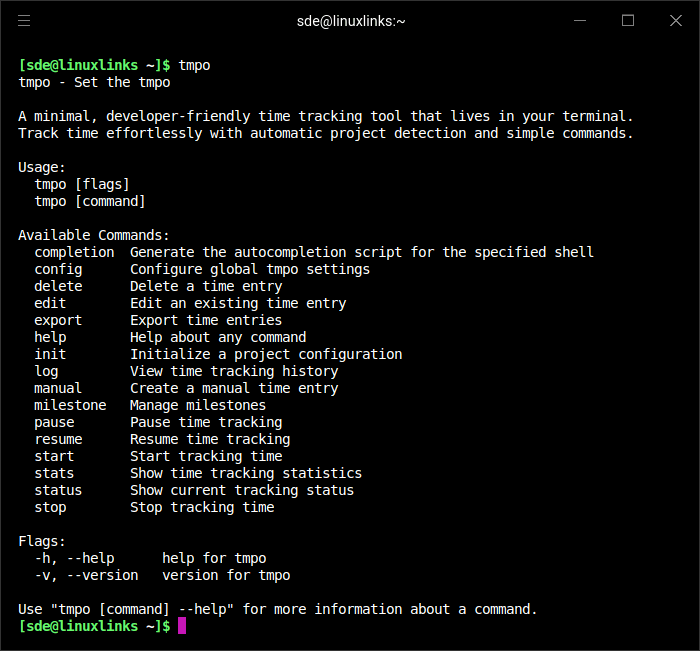
Time tracking records are stored locally in SQLite. The application provides commands for inspecting activity, generating reports and exporting information for further analysis. Its milestone system allows tracked work to be grouped into larger development phases such as sprints or releases.
This is free and open source software.
Key Features
- Start and stop time tracking sessions from the terminal.
- Automatically detect project names from Git repositories.
- Read project information from local configuration files.
- Define global projects that can be tracked from any directory.
- Associate descriptive information with tracked activities.
- Group recorded time into milestones and development phases.
- Store time records locally using SQLite.
- Inspect current tracking status and previously recorded activities.
- Generate statistics for projects and reporting periods.
- Export tracked time as CSV and JSON.
- Associate hourly rates with projects for reporting purposes.
- Configure preferred currencies, date formats, time formats and time zones.
- Create and restore database backups.
- Use project-specific and global configuration settings.
- Cross-platform support – runs on Linux, macOS, and Windows.
Website: github.com/DylanDevelops/tmpo
Support:
Developer: Dylan Ravel
License: MIT License
tmpo is written in Go. Learn Go with our recommended free books and free tutorials.
Related Software
| Terminal-Based Time Tracking | |
|---|---|
| doing | A CLI for a What Was I Doing system |
| Timewarrior | Records time and associates blocks of time with tags |
| Watson | Superb CLI to track your time |
| timetrap | Command line time tracker written in Ruby |
| timetrace | CLI to track working time supporting tags |
| arttime | Intriguing clock, timer, time manager with text art |
| tiempo | Stores entries as UTC |
| utt | Ultimate Time Tracker written in the Python programming language |
| Tock | Simple timetracker |
| Bartib | Simple timetracker |
| Timet | Time tracking gem with time reports |
| WorkTUImer | Keyboard-driven TUI for time-tracking |
| klog | Track working hours and activities using plain-text logs |
| harsh | Habit tracking for geeks |
| arbtt | Automatic rule-base time tracker |
| hours | No-frills time tracking |
| MyTimer | Geeky timer for terminal lovers |
| ctt | Time tracking for geeks |
| timr | TUI to organize your time |
| habitctl | Track and examine your habits |
| Tomat | Pomodoro timer |
| tmpo | Minimal CLI time tracker for developers |
| Productivity Timer | Pomodoro timer application for keyboard addicts and terminal fans |
| DevChron | TUI Pomodoro timer |
| Tmux Pomodoro Plus | Incorporate the Pomodoro technique |
| Y.A.c.H.T. | Habit tracker |
| timetracking | Simple utility to keep track of time |
| Timer-CLI | Very simple Python CLI tool to start a countdown timer |
| Taskmaster | Keep track of time worked and a simple todo list. |
| pomoru | Minimalist Pomodoro TUI |
| pom | Pomodoro timer |
| MatteriaTrack | Mystical Final Fantasy-themed CLI time tracker |
| fokus | Minimalist focus timer and stopwatch with daily logging |
| dijo | Scriptable, curses-based, digital habit tracker |
| Dayplan | Plan and track your time |
| cations | Build and maintain good habits through incremental progress |
Read our verdict in the software roundup.
 LinuxLinks helps you discover the best free and open source software for Linux. Explore our extensive collection of recommended applications, including alternatives to popular proprietary software. We also publish software reviews, Linux tutorials, hardware reviews, free programming books and articles covering the wider open source community. Browse our Linux resources to discover more. Know a useful free and open source Linux application we haven't covered? Suggest a program for inclusion. Has your software been featured on LinuxLinks? Display one of our Featured on LinuxLinks badges on your website or GitHub README. |
Please read our Comment Policy before commenting.