
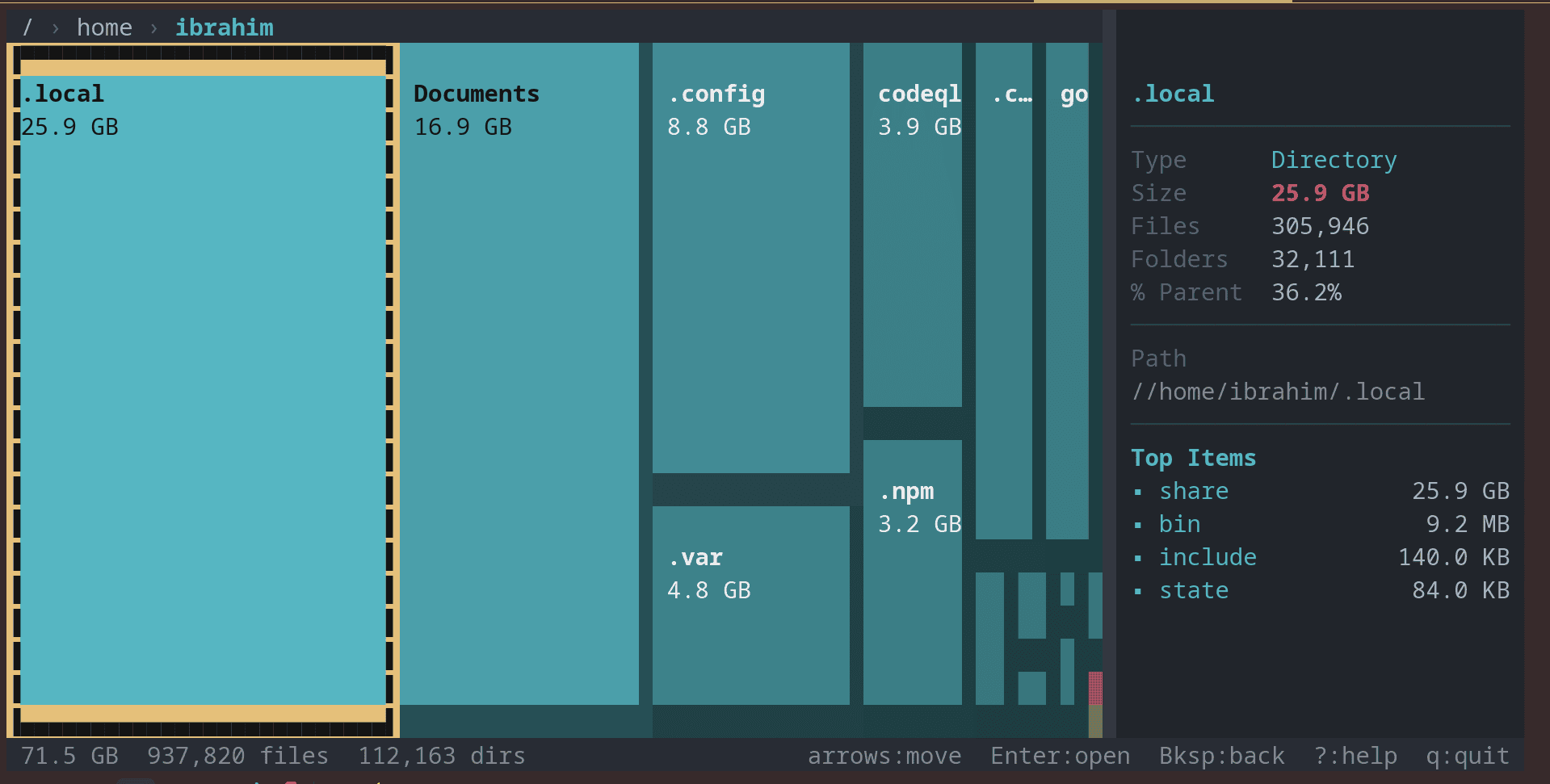
lintree is a terminal-based disk usage visualizer that helps identify files and directories consuming storage space. Instead of presenting a conventional list of directory sizes, it displays a colourful treemap, making it easier to recognise large files and storage-heavy folders at a glance.
The application brings a graphical style of disk analysis to the command line. It is particularly useful for administrators working over SSH, developers investigating large project directories, and anyone who prefers managing storage without launching a desktop application.
This is free and open source software.
Key Features
- Squarified treemap layout displays files and directories as proportional rectangular blocks.
- Colour-codes file types, including source code, documents, images, videos, audio files, archives, and binaries.
- Adjusts colour brightness according to file size, making larger items more prominent.
- Interactive navigation with arrow keys, Vim-style shortcuts, and mouse selection.
- Drill down into directories and return to parent folders without restarting the scan.
- Information sidebar displays file size, type, path, percentage of total usage, and largest children.
- Breadcrumb navigation identifies the current location within the directory hierarchy.
- Concurrent filesystem scanning uses a configurable number of workers based on available CPU resources.
- Fast scanning mode increases parallelism for quicker analysis at the expense of higher CPU usage.
- Repeatable exclusion rules support paths, filenames, and shell-style glob patterns.
- Automatically excludes virtual filesystems such as /proc, /sys, /dev, and /run.
- Displays a help overlay with available keyboard shortcuts.
- Cross-platform support – runs on Linux, macOS, and Windows.
Website: github.com/PatchMon/lintree
Support:
Developer: Muhammad Ibrahim
License: MIT License
lintree is written in Go. Learn Go with our recommended free books and free tutorials.
Related Software
| du alternatives | Programming Language | License |
|---|---|---|
| dust | Rust | Apache License 2.0 |
| duf | Go | MIT License |
| Duc | C | GNU Lesser General Public License v3 |
| Ncdu | C | GNU GPL v2.0 License |
| gdu | Go | MIT License |
| cull | Go | MIT License |
| dua | Rust | MIT License |
| erdtree | Rust | MIT License |
| pdu | Rust | Apache License 2.0 |
| vizex | Python | MIT License |
| godu | Go | MIT License |
| dutree | Rust | GNU General Public License v3 |
| space | Rust | MIT License |
| darya | Rust | GNU General Public License v3.0 |
| diskus | Rust | MIT License or Apache License 2.0 |
| NoxDir | Go | MIT License |
| mcdu | Rust | MIT License |
| dirstat-rs | Rust | MIT License |
| diskonaut | Rust | MIT License |
| bonsai | C++ | GNU General Public License v3.0 |
| diskard | Rust | MIT License or Apache License 2.0 |
| cdu | Perl | GNU General Public License v2.0 |
| tdu | Go | GNU General Public License v2 |
| duviz | Python | MIT License |
| dut | C | GNU General Public License v3.0 |
| whalespotter | Rust | MIT License |
| sn | Rust | BSD 3-Clause “New” or “Revised” License |
Read our verdict in the software roundup.
 LinuxLinks helps you discover the best free and open source software for Linux. Explore our extensive collection of recommended applications, including alternatives to popular proprietary software. We also publish software reviews, Linux tutorials, hardware reviews, free programming books and articles covering the wider open source community. Browse our Linux resources to discover more. Know a useful free and open source Linux application we haven't covered? Suggest a program for inclusion. Has your software been featured on LinuxLinks? Display one of our Featured on LinuxLinks badges on your website or GitHub README. |
Please read our Comment Policy before commenting.