

A container is an operating-system-level virtualization method for running multiple isolated Linux systems on a control host using a single Linux kernel. The container runs a set of processes isolated from the system, running from a distinct image that provides all the files necessary to support the processes.
There’s an important distinction between OS-level virtualization and virtualization. The former is often known as containers.
OS-level virtualization (containers) share the same operating system kernel and isolate the application processes from the rest of the system. For example: ARM Linux systems run ARM Linux containers, x86 Linux systems run x86 Linux containers, x86 Windows systems run x86 Windows containers. Linux containers are extremely portable, but they must be compatible with the underlying system.
Containers are different from Type 1 and 2 hypervisors. A Type 1 hypervisor is known as native or bare-metal. With this type, the hypervisor runs directly on the host’s hardware to control the hardware resources and to manage guest operating systems. In other words, the software hypervisor does not require an additional underlying operating system.
This article focuses on container managers, software which make it easy to find, run, build, share and deploy applications using open containers. We explore containers in a separate article.
Here’s our verdict captured in a legendary LinuxLinks-style ratings chart. Only free and open source software is eligible for inclusion here.
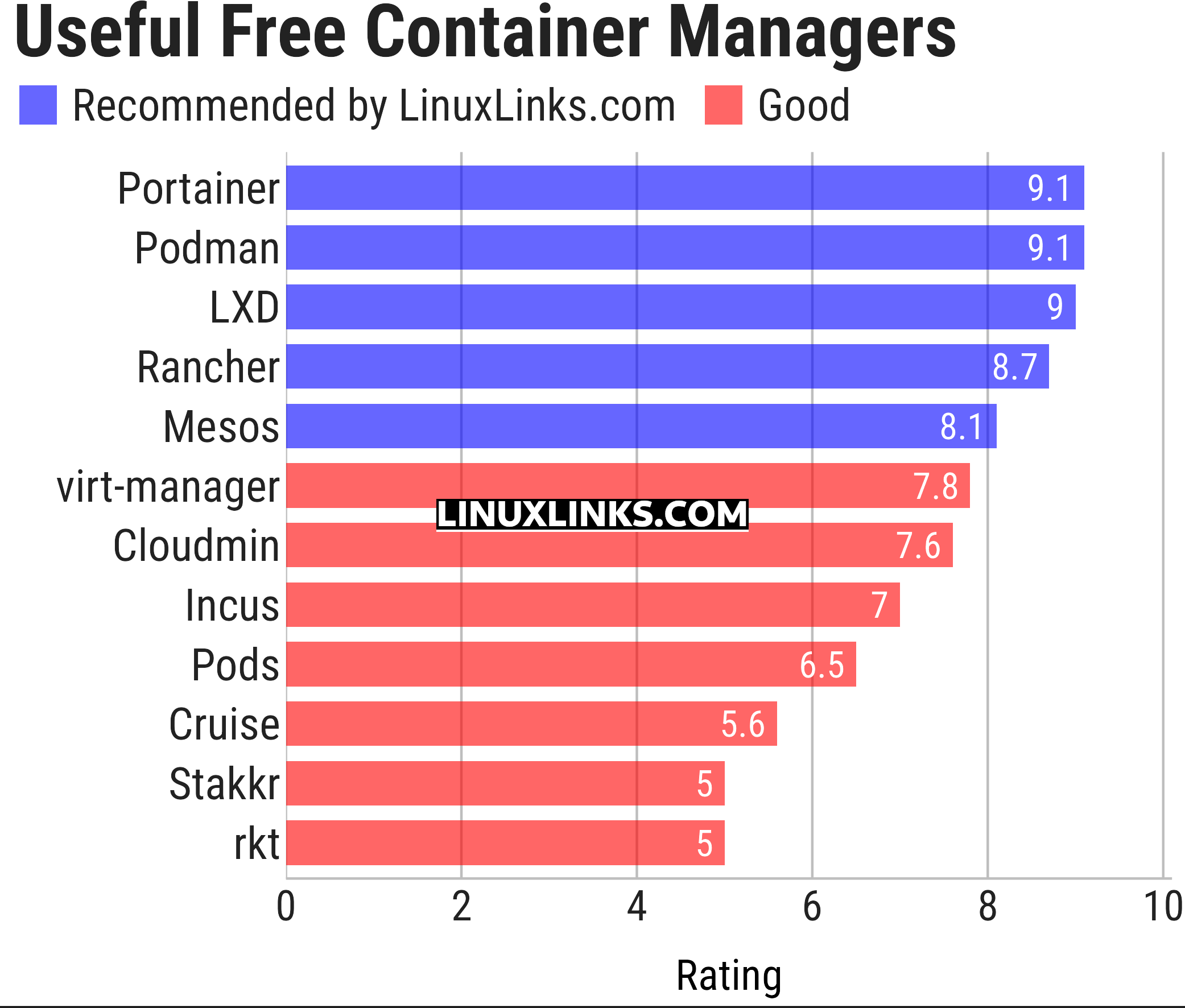
Let’s explore each of the container managers.
| Container Managers | |
|---|---|
| Portainer | Lightweight and easy to use management UI |
| Podman | Tool for managing OCI containers and pods |
| LXD | Manage virtual machines and containers |
| Rancher | Container management platform |
| Mesos | Cluster manager |
| virt-manager | Desktop tool for managing virtual machines via libvirt |
| Cloudmin | Manage virtual systems running virtualization technology |
| Incus | Modern, secure and powerful system container and virtual machine manager |
| Pods | Manage your Podman containers |
| Cruise | Docker TUI client |
| Stakkr | Docker recompose tool |
| rkt | Application container engine |
This article has been updated to reflect the changes outlined in our recent announcement.
 Explore our comprehensive directory of recommended free and open source software. Our carefully curated collection spans every major software category. Explore our comprehensive directory of recommended free and open source software. Our carefully curated collection spans every major software category.This directory is part of our ongoing series of informative articles for Linux enthusiasts. It features hundreds of detailed reviews, along with open source alternatives to proprietary solutions from major corporations such as Google, Microsoft, Apple, Adobe, IBM, Cisco, Oracle, and Autodesk. You’ll also find interesting projects to try, hardware coverage, free programming books and tutorials, and much more. Know a useful open source Linux program that we haven’t covered yet? Let us know by completing this form. |