

Dalfox is a command-line security testing tool designed to identify cross-site scripting (XSS) vulnerabilities in web applications. It combines automated parameter analysis with vulnerability testing to help security professionals investigate potentially unsafe input handling.
The software examines HTTP parameters and other request components, using analysis and testing techniques to identify possible injection points. It supports testing for reflected, stored and DOM-based XSS vulnerabilities, with additional verification facilities for reducing false positives.
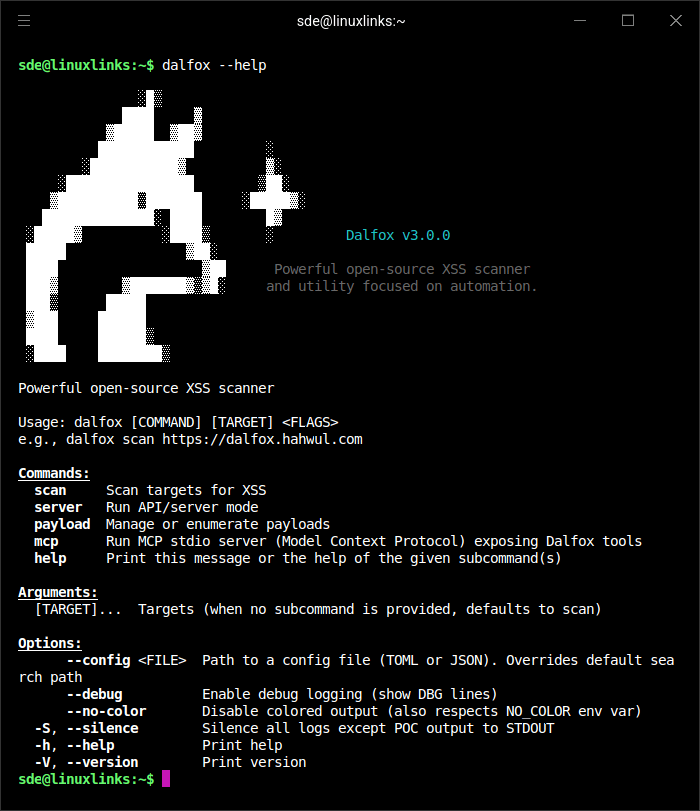
Dalfox can scan individual URLs, process lists of targets and read input from pipelines. Its configurable HTTP handling supports custom headers, cookies, proxy settings and payloads, making it suitable for both manual assessments and automated security workflows.
It also provides web application firewall fingerprinting, multiple report formats and interfaces for integration with other security testing tools.
This is free and open source software.
Key Features
- Test web applications for reflected, stored and DOM-based XSS vulnerabilities.
- Analyse parameters and discover potential injection points.
- Use static analysis and parameter mining during discovery.
- Verify potential findings through DOM and AST analysis.
- Identify web application firewalls through fingerprinting.
- Support custom HTTP headers, cookies, methods and proxy settings.
- Process individual URLs, files and piped input.
- Use custom payloads and remote wordlists.
- Generate reports in JSON, JSONL, Markdown, SARIF and other formats.
- Provide server and MCP interfaces for integration with other tools.
- Support automation through command-line and REST interfaces.
Website: github.com/hahwul/dalfox
Support:
Developer: HAHWUL
License: MIT License
Dalfox is written in Rust. Learn Rust with our recommended free books and free tutorials.
Related Software
| Vulnerability Detection Tools | |
|---|---|
| sqlmap | Automates testing and exploitation of SQL injection flaws |
| Nuclei | Fast and customisable vulnerability scanner |
| OpenVAS | Full-featured vulnerability scanner |
| Nikto | Web server scanner |
| OWASP ZAP | Popular web application security scanner and penetration testing proxy |
| Vuls | Agentless security scanner for Linux, FreeBSD and network environments |
| Tsunami | Extensible network security scanner for identifying exposed services |
| OSV-Scanner | Scans projects and dependencies against the OSV database |
| grype | Vulnerability scanner for container images and filesystems |
| Dalfox | Fast command-line tool for analysing and exploiting XSS flaws |
| Wapiti | Black-box web application scanner with broad attack coverage |
| testssl.sh | Tests TLS/SSL services, protocols, ciphers and cryptographic weaknesses |
| jSQL Injection | Java tool for automatically testing and exploiting SQL injection flaws |
| sif | Penetration testing suite combining reconnaissance and exploitation tools |
| XSSer | Automates testing, exploitation and reporting of cross-site scripting flaws |
| Terrapin | Terrapin Vulnerability Scanner for the Terrapin attack |
| Trivy | Comprehensive and versatile security scanner |
Read our verdict in the software roundup.
| Security Testing | |
|---|---|
| ZAP | Web app scanner |
| mitmproxy | Interactive HTTPS proxy |
| ffuf | Fast web fuzzer for discovering hidden paths, virtual hosts and parameters |
| Wfuzz | Web application fuzzer and Python library for security assessments |
| sqlmap | Penetration testing tool |
| Dalfox | Identify cross-site scripting vulnerabilities in web applications |
| Commix | Python-based penetration testing tool |
| jwt_tool | Toolkit for auditing JSON Web Tokens and testing security weaknesses |
Read our verdict in the software roundup.
 Explore our carefully curated directory of recommended free and open source software, covering every major software category. Explore our carefully curated directory of recommended free and open source software, covering every major software category.The directory forms part of our extensive collection of articles for Linux enthusiasts. It includes hundreds of detailed reviews, together with free and open source alternatives to proprietary software from companies such as Google, Microsoft, Apple, Adobe, IBM, Cisco, Oracle, and Autodesk. LinuxLinks also covers interesting projects worth exploring, Linux-compatible hardware, free programming books and tutorials, and much more. Know a useful free and open source Linux application that we haven’t covered? Tell us about it using our submission form. |
Please read our Comment Policy before commenting.