

SystemRescue, formerly known as SystemRescueCd, is a Linux system rescue toolkit that runs from a bootable medium and is designed for administrating, repairing, and recovering systems after a crash.
It provides a practical environment for partitioning disks, working with filesystems, copying data from damaged or unbootable machines, and carrying out general recovery tasks on desktops and servers.
Key Features
- Runs as a bootable rescue environment from CD, DVD, or USB media.
- Includes system utilities such as GNU Parted, GParted, FSArchiver, ddrescue, ntfs-3g, TestDisk, and rsync.
- Supports Linux and Windows computers, with access to filesystems including ext4, XFS, Btrfs, VFAT, and NTFS.
- Provides networking tools, editors, Midnight Commander, filesystem tools, and diagnostics for recovery work.
- Offers advanced options including PXE booting, YAML configuration, autorun scripts, backing-store support, and custom live images.
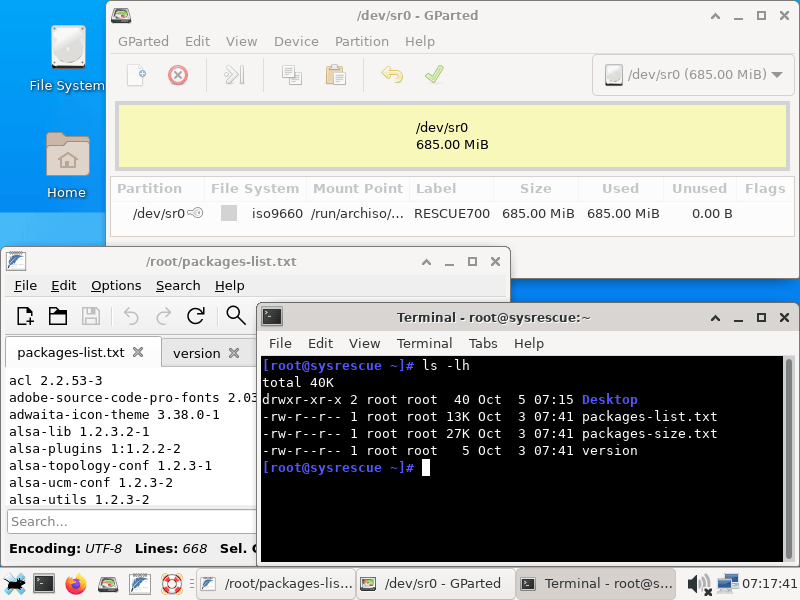
| Working state: | Active |
| Desktop: | Xfce |
| Init Software: | systemd |
| Package Management: | Pacman |
| Release Model: | Fixed |
| Platforms: | x86_64 |
| Home Page: | https://www.system-rescue.org/ |
| Developer: | François Dupoux |
| This article is part of our Big List of Active Linux Distributions and Open Source Operating Systems. |
What's a Linux distribution ("distro")? |
| A distro provides the user with a desktop environment, preloaded applications, and ways to update and maintain the system. Each distro makes different choices, deciding which open source projects to install and provides custom written programs. They can have different philosophies. Some distros are intended for desktop computers, some for servers without a graphical interface, and others for special uses. Because Linux is an open source operating system, combinations of software vary between Linux distros. |
Please read our Comment Policy before commenting.