

There’s a huge raft of free and open source music software available on the Linux platform which is both mature and sophisticated. Linux has many music tools which offer enhanced functionality and integration with internet music services. With most desktop environments having several audio players, together with cross-platform applications, integrated media players, there is a plethora of music players to choose from.
Like many types of software, the selection of a favorite music player is, to some extent, dependent on personal preferences. Nevertheless, we are confident that the applications featured in this article represent the most appealing music players.
All music libraries are different, and the right open source music player can make a world of difference – especially if you’ve a large collection.
 Terminal-based applications are light on system resources (very useful on low specified machines), are often faster and more efficient than their graphical counterparts, they do not stop working when X/Wayland is restarted, and are perfect for scripting purposes. When designed well, terminal-based programs offer a surprisingly improvement in productivity. The applications are leaner, faster, easier to maintain, and remove the need to install a whole raft of libraries.
We recommend the following software. All of the programs featured in this article are open source.
We cover the finest free and open source graphical music players in this roundup.
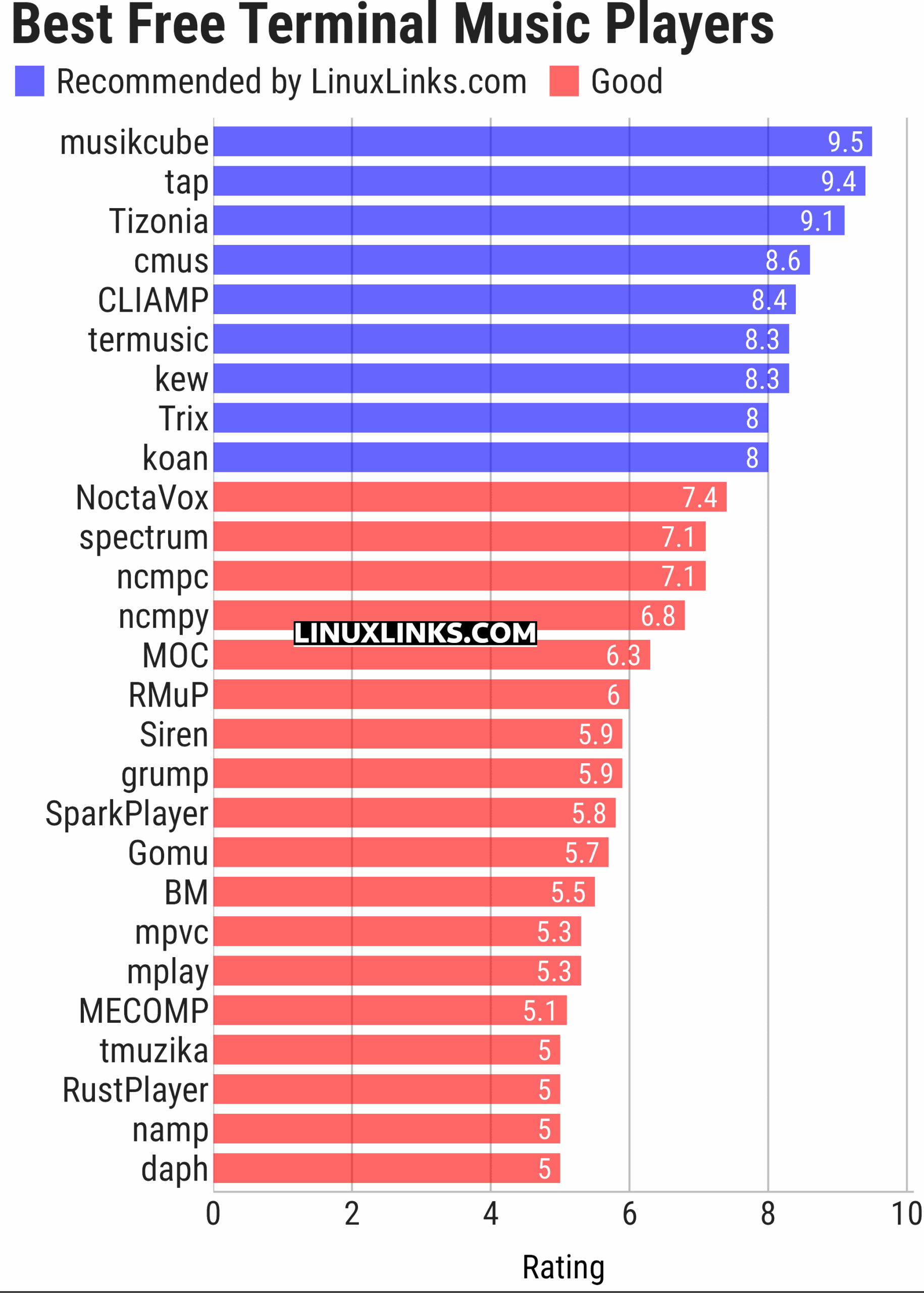
Let’s explore the 27 terminal-based music players. Click the links in the table below to read each review.
| Terminal-Based Music Players | |
|---|---|
| musikcube | Sublime audio engine, library, player and server written in C++ |
| tap | The lightest music player with gapless playback |
| Tizonia | Powerful cloud music player based on OpenMAX IL 1.2 written in C and C++ |
| cmus | Great set of features including the essential gapless playback |
| CLIAMP | Winamp-inspired retro player bursting with nostalgic character |
| termusic | Music Player TUI written in Rust |
| kew | Music player written in C |
| Trix | Straightforward Linux player with a clean design and low overhead |
| koan | Purist audio player created for focused, high-fidelity listening |
| NoctaVox | Atmospheric local library player with fluid, intuitive navigation |
| spectrum | Simple and intuitive music player for tech enthusiasts |
| ncmpc | Frugal Music Player Daemon client |
| ncmpy | Music Player Daemon client |
| MOC | Designed to be powerful and easy to use |
| RMuP | Simple music player lacking gapless playback |
| Siren | Extremely frugal with system resources |
| grump | CLI audio player written in Go |
| SparkPlayer | Eye-catching media player blending rich visuals with easy playback |
| Gomu | Another Go music player |
| BM | Distraction-free player with crisp controls and a deliberately sparse UI |
| mpvc | mpc-like control interface for mpv |
| mplay | No-fuss command-line player for launching tracks in an instant |
| MECOMP | Ambitious library player with flexible playback and organisation |
| tmuzika | Lean, responsive player for browsing albums and queuing tracks |
| RustPlayer | Audio and radio player written in Rust |
| namp | Keyboard-led audio player with playlists and vivid visual effects |
| daph | Sleek text-based player built for speed and effortless control |
This article has been updated to reflect the changes outlined in our recent announcement.
 Explore our carefully curated directory of recommended free and open source software, covering every major software category. Explore our carefully curated directory of recommended free and open source software, covering every major software category.The directory forms part of our extensive collection of articles for Linux enthusiasts. It includes hundreds of detailed reviews, together with free and open source alternatives to proprietary software from companies such as Google, Microsoft, Apple, Adobe, IBM, Cisco, Oracle, and Autodesk. LinuxLinks also covers interesting projects worth exploring, Linux-compatible hardware, free programming books and tutorials, and much more. Know a useful free and open source Linux application that we haven’t covered? Tell us about it using our submission form. |
Please read our Comment Policy before commenting.
rmpc is a good alternative to ncmpcpp/py (in rust, with ratatui)
also waves is nice
cmus has nice scripting possibilities
mpc I haven’t tried.
waves is AI slop
cmus is already listed.
ah yes sorry, missed cmus 🙂
indeed waves have been claude-d or whatever, but i was in touch with the dev to fix some bugs for freebsd and he was pretty nice, i guess i sort of gave up fighting against ai, sadly
maybe rmpc is also ai slop?
kew is really cool, i think i got the hint from this website.
when you say “he was pretty nice” you mean Claude fixed the bugs; the bugs it wrote in the first place. lol
rmpc is definitely not an Ai-generated or vibe-coded project. In fact there is no explicit AI activity at all, there were a couple of Copilot PR but they weren’t even merged into the codebase. It’s definitely a human-engineered project.
“kew is cool” TM.
I looked at the issue you raised hern42. You were talking to Claude throughout as it wrote each response, probably 100% of the text of each response, maybe a little human editing.
Thanks for your suggestions hern42.
We did consider waves but decided not to include it given the extensive AI usage.
Our roundups are not intended to include every tool. This one probably has already too many, and maybe the MPD clients shouldn’t be listed here as there is a separate roundup for them. So a bit of overlap.
There are other music players that deliberately were omitted such as mpv-music and cplay-ng. But if they improve they might get added.
Are projects written using AI excluded from LL? Do you have an AI policy?
Hi Craig.
I don’t automatically exclude simply because AI is used during development of an app. It is often difficult to determine how much of a codebase is written by AI, and many developers now use AI tools alongside conventional development methods. A good chunk of developers are using AI to help write their code and not disclosing that.
We don’t currently have a formal published AI policy. I tend to judge projects on their merits: whether they are useful, genuinely open source (i.e. OSI-compatible license), actively maintained, and of sufficient quality to recommend.
A project consisting largely of unreviewed AI-generated code, misleading claims or low-quality output won’t be included, but AI assistance by itself is not a reason for exclusion.
Linus Torvalds seems pretty relaxed about AI; Linux is not an anti-AI project.
Yes, he’s changed his tune.