

Linux offers a huge range of free and open source music software, much of it mature, powerful, and actively developed. Many Linux music players include advanced features and integrate smoothly with online music services. Most desktop environments already come with one or more audio players, and there are also many excellent cross-platform and standalone options available. With so many choices, Linux users are genuinely spoiled when it comes to music players.
Every music collection is different, and choosing the right open source music player can make a real difference to how you enjoy your library, particularly if you manage a large collection of music.
Astra is a music player designed for playing local music files, whether your collection consists of FLAC, MP3, or other common audio formats. What began as a side project it aims to produce a capable application featuring a native C++ digital signal processing engine, real-time audio visualizers, multichannel audio remapping, and Dolby Atmos decoding support. It’s free and open source too. Sounds tantalizing.
Installation
I wanted to evaluate Astra with Manjaro, an Arch-based Linux distribution, installing the software with Pamac. The project also provides binaries for Windows and macOS, but my testing is limited in Linux.
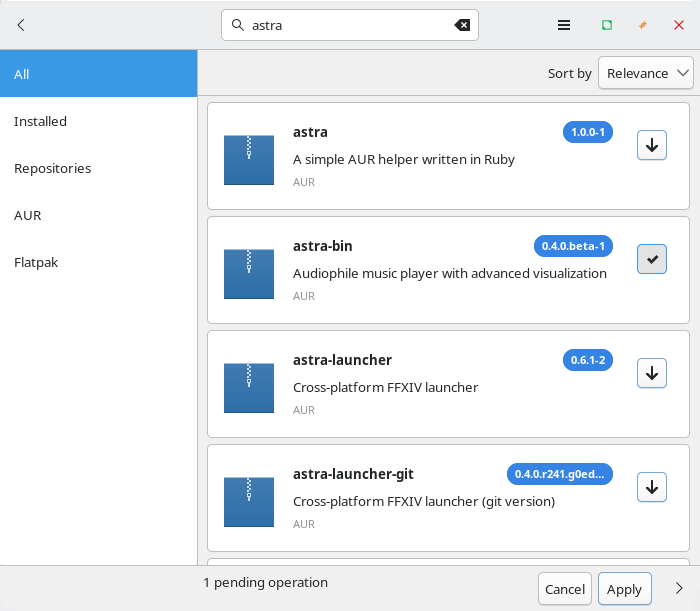
You’ll note there are a few different programs with the same name. I wish projects would not duplicate names.
The AUR package simply installs an AppImage and a symbolic link. If you’re running a Debian/Ubuntu-based distro, you’ll be better off installing the project’s deb package.
The AppImage fails to launch. Rather than waste time investigating if that’s a local issue, I moved over to Ubuntu and installed the deb package.
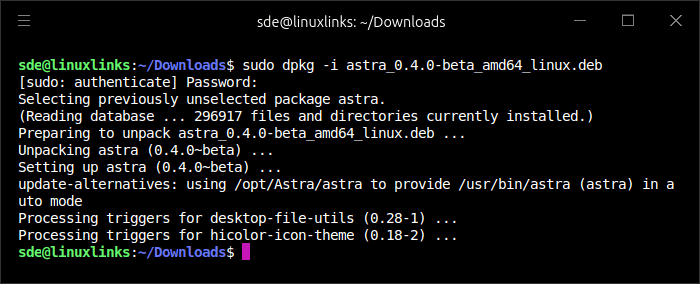
As the program starts with no fuss under Ubuntu, I evaluated the program under Ubuntu only.
In Operation
I’m showing an image of Astra with its default configuration. I’ve simply added a small collection of music.
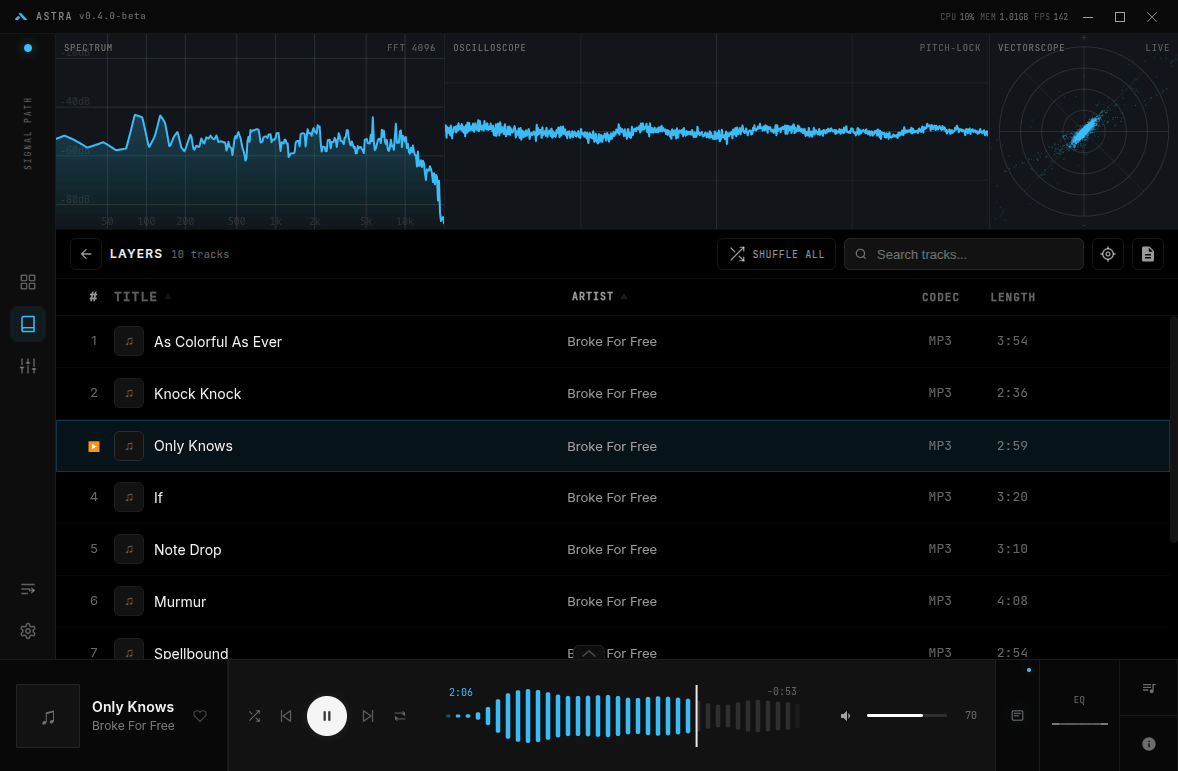
By default, a significant chunk of the UI is taken up with the program’s real-time visualizers. There’s a spectrum analyzer, oscilloscope, and even a vectorscope. They can be ‘popped’ out of the interface but can’t currently be removed. The developer is planning to make them optional which makes a lot of sense, as many users will just find them a real distraction.
The player supports a wide range of audio formats including MP3, FLAC, WAV, OGG, AAC, M4A, OPUS, WMA, and AIFF, with FFmpeg fallback support for additional codecs
Other Features
- Native C++ DSP engine for audio processing.
- Fully parametric equalizer with up to 10 bands and live frequency response graph.
- Import support for AutoEQ headphone calibration profiles.
- Automatic music library scanning with metadata extraction and artwork detection.
- Searchable library with browsing by artist, album, and track.
- Multichannel audio remapping and Dolby Atmos decoding.
- Output device selection, loudness normalization, and delay calibration.
- Built-in metadata editor for correcting tags within the player.
Summary
Astra is quite different from a typical Linux music player and shows promise. However, it currently suffers from several significant issues. For example, I am experiencing audio glitches during playback, and gapless playback does not work properly. There are noticeable gaps between tracks when playing FLAC albums. I tested both local files and music stored on a network, and the problem occurs in both cases.
The program is also extremely CPU intensive and uses a large amount of memory, exceeding 670MB of RAM. This is likely due in part to its use of Electron, a framework often regarded as inefficient compared to native applications.
I’ve compiled a long list of things that need fixing some of which are just cosmetic (and remember the project is in beta, so I’d expect problems). I won’t be adding them as issues on the project’s GitHub, as the developer would be best placed getting the fundamentals right (i.e. playback) and reducing system resource usage. However, it’s probably too late to move away from Electron at this stage.
Some of the program is written with the help of AI but this does not appear to be a vibe-coded project. AI assistance is getting more common these days in any event.
Website: github.com/boof2015/astra
Support:
Developer: Boof2015
License: GNU General Public License v3.0
Astra is written in TypeScript. Learn TypeScript with our recommended free books and free tutorials.
Related Software
| Graphical Music Players | |
|---|---|
| fooyin | Customizable music player similar to foobar2000 |
| Tauon | Python-based music player that's an absolute gem |
| Strawberry | Music player and collection organizer originally forked from Clementine |
| Rhythmbox | Integrated music management application, originally inspired by iTunes |
| Sayonara Player | Small, clear and fast music player written in C++ |
| Audacious | XMMS-like skinnable player |
| Exaile | Music player aiming to be similar to KDE's Amarok, but for GTK+ |
| DeaDBeeF | Basic and simple player with a small footprint. |
| Clementine | Modern music player and library organiser. Inspired by Amarok |
| Lollypop | Modern music player for GNOME |
| Amarok | KDE audio player offering a wealth of features, yet intuitive to use |
| Musique | Small but sophisticated graphical music player |
| Cantata | Feature-rich client for Music Player Daemon |
| Quod Libet | GTK+-based music management program |
| GogglesMM | Polished music collection manager and player |
| Aqualung | Advanced, gapless Gtk2-based audio player |
| MusicPod | Music, podcast and internet radio player |
| gmusicbrowser | Music jukebox for large collections |
| Yarock | Qt music player with browsing based on cover art |
| qoob | A foobar-like music player |
| GNOME Music | Simple music player |
| Soul Player | Local-first music player built for privacy |
| Pragha | Distinguished and resplendent open source music player |
| Hummingbird | Rust-based music player with basic functionality |
| Deepin Music | Visually attractive and simple music player |
| Musicat | Music player for your local music library |
| Musicalypse | Music player and server built with Web technologies |
| Melody | Music player designed for elementary OS |
| Elisa | Simple music player developed by the KDE community |
| QMPlay2 | Video and audio player which can play most formats and codecs |
| Tomahawk | Qt-based music player |
| mtoc | Visually-rich music player and library browser |
| FolderPlay | Minimalist music player for local music collections |
| Daphne | Audio player and music library manager |
| Ratic | Basic offline music player |
| Musik | Lightweight audio player built for the KDE Plasma desktop |
| Kalorite | Lightweight audio player |
| Astra | Billed as an audiophile music player |
Read our verdict in the software roundup.
 Explore our carefully curated directory of recommended free and open source software, covering every major software category. Explore our carefully curated directory of recommended free and open source software, covering every major software category.The directory forms part of our extensive collection of articles for Linux enthusiasts. It includes hundreds of detailed reviews, together with free and open source alternatives to proprietary software from companies such as Google, Microsoft, Apple, Adobe, IBM, Cisco, Oracle, and Autodesk. LinuxLinks also covers interesting projects worth exploring, Linux-compatible hardware, free programming books and tutorials, and much more. Know a useful free and open source Linux application that we haven’t covered? Tell us about it using our submission form. |
Please read our Comment Policy before commenting.
Is this program just AI slop?
Maybe not, nowadays experienced developers are using Claude etc as a more sophisticated stackoverflow. They know how to code, just it’s quicker to look something up with an AI bot.
A significant chunk of the commits are by the AI bot though.