

LinuxLinks, like most modern websites, is dynamic in that content is stored in a database and converted into presentation-ready HTML when readers access the site.
While we employ built-in server caching which creates static versions of the site, we don’t generate a full, static HTML website based on raw data and a set of templates. However, sometimes a full, static HTML website is desirable. Because HTML pages are all prebuilt, they load extremely quickly in web browsers.
There are lots of other advantages of running a full, static HTML website.
Here are some of the main advantages:
- Less software is needed to produce a static site. A small software stack can improve security. Static sites do not contain dynamic content, and are therefore immune to most common attacks;
- Obsolescence. Running a dynamic site relies on a content management system that constantly needs to be updated. The foundations of a dynamic site changes over time;
- Cost – every time a visitor accesses a page, a set of database queries are made with dynamic sites. While caching reduces these queries, there are always pages that aren’t in the cache or need to be refreshed. With a static site, the load on the server is considerably reduced;
- Previewable – as static sites are developed locally, you can play around with the site to your heart’s content without affecting the live site;
- A static site means that data is easier to export than if it’s contained within a database;
- Versionable – ideal to be used with version control system, such as Git.
A static site works very well in certain use cases. For example, it’s great for documentation. And static sites can be just as engaging as dynamic sites. The only real difference is that all the HTML is generated before being uploaded.
To provide an insight into the quality of software that is available, we have compiled a list of 7 best OCaml static site generators. All of these tools are released under a freely distributable license. Here’s our verdict.
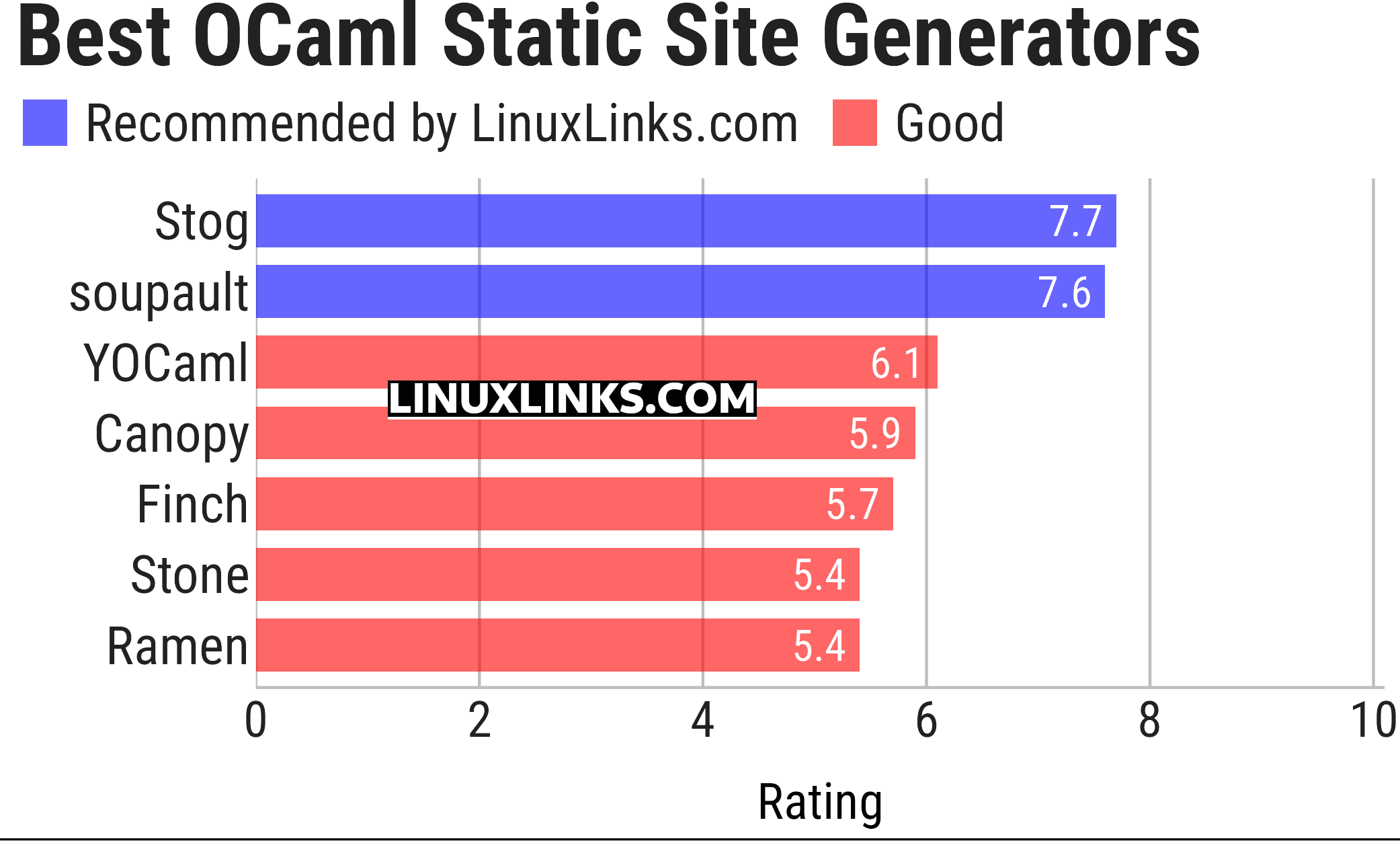
Let’s explore the 7 static site generators at hand. For each application we have compiled its own portal page, a full description with an in-depth analysis of its features, together with links to relevant resources.
| OCaml Static Site Generators | |
|---|---|
| Stog | Static web site compiler supporting blog posts, plugins, and multi-language sites |
| soupault | Static website generator/framework |
| YOCaml | Build systems in OCaml |
| Canopy | Git-blogging unikernel with HTTPS/TLS support |
| Finch | Simple and fast site generator |
| Stone | Another site generator designed to generate simple websites |
| Ramen | Type-safe static site generator |
This article has been updated to reflect the changes outlined in our recent announcement.
 LinuxLinks helps you discover the best free and open source software for Linux. Explore our extensive collection of recommended applications, including alternatives to popular proprietary software. We also publish software reviews, Linux tutorials, hardware reviews, free programming books and articles covering the wider open source community. Browse our Linux resources to discover more. Know a useful free and open source Linux application we haven't covered? Suggest a program for inclusion. Has your software been featured on LinuxLinks? Display one of our Featured on LinuxLinks badges on your website or GitHub README. |
Please read our Comment Policy before commenting.
I have a static site generator built entirely in ocaml.
Mod — Link removed, please see the Comment FAQ. We have a form to complete for software submissions. There’s a link on every page.