
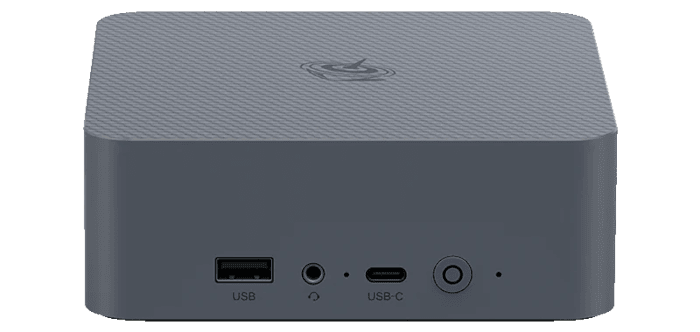
This is a new series looking at the Beelink EQi Core 3 304 mini PC running Linux. In this series, I’ll put the Beelink mini PC through its paces from a Linux perspective, comparing it with other systems to see how it performs in real-world Linux use.
The Beelink EQi Core 3 304 is a recent addition to Beelink’s EQ range of compact PCs. It’s built around Intel’s Wildcat Lake Core 3 304 processor, a 5-core, 5-thread chip comprising one performance core and four low-power efficiency cores. The processor integrates Xe3-LPG graphics and currently has a CPU Mark of 11,720. The review unit comes with 16GB of LPDDR5 6400MT/s memory and 512GB of UFS 3.1 storage, giving the system a capable hardware base for everyday desktop use, office work, media playback and lighter Linux workloads.
In this article, I benchmark the Beelink EQi 304 across a range of tests, most of which are run using the Phoronix Test Suite. Together with the Beelink EQi 304, I’ve run the same benchmarks on a few other machines to put the results into context. Note the N100 machine is much cheaper than the other machines. It’s included simply to put the performance improvement offered by the higher-specification machines into perspective.
Each machine is tested with the same software stack and configured to keep the results as consistent as possible. Power-saving features are disabled during benchmarking. Where the BIOS offers power-limit options, I select Performance Mode. I also apply every relevant performance setting, including using the performance governor, minimizing background processes, and running without Wayland unless a graphics benchmark requires it.
Let’s begin with a variety of processor benchmarks.
$ phoronix-test-suite benchmark smallpt
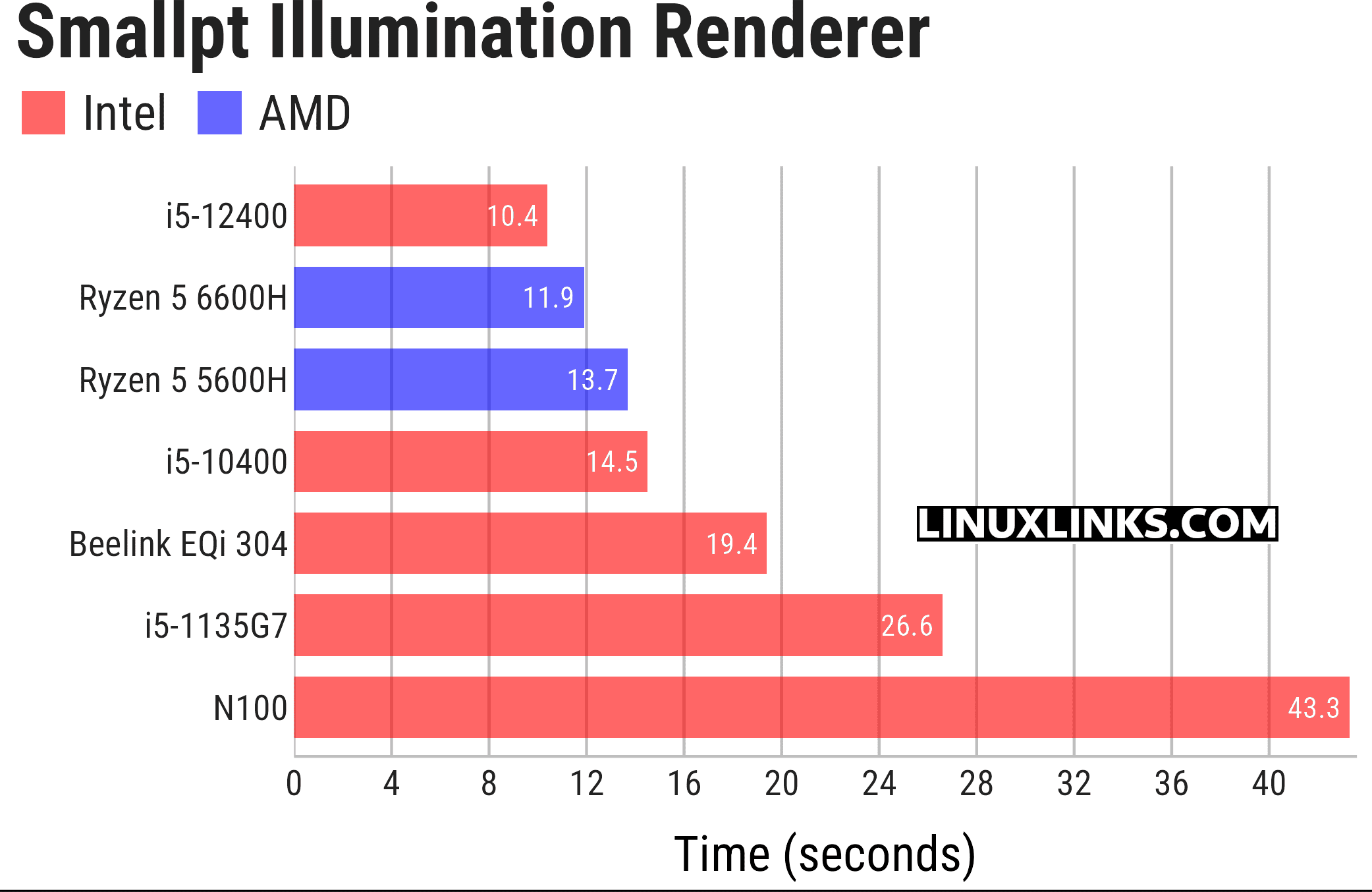
Smallpt is a C++ global illumination renderer written in fewer than 100 lines of code. It performs unbiased Monte Carlo path tracing and supports multi-threading via OpenMP. As this benchmark can use all CPU cores, processors with more cores complete the test considerably quicker.
The Beelink completes the rendering workload in 19.4 seconds, compared with 43.3 seconds for the Intel N100. It therefore finishes in 55% less time, equivalent to roughly 2.23 times the performance.
This is a much larger uplift than the modest difference in core count might suggest. The N100 relies on four efficiency cores, whereas the Core 3 304 combines four efficiency cores with a considerably faster performance core. That hybrid design gives the Beelink much stronger processing capability while retaining a low power envelope.
The Core 3 304 also comfortably beats the older Core i5-1135G7 system, reducing the rendering time from 26.6 to 19.4 seconds.
Its result is less impressive against the Core i5-10400. Despite the two processors achieving broadly comparable overall PassMark scores, the i5-10400 completes the test in 14.5 seconds, around 25% less time than the Beelink. Smallpt is a sustained, heavily multithreaded workload that favours the i5-10400’s six full-performance cores and twelve threads. By comparison, the Core 3 304 has only five threads and operates within a much lower power envelope.
Overall, its performance sits well above entry-level N-series processors and approaches that of older mainstream desktop and mobile CPUs.
$ phoronix-test-suite benchmark openssl
OpenSSL is an open-source cryptography toolkit best known for implementing TLS, and historically SSL, protocols. This test profile makes use of the built-in “openssl speed” benchmarking capabilities.
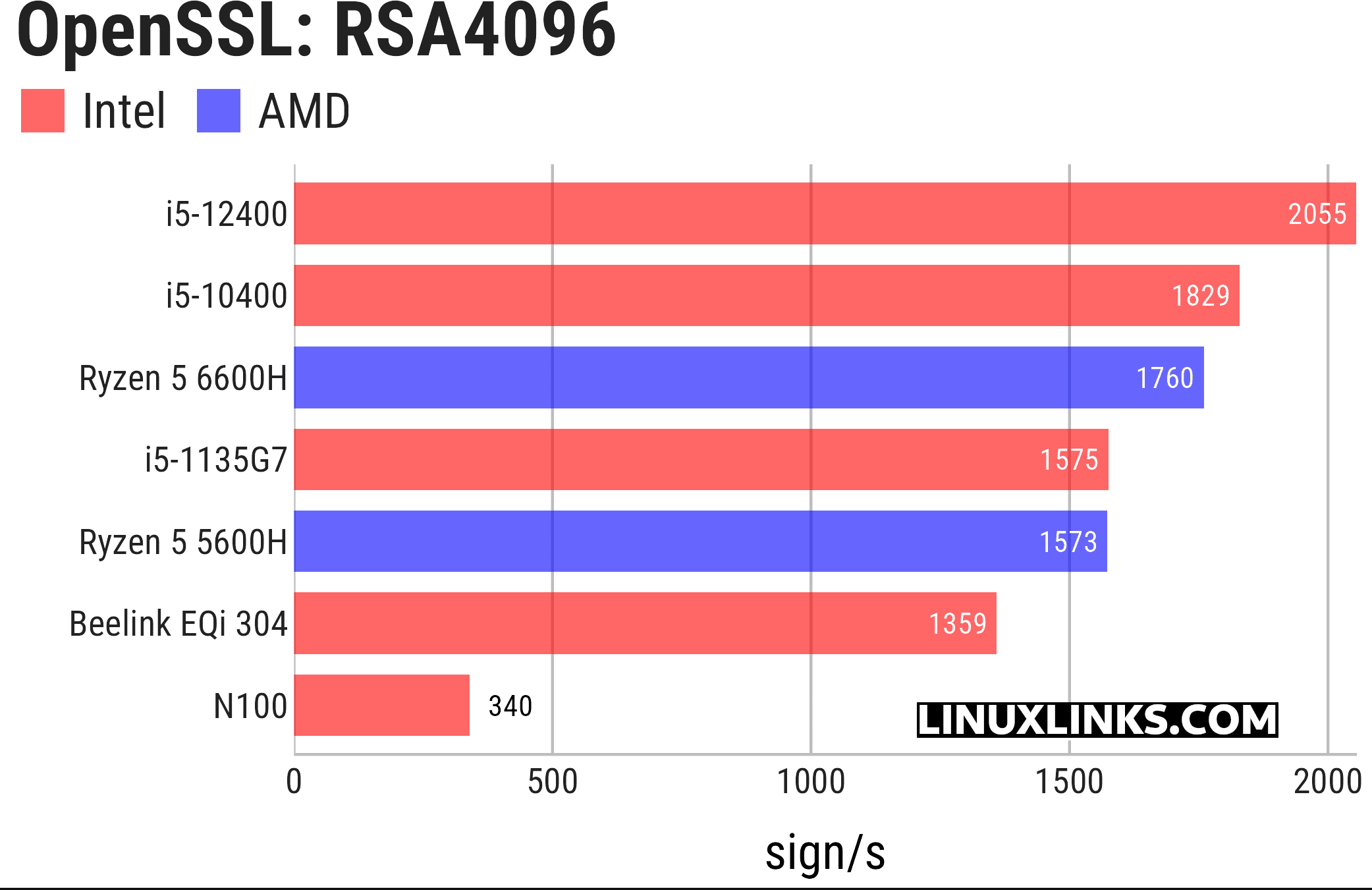
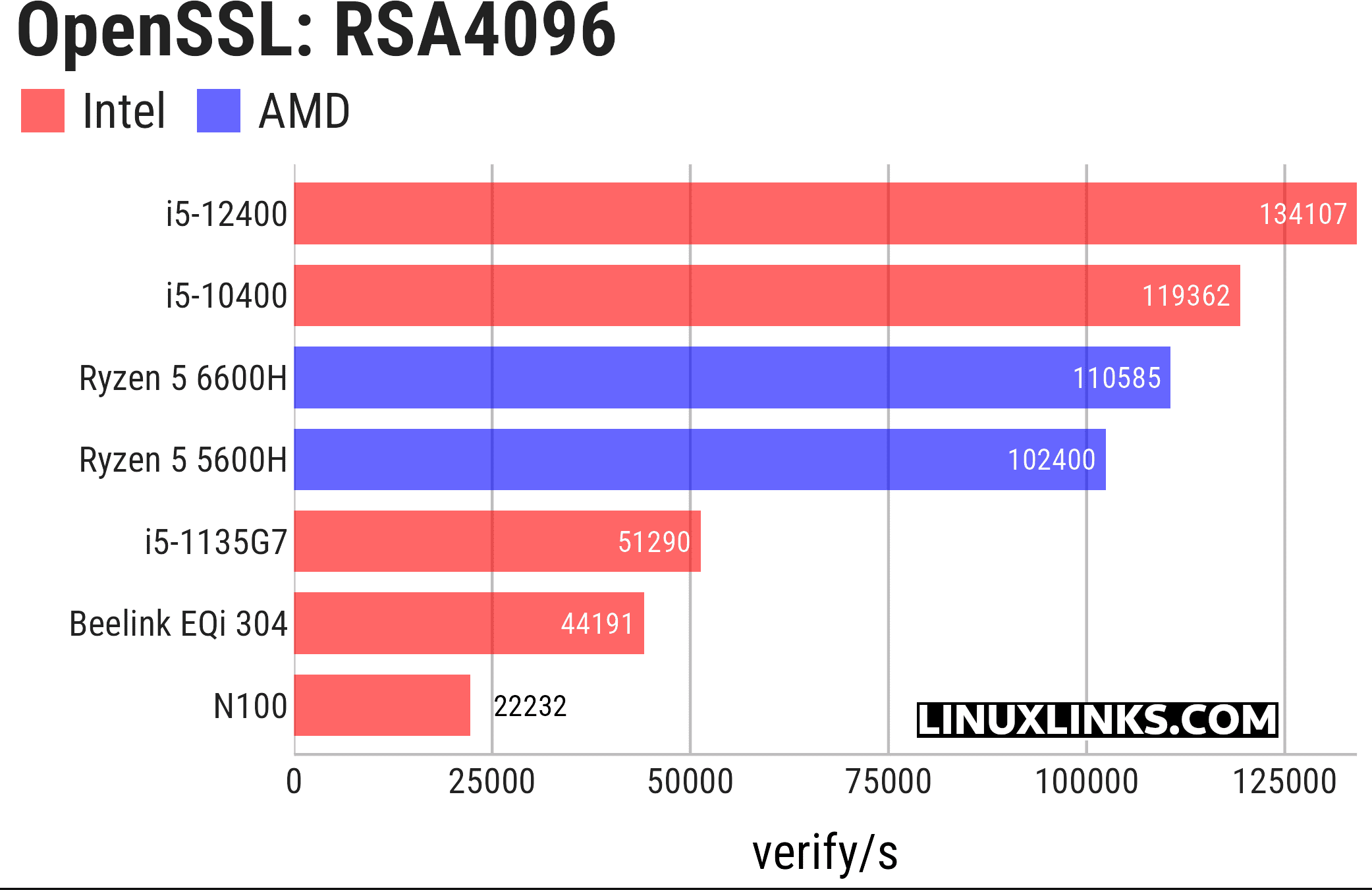
Various algorithms can be used for this benchmark. I focused on the RSA-4096 algorithm, since it serves as a good representative example for the other options. This benchmark includes two charts: one for signing speeds and another for verification speeds.
The Core 3 304 performs particularly well in RSA-4096 signing, reaching 1,359 signatures per second. That is almost exactly four times the N100’s performance and places the Beelink only around 14% behind the Core i5-1135G7. It also delivers about 74% of the Core i5-10400’s signing throughput, which is a respectable result given the 304’s much lower power envelope and its modest one-P-core-plus-four-E-core configuration.
RSA verification presents a less favourable comparison. The Beelink achieves 44,191 verifications per second, almost twice the N100’s result, but only around 37% of the Core i5-10400’s throughput. It again finishes about 14% behind the Core i5-1135G7, while the six-core desktop and mobile processors establish a substantial lead.
The difference between the signing and verification results reflects the distinct arithmetic and scaling characteristics of the two RSA operations. Signing is a much more computationally expensive private-key operation, whereas verification is considerably faster and can benefit strongly from additional cores and threads. The Core i5-10400’s six cores and twelve threads therefore give it a much larger advantage in the verification test.
Overall, the Core 3 304 offers a major advance over the N100: approximately 4 times faster signing and 2 times faster verification. Its RSA performance is broadly competitive with the older Core i5-1135G7, but the comparison with the i5-10400 again shows that a similar aggregate PassMark score does not imply equivalent performance across sustained, heavily parallel workloads.
$ phoronix-test-suite benchmark crafty
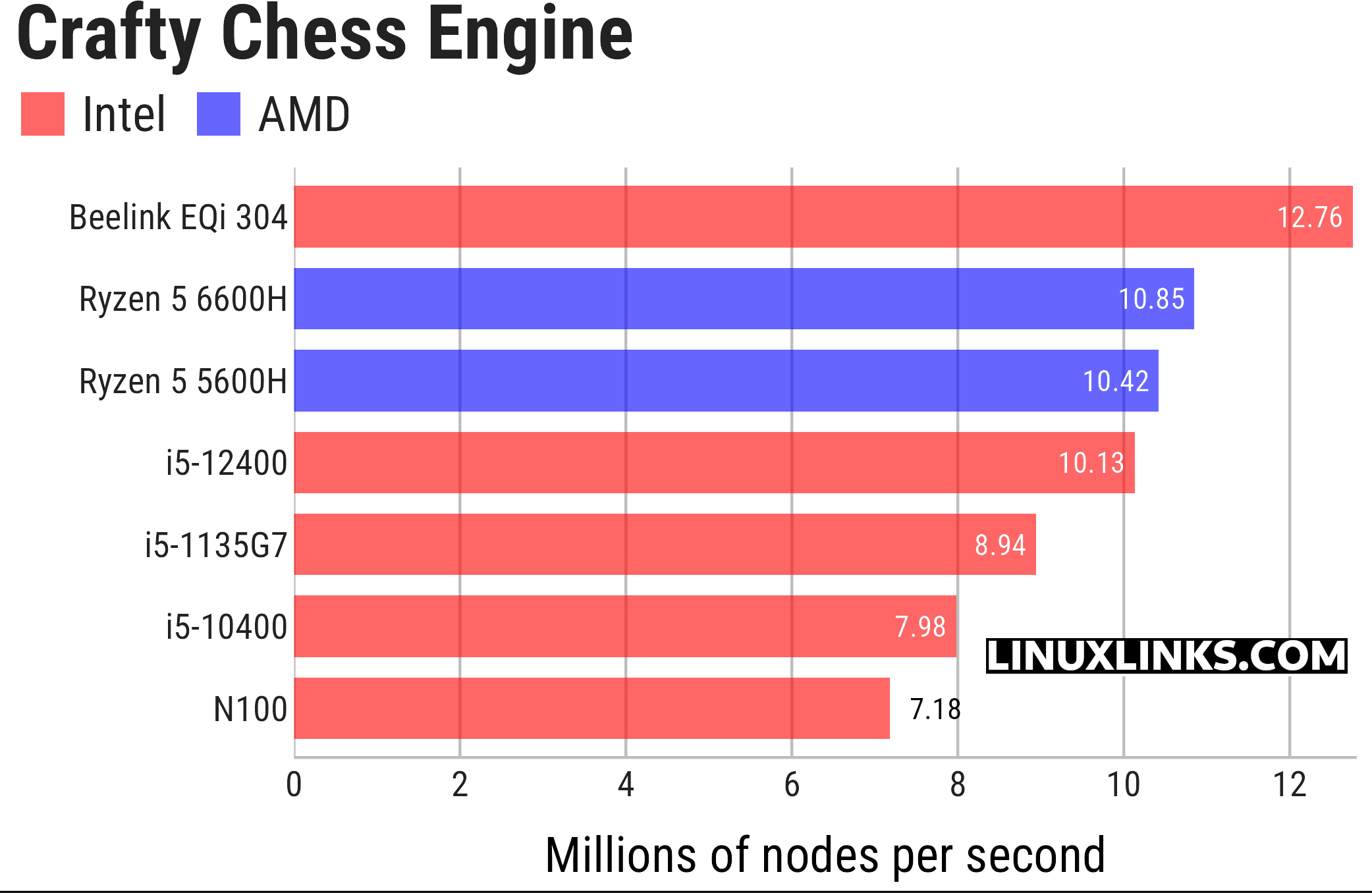
Crafty is a chess program directly derived from Cray Blitz, winner of the 1983 and 1986 World Computer Chess Championships. Crafty is a single-core benchmark.
The Crafty result is arguably the standout CPU result for the Beelink EQi 304. This is a single-threaded benchmark, and the Core 3 304 processes an impressive 12.76 million nodes per second, highlighting the strength of its solitary P-core.
That score is only 9% behind the Core Ultra 7 356H in the Minisforum M2, 11% behind the Core Ultra 7 255H in the ASRock Industrial NUC BOX-255H, and 13% behind the Core Ultra 9 285H in the BOSGAME M7. Even the much more powerful Core Ultra 9 285HX in the Minisforum MS-02 Ultra is only around 19% faster, scoring 15.81 million nodes per second.
The Core 3 304 also outperforms the Ryzen 5 6600H by 18%, the Ryzen 5 5600H by 22%, and the Core i5-12400 by 26%. Compared with the Intel N100, the Beelink is an enormous 78% faster.
This result is particularly important for general desktop use. Many everyday operations cannot distribute their work efficiently across numerous cores. Application startup, interface rendering, input handling, JavaScript execution and parts of web-page layout often depend heavily on the speed of one or two cores. Strong single-threaded performance therefore helps applications open promptly, keeps complex websites responsive and makes the desktop feel much quicker than the processor’s modest five-core configuration might suggest.
The Core 3 304 cannot compete with high-end processors in sustained, heavily multithreaded workloads, as the Smallpt and OpenSSL results demonstrate. However, its remarkably capable P-core means the EQi 304 should feel fast and responsive during typical desktop use. For many users, that will matter more than its comparatively limited aggregate processing throughput.
Pages in this article:
Page 1 – Introduction and Design
Page 2 – Graphics
Page 3 – Memory
Page 4 – Disk and Summary
Complete list of articles in this series:
| Beelink EQi 304 Mini PC | |
|---|---|
| Introduction | Introduction to the series and interrogation of the machine |
| Benchmarks | Benchmarking the Beelink EQi 304 Mini PC |
| Power | Testing and comparing the power consumption |
| BIOS | The BIOS, which stands for Basic Input/Output System, plays a crucial role |
| Cores | P-core and LP Efficient-cores examined |
| Noise | How quiet is this mini PC? |
| NPU and Llama | Testing the NPU with Llama models |
| Scheduling | Can Linux use its one fast CPU core efficiently? |
Please read our Comment Policy before commenting.
It’s impressive how close the EQi 304 gets to the much more expensive Core Ultra machines in single-core performance. For everyday desktop work, that lone P-core appears to punch well above the system’s weight.