
Disk
The Beelink EQi 304 has 512GB of UFS 3.1 flash storage, not an NVMe SSD. It is made by Yangtze Memory Technologies Co., Ltd. (YMTC), a Chinese NAND flash manufacturer.
Here are the results with KDiskMark, an open-source benchmark software for storage devices. It’s a GUI tool that uses fio, the Flexible I/O Tester.
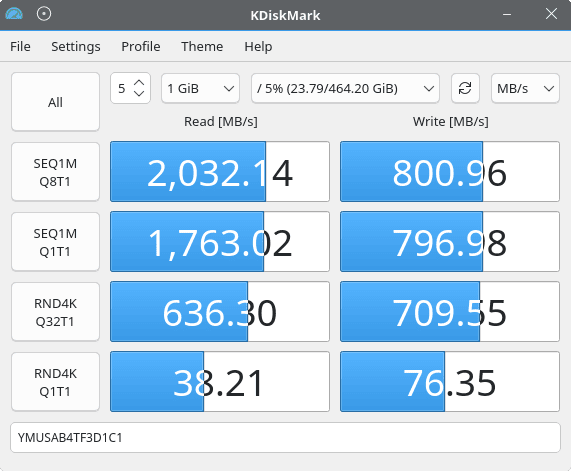
Performance is very strong for UFS 3.1 storage. Sequential reads of about 2.0GB/s are excellent, while sequential writes around 800MB/s are respectable and comfortably ahead of SATA SSD territory for reads.
The main limitation is low-queue random performance: 38MB/s read and 76MB/s write at Q1T1. That is adequate for booting Linux, launching applications and general desktop use, but a good PCIe 4.0 NVMe SSD would usually feel quicker under heavier multitasking, package compilation or workloads involving many small files.
Overall, the result is impressive for soldered UFS storage: fast reads, decent writes, but not a substitute for a strong NVMe drive in demanding storage workloads. Fortunately, the machine has two empty M.2 2280 slots.
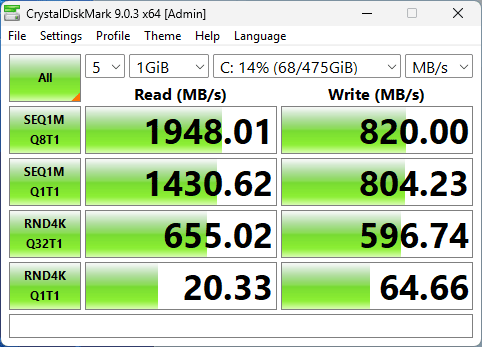
The EQi 304 ships with Windows 11 Pro, so I also ran CrystalDiskMark before installing Linux to compare the disk’s performance under Windows.
Summary
The Beelink EQi 304 delivers a convincing balance of performance for a low-power mini PC. Its Core 3 304 is a substantial step up from the Intel N100, with especially strong single-threaded performance from its solitary P-core; this translates into responsive application launches, web browsing and general desktop use. Heavily threaded workloads expose the limitations of its five-core, five-thread design, so it cannot match older six-core desktop processors under sustained load. Graphics performance is similarly impressive for an iGPU containing only one Xe core: it comfortably outpaces the N100, remains competitive with several older integrated GPUs, and provides ample capability for desktop acceleration, media playback and lighter or older games.
The memory subsystem is one of the machine’s strongest areas. Its 16GB of LPDDR5 reaches about 33.3–33.7GB/s in RAMspeed, leads the tested systems in memset, and places close to the front in memcpy, helping both the CPU and integrated graphics perform effectively. The 512GB YMTC UFS 3.1 storage is also fast for embedded flash, with sequential reads around 2.0GB/s and writes near 800MB/s. Its weaker low-queue random performance means a good PCIe 4.0 NVMe SSD would still be preferable for compilation, heavy multitasking and small-file workloads, but for everyday Linux use the supplied storage is entirely adequate, and the two vacant M.2 slots leave a straightforward upgrade path.
In the next article in the series, I’ll assess the power consumption of the machine.
Pages in this article:
Page 1 – Introduction and Design
Page 2 – Graphics
Page 3 – Memory
Page 4 – Disk and Summary
Complete list of articles in this series:
| Beelink EQi 304 Mini PC | |
|---|---|
| Introduction | Introduction to the series and interrogation of the machine |
| Benchmarks | Benchmarking the Beelink EQi 304 Mini PC |
| Power | Testing and comparing the power consumption |
| BIOS | The BIOS, which stands for Basic Input/Output System, plays a crucial role |
| Cores | P-core and LP Efficient-cores examined |
| Noise | How quiet is this mini PC? |
| NPU and Llama | Testing the NPU with Llama models |
| Scheduling | Can Linux use its one fast CPU core efficiently? |
Please read our Comment Policy before commenting.
It’s impressive how close the EQi 304 gets to the much more expensive Core Ultra machines in single-core performance. For everyday desktop work, that lone P-core appears to punch well above the system’s weight.