
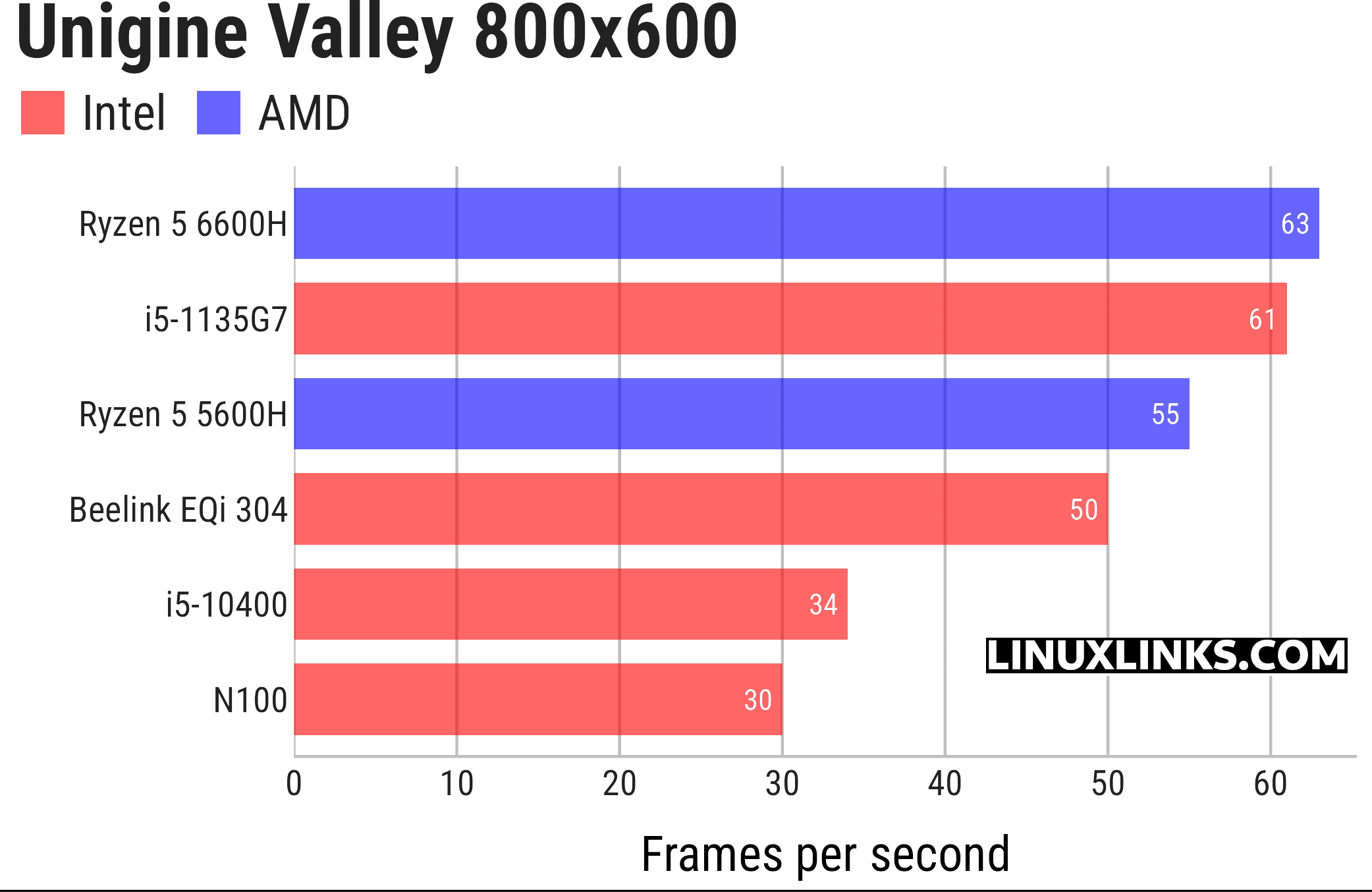
The 800×600 result is only useful as a synthetic comparison point; it’s not a realistic gaming resolution.
The Core 3 304’s integrated GPU performs remarkably well given that it contains only a single Xe core. At 800×600, the Beelink EQi 304 reaches 50 FPS, making it 67% faster than the N100 and 47% faster than the older Core i5-10400. It also comes within 9% of the Ryzen 5 5600H and is only around 18–21% behind the Core i5-1135G7 and Ryzen 5 6600H.
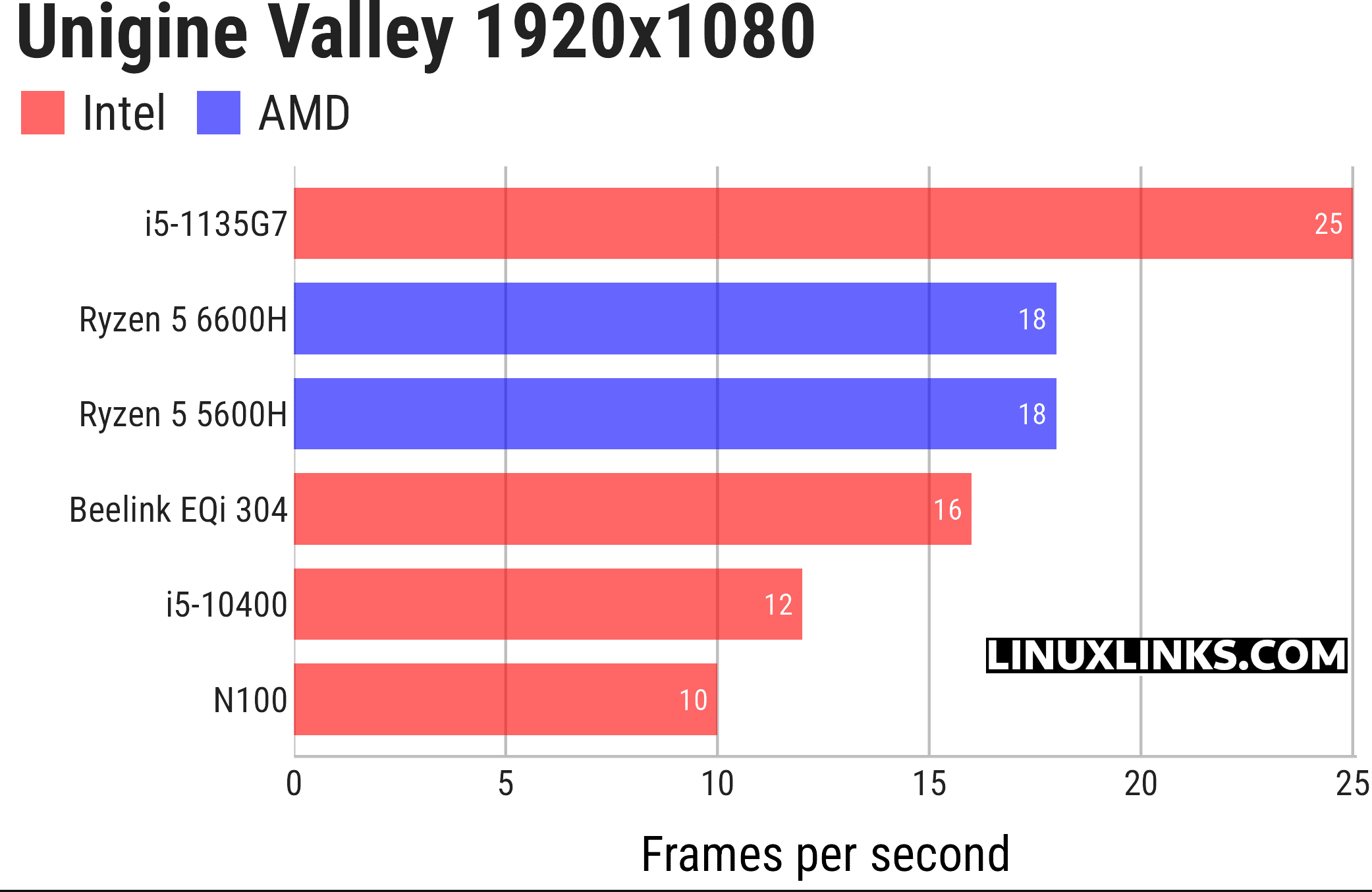
At 1920×1080, the EQi 304 records 16 FPS. That remains 60% faster than the N100 and 33% ahead of the Core i5-10400. It is only 2 FPS behind both Ryzen processors, although the Core i5-1135G7 establishes a clearer lead at 25 FPS.
The results show that the single Xe-core design is not directly comparable to a single conventional execution unit. That Xe core incorporates multiple vector-processing resources and benefits from a much newer graphics architecture. It gives the Core 3 304 considerably stronger graphics performance than the N100-class processors it otherwise resembles in power consumption and overall market position.
The fall from 50 FPS at 800×600 to 16 FPS at 1080p also confirms that the benchmark becomes predominantly GPU-bound as resolution increases. Even so, the EQi 304 remains surprisingly close to the substantially larger Radeon integrated GPUs in the Ryzen 5 5600H and 6600H. It is not a gaming processor, but its one-core GPU is clearly capable enough for desktop acceleration, media work and light or older games.
I also ran glmark2, an OpenGL 2.0 / OpenGL ES 2.0 benchmark, on the Beelink EQi 304 and compared its score with results from several other systems.
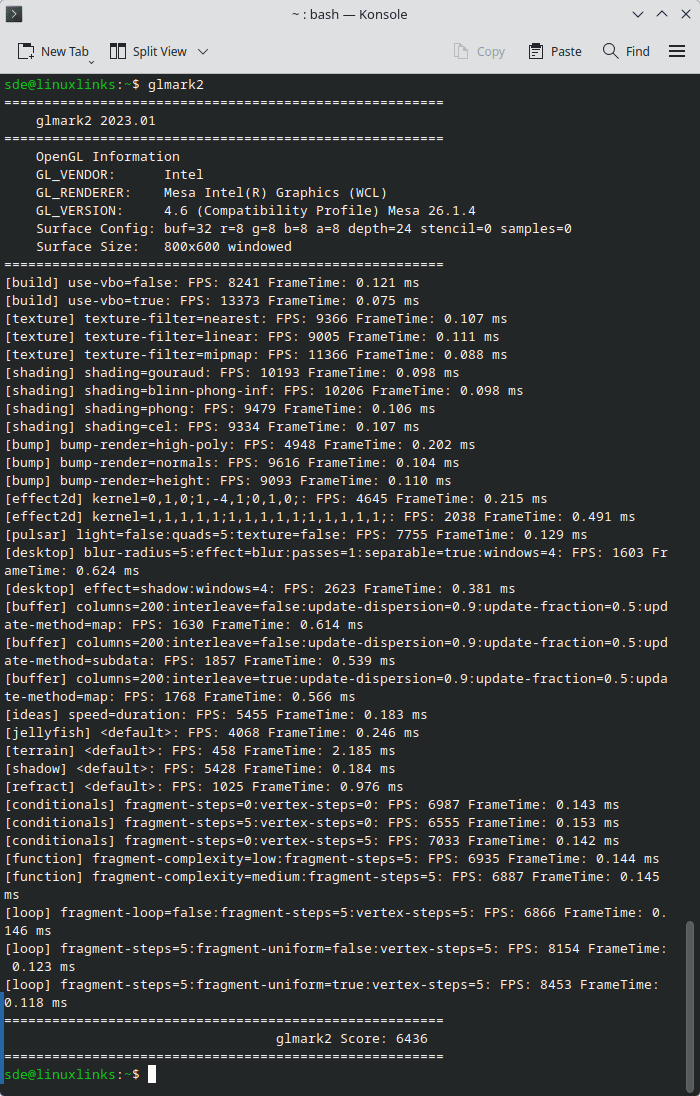
The Beelink EQi 304 records a glmark2 score of 6,436. Despite having only one Xe-core, that is just 7% behind the ASRock NUC BOX-255H’s Arc 140T score of 6,914, although it is around 50% slower than the Minisforum M2’s 12,789. AMD’s Radeon 890M systems occupy a different performance class: the BOSGAME M6 scores 24,878 and the newer VTA-439 reaches 26,997, approximately four times the Beelink’s result. Overall, the result is respectable for such a modest single-core iGPU, but glmark2 does not scale cleanly with GPU specifications and should not be treated as a direct indication of gaming performance.
Pages in this article:
Page 1 – Introduction and Design
Page 2 – Graphics
Page 3 – Memory
Page 4 – Disk and Summary
Complete list of articles in this series:
| Beelink EQi 304 Mini PC | |
|---|---|
| Introduction | Introduction to the series and interrogation of the machine |
| Benchmarks | Benchmarking the Beelink EQi 304 Mini PC |
| Power | Testing and comparing the power consumption |
| BIOS | The BIOS, which stands for Basic Input/Output System, plays a crucial role |
| Cores | P-core and LP Efficient-cores examined |
| Noise | How quiet is this mini PC? |
| NPU and Llama | Testing the NPU with Llama models |
| Scheduling | Can Linux use its one fast CPU core efficiently? |
Please read our Comment Policy before commenting.
It’s impressive how close the EQi 304 gets to the much more expensive Core Ultra machines in single-core performance. For everyday desktop work, that lone P-core appears to punch well above the system’s weight.