
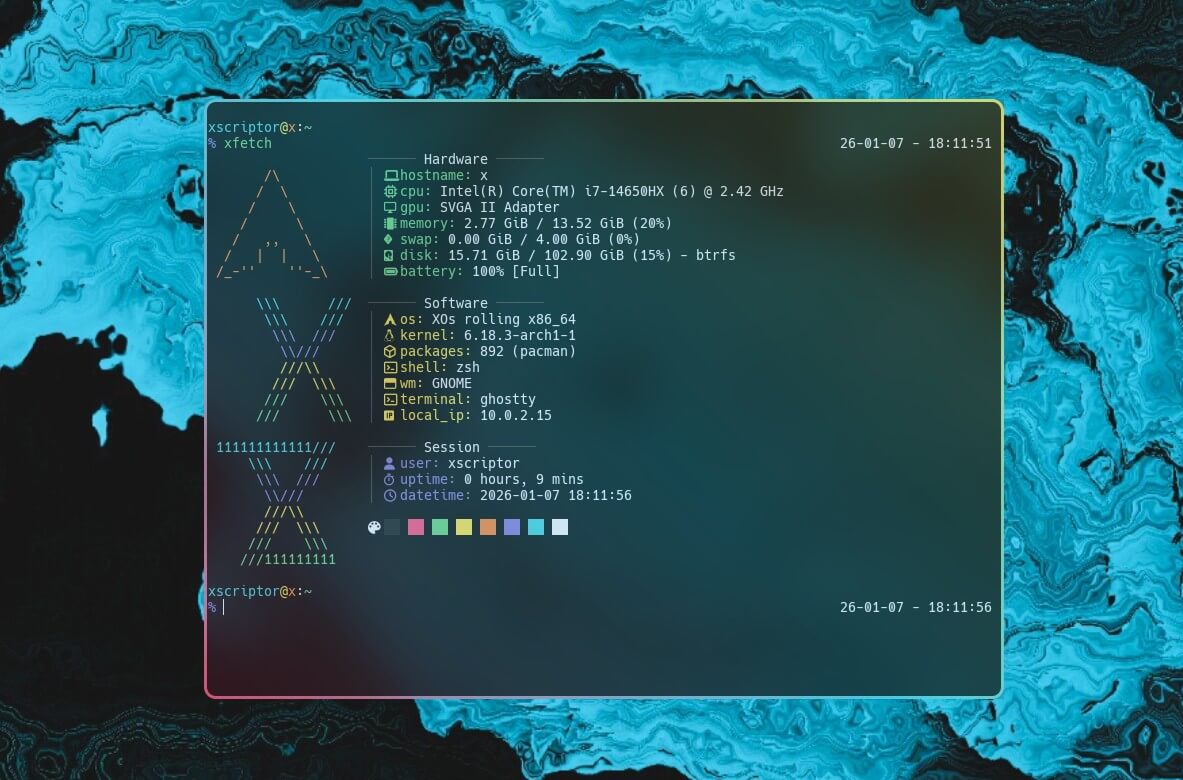
Xfetch is a highly configurable system-information utility for people who want a personalised terminal display. It draws on the familiar fetcher concept but extends it with modules, themes, effects and mechanisms for adding functionality.
The basic application presents hardware, operating system and session details beside ASCII artwork. Users can decide which modules appear, rearrange the layout and select colours appropriate to their terminal.
Xfetch also supports more dynamic forms of presentation. Animated logos and optional effects can change how the information first appears, while a persistent display mode can keep the summary visible during a terminal session.
Its extensibility is another distinguishing characteristic. Plugins and additional commands allow users to go beyond the default information modules. Structured output makes it useful for scripting as well as visual presentation.
For a conventional screenshot, the default layout may be sufficient. Users who spend much of their day in a terminal can take advantage of its broader customisation and persistent-display facilities.
This is free and open source software.
Key Features
- Display operating system, CPU, GPU, memory, storage and session information.
- Select and reorder information modules with a JSONC configuration file.
- Choose custom ASCII artwork, layouts, icons and colours.
- Apply presentation themes and optional introduction effects.
- Animate logos using supported plugins.
- Pin a persistent fetch display above an active shell.
- Refresh selected live statistics in persistent display mode.
- Add functionality using plugins, extensions and custom commands.
- Support WebAssembly-based extensions and effects.
- Export structured JSON and individual values for scripts.
- Validate configuration and inspect diagnostic information.
- Cross-platform support – runs on Linux, macOS, and Windows.
Website: github.com/xfetch-cli/xfetch
Support:
Developer: Xscriptor
License: MIT License
Learn Rust with our recommended free books and free tutorials.
Related Software
| Terminal-Based System Profilers | |
|---|---|
| inxi | Perl-based CLI system information tool |
| HyFetch | neofetch with LGBTQ+ pride flags |
| CPU-X | Similar tool to CPU-Z but differs in a few important ways |
| Fastfetch | Written in C, Fastfetch is a speedy fetcher |
| dmidecode | Reports information according to the SMBDIOS/DMI standard |
| Neofetch | Extremely customizable and runs on any operating that supports Bash |
| macchina | System information fetcher |
| brokefetch | neofetch clone |
| hwinfo | Provides a hardware probing library and a command line tool |
| screenFetch | Bash information tool |
| lshw | Console and graphical tool extracting detailed information |
| i7z | Reporting tool for i7, i5, i3 CPUs |
| Freshfetch | Fresh take on Neofetch |
| Katifetch | Focuses on identity and customization |
| rxfetch | Minimal but geeky fetch utility |
| albafetch | Written in C |
| UniFetch | Forked from Neofetch |
| NerdFetch | Fetch script using Nerdfonts |
| ArTTY | Art for your TTY |
| rtfetch | Neofetch but in Rust |
| F-Fetch | Fast and minimal system fetcher |
| Archey 4 | Simple system information tool |
| zeptofetch | No scripts, no bloat, just pure C |
| switchfetch | Written in Rust |
| pfetch | Pretty system information tool written in POSIX sh |
| dmitui | TUI version of dmidecode |
| zigfetch | Written in Zig |
| ufetch | Consists of platform-specific shell scripts that print concise system details |
| noorfetch | Minimalist system fetch |
| LeenFetch | Includes JSON output and remote fetching over SSH |
| Xfetch | Inspired by fastfetch and neofetch, written in Rust |
| blaeckfetch | Powered by blaeck for rendering |
| zfetch-rs | Focuses on providing a fast, minimal implementation |
| Yoctofetch | Billed as the fast(est) system fetch tool for Linux with a low footprint |
| Stormfetch | Written in Go |
| PeekFetch | Built with Go and Bubble Tea |
| NiTch Revived | System fetch written fully in Nim without any dependencies |
| Metetch | Minimal aesthetic inspired by KDE Plasma and Wayland |
| gnfetch | Written in Rust |
| bestfetch | Billed as a customizable, beautiful, and blazing fast system fetch |
Read our verdict in the software roundup.
 LinuxLinks helps you discover the best free and open source software for Linux. Explore our extensive collection of recommended applications, including alternatives to popular proprietary software. We also publish software reviews, Linux tutorials, hardware reviews, free programming books and articles covering the wider open source community. Browse our Linux resources to discover more. Know a useful free and open source Linux application we haven't covered? Suggest a program for inclusion. Has your software been featured on LinuxLinks? Display one of our Featured on LinuxLinks badges on your website or GitHub README. |
Please read our Comment Policy before commenting.