
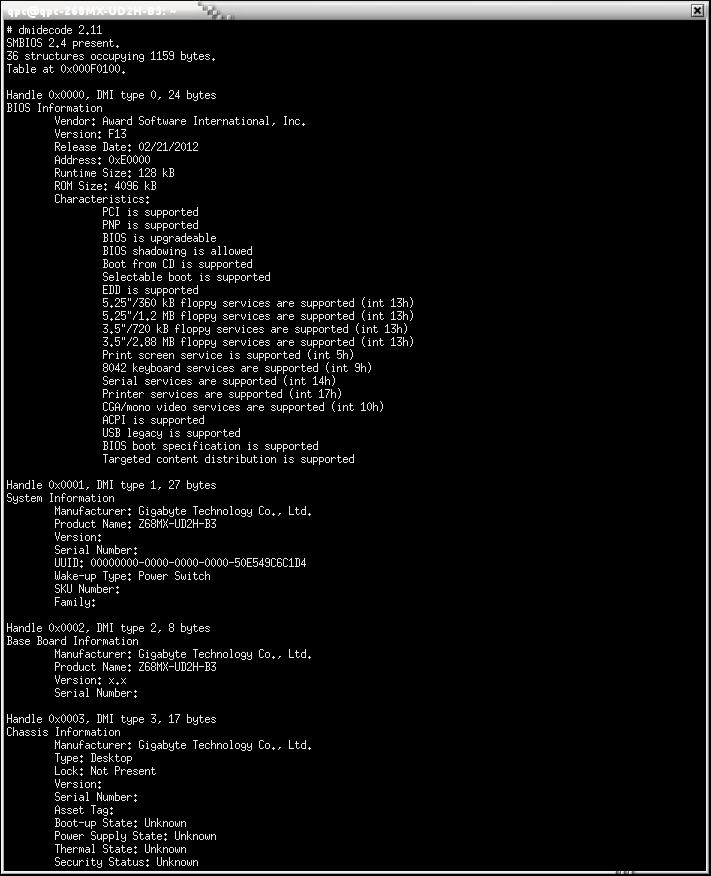
dmidecode reports information about your system’s hardware as described in your system BIOS according to the SMBIOS/DMI standard. This table contains a description of the system’s hardware components, as well as other useful pieces of information, and typically includes system manufacturer, model name, serial number, BIOS version, asset tag as well as a lot of other details of varying level of interest and reliability depending on the manufacturer. This will often include usage status for the CPU sockets, expansion slots (e.g. AGP, PCI, ISA) and memory module slots, and the list of I/O ports (e.g. serial, parallel, USB).
Thanks to this table, you can retrieve this information without having to probe for the actual hardware. While this is a good point in terms of report speed and safeness, this also makes the presented information possibly unreliable.
The DMI table does not only describe what the system is currently made of, it also can report the possible evolutions (such as the fastest supported CPU or the maximal amount of memory supported).
dmidecode will try to locate the DMI table. If it succeeds, it will then parse this table and display a list of records.
Key Features
- Supports the following systems:
- Linux i386, x86-64, ia64.
-
- FreeBSD i386, amd64.
-
- NetBSD i386, amd64.
-
- OpenBSD i386, amd64.
-
- BeOS i386.
-
- Cygwin i386.
-
- Solaris x86.
-
- Haiku i586.
- Three other tools are provided with dmidecode:
- biosdecode – prints all BIOS related information it can find in /dev/mem.
-
- ownership – retrieves the “ownership tag” that can be set on most Compaq computers.
-
- vpddecode – prints the contents of the “vital product data” structure as found in most IBM and Lenovo computers.
Website: www.nongnu.org/dmidecode
Support: Mailing List
Developer: Anton Arapov, Alan Cox, Jean Delvare (original authors), and many contributors
License: GNU General Public License v2.0
dmidecode is written in C. Learn C with our recommended free books and free tutorials.
Related Software
| Terminal-Based System Profilers | |
|---|---|
| inxi | Perl-based CLI system information tool |
| HyFetch | neofetch with LGBTQ+ pride flags |
| CPU-X | Similar tool to CPU-Z but differs in a few important ways |
| Fastfetch | Written in C, Fastfetch is a speedy fetcher |
| dmidecode | Reports information according to the SMBDIOS/DMI standard |
| Neofetch | Extremely customizable and runs on any operating that supports Bash |
| macchina | System information fetcher |
| brokefetch | neofetch clone |
| hwinfo | Provides a hardware probing library and a command line tool |
| screenFetch | Bash information tool |
| lshw | Console and graphical tool extracting detailed information |
| i7z | Reporting tool for i7, i5, i3 CPUs |
| Freshfetch | Fresh take on Neofetch |
| Katifetch | Focuses on identity and customization |
| rxfetch | Minimal but geeky fetch utility |
| albafetch | Written in C |
| UniFetch | Forked from Neofetch |
| NerdFetch | Fetch script using Nerdfonts |
| ArTTY | Art for your TTY |
| rtfetch | Neofetch but in Rust |
| F-Fetch | Fast and minimal system fetcher |
| Archey 4 | Simple system information tool |
| zeptofetch | No scripts, no bloat, just pure C |
| switchfetch | Written in Rust |
| pfetch | Pretty system information tool written in POSIX sh |
| dmitui | TUI version of dmidecode |
| zigfetch | Written in Zig |
| ufetch | Consists of platform-specific shell scripts that print concise system details |
| noorfetch | Minimalist system fetch |
| LeenFetch | Includes JSON output and remote fetching over SSH |
| Xfetch | Inspired by fastfetch and neofetch, written in Rust |
| blaeckfetch | Powered by blaeck for rendering |
| zfetch-rs | Focuses on providing a fast, minimal implementation |
| Yoctofetch | Billed as the fast(est) system fetch tool for Linux with a low footprint |
| Stormfetch | Written in Go |
| PeekFetch | Built with Go and Bubble Tea |
| NiTch Revived | System fetch written fully in Nim without any dependencies |
| Metetch | Minimal aesthetic inspired by KDE Plasma and Wayland |
| gnfetch | Written in Rust |
| bestfetch | Billed as a customizable, beautiful, and blazing fast system fetch |
Read our verdict in the software roundup.
 Explore our carefully curated directory of recommended free and open source software, covering every major software category. Explore our carefully curated directory of recommended free and open source software, covering every major software category.The directory forms part of our extensive collection of articles for Linux enthusiasts. It includes hundreds of detailed reviews, together with free and open source alternatives to proprietary software from companies such as Google, Microsoft, Apple, Adobe, IBM, Cisco, Oracle, and Autodesk. LinuxLinks also covers interesting projects worth exploring, Linux-compatible hardware, free programming books and tutorials, and much more. Know a useful free and open source Linux application that we haven’t covered? Tell us about it using our submission form. |
Please read our Comment Policy before commenting.