
hwinfo is a hardware detection and diagnostic utility that examines the devices connected to a Linux system. It identifies hardware components and provides detailed information that can help administrators troubleshoot problems, inspect device configuration and prepare technical support reports.
The program is developed by the openSUSE project and consists of the hwinfo command-line application and the libhd hardware probing library. The library is also used by YaST, openSUSE’s system administration and installation tool.
hwinfo can examine the complete hardware configuration or concentrate on selected types of devices. For example, users can investigate graphics adapters, disks, network interfaces or other components without having to examine an extensive system report.
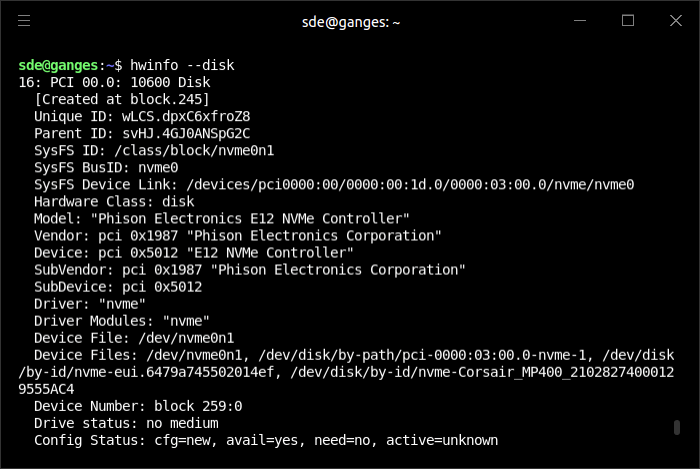
The level of detail is configurable. A full hardware report provides information such as device identifiers, drivers, hardware resources and configuration status, while the short output mode offers a more manageable summary.
This is free and open source software.
Key Features
- Probe hardware components and generate detailed system information reports.
- Identify graphics cards, processors, storage devices, network interfaces and other hardware.
- Display PCI device identifiers, vendor information and associated drivers.
- Report device configuration, hardware resources and driver activation information.
- Restrict hardware detection to selected device classes such as disks or graphics adapters.
- Produce concise hardware summaries using the –short option.
- Examine individual devices using the –only option.
- Include detected RAID devices using –listmd.
- Record hardware probing information in a log file using –log.
- Save and retrieve selected device configuration information.
- Control probing behaviour using the hwprobe environment variable.
- Provide the libhd library for applications requiring hardware detection functionality.
Website: github.com/openSUSE/hwinfo
Support:
Developer: Steffen Winterfeldt / openSUSE
License: GNU General Public License v2.0
hwinfo is written in C. Learn C with our recommended free books and free tutorials.
Related Software
| Terminal-Based System Profilers | |
|---|---|
| inxi | Perl-based CLI system information tool |
| HyFetch | neofetch with LGBTQ+ pride flags |
| CPU-X | Similar tool to CPU-Z but differs in a few important ways |
| Fastfetch | Written in C, Fastfetch is a speedy fetcher |
| dmidecode | Reports information according to the SMBDIOS/DMI standard |
| Neofetch | Extremely customizable and runs on any operating that supports Bash |
| macchina | System information fetcher |
| brokefetch | neofetch clone |
| hwinfo | Provides a hardware probing library and a command line tool |
| screenFetch | Bash information tool |
| lshw | Console and graphical tool extracting detailed information |
| i7z | Reporting tool for i7, i5, i3 CPUs |
| Freshfetch | Fresh take on Neofetch |
| Katifetch | Focuses on identity and customization |
| rxfetch | Minimal but geeky fetch utility |
| albafetch | Written in C |
| UniFetch | Forked from Neofetch |
| NerdFetch | Fetch script using Nerdfonts |
| ArTTY | Art for your TTY |
| rtfetch | Neofetch but in Rust |
| F-Fetch | Fast and minimal system fetcher |
| Archey 4 | Simple system information tool |
| zeptofetch | No scripts, no bloat, just pure C |
| switchfetch | Written in Rust |
| pfetch | Pretty system information tool written in POSIX sh |
| dmitui | TUI version of dmidecode |
| zigfetch | Written in Zig |
| ufetch | Consists of platform-specific shell scripts that print concise system details |
| noorfetch | Minimalist system fetch |
| LeenFetch | Includes JSON output and remote fetching over SSH |
| Xfetch | Inspired by fastfetch and neofetch, written in Rust |
| blaeckfetch | Powered by blaeck for rendering |
| zfetch-rs | Focuses on providing a fast, minimal implementation |
| Yoctofetch | Billed as the fast(est) system fetch tool for Linux with a low footprint |
| Stormfetch | Written in Go |
| PeekFetch | Built with Go and Bubble Tea |
| NiTch Revived | System fetch written fully in Nim without any dependencies |
| Metetch | Minimal aesthetic inspired by KDE Plasma and Wayland |
| gnfetch | Written in Rust |
| bestfetch | Billed as a customizable, beautiful, and blazing fast system fetch |
Read our verdict in the software roundup.
 LinuxLinks helps you discover the best free and open source software for Linux. Explore our extensive collection of recommended applications, including alternatives to popular proprietary software. We also publish software reviews, Linux tutorials, hardware reviews, free programming books and articles covering the wider open source community. Browse our Linux resources to discover more. Know a useful free and open source Linux application we haven't covered? Suggest a program for inclusion. Has your software been featured on LinuxLinks? Display one of our Featured on LinuxLinks badges on your website or GitHub README. |
Please read our Comment Policy before commenting.