
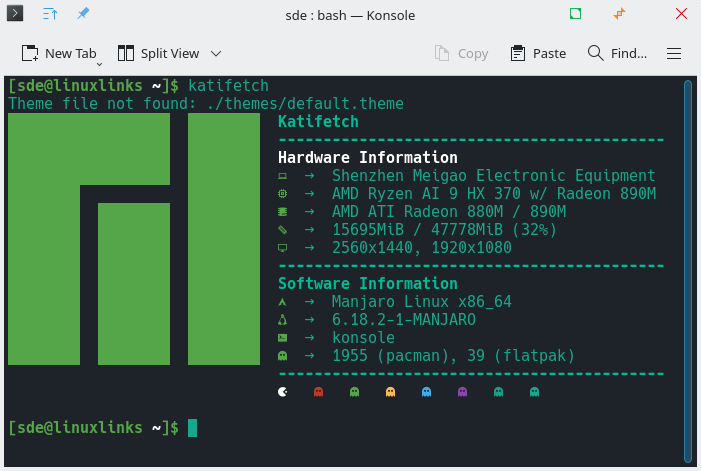
Katifetch is a system information utility that puts considerable emphasis on the appearance and identity of the computer being examined. It presents hardware and operating system information alongside ASCII artwork, but offers more variation in style than a conventional distribution-logo fetcher.
Rather than treating the operating system as the only defining characteristic, Katifetch includes themed output and specialised detection for different environments. This is useful on machines running unusual distributions, gaming-oriented installations or virtualised systems.
A typical display combines details about the machine’s hardware and software environment with configurable colours and a prominent logo. Themes can change the visual presentation without altering the basic purpose of the application.
Katifetch is aimed at users who enjoy tailoring their terminal and want a system-information display that reflects their particular setup. It is less concerned with exhaustive diagnostics than tools such as hwinfo or inxi, but gives users considerably more choice over how a short summary looks.
This is free and open source software.
Key Features
- Display operating system, kernel, CPU, GPU, memory and uptime information.
- Show ASCII artwork appropriate to the detected operating system or edition.
- Apply themes to control the colours and appearance of the terminal display.
- Customise logos, output formatting and presentation preferences.
- Recognise supported virtual-machine environments.
- Identify selected specialised Linux environments, including Bazzite and SteamOS.
- Provide alternative visual styles, including a retro-inspired presentation.
- Include specialised support for environments such as Termux and ChromeOS.
- Cross-platform support – runs on Linux, macOS, and Windows.
Website: github.com/ximimoments/katifetch
Support:
Developer: ximimoments
License: MIT License
Related Software
| Terminal-Based System Profilers | |
|---|---|
| inxi | Perl-based CLI system information tool |
| HyFetch | neofetch with LGBTQ+ pride flags |
| CPU-X | Similar tool to CPU-Z but differs in a few important ways |
| Fastfetch | Written in C, Fastfetch is a speedy fetcher |
| dmidecode | Reports information according to the SMBDIOS/DMI standard |
| Neofetch | Extremely customizable and runs on any operating that supports Bash |
| macchina | System information fetcher |
| brokefetch | neofetch clone |
| hwinfo | Provides a hardware probing library and a command line tool |
| screenFetch | Bash information tool |
| lshw | Console and graphical tool extracting detailed information |
| i7z | Reporting tool for i7, i5, i3 CPUs |
| Freshfetch | Fresh take on Neofetch |
| Katifetch | Focuses on identity and customization |
| rxfetch | Minimal but geeky fetch utility |
| albafetch | Written in C |
| UniFetch | Forked from Neofetch |
| NerdFetch | Fetch script using Nerdfonts |
| ArTTY | Art for your TTY |
| rtfetch | Neofetch but in Rust |
| F-Fetch | Fast and minimal system fetcher |
| Archey 4 | Simple system information tool |
| zeptofetch | No scripts, no bloat, just pure C |
| switchfetch | Written in Rust |
| pfetch | Pretty system information tool written in POSIX sh |
| dmitui | TUI version of dmidecode |
| zigfetch | Written in Zig |
| ufetch | Consists of platform-specific shell scripts that print concise system details |
| noorfetch | Minimalist system fetch |
| LeenFetch | Includes JSON output and remote fetching over SSH |
| Xfetch | Inspired by fastfetch and neofetch, written in Rust |
| blaeckfetch | Powered by blaeck for rendering |
| zfetch-rs | Focuses on providing a fast, minimal implementation |
| Yoctofetch | Billed as the fast(est) system fetch tool for Linux with a low footprint |
| Stormfetch | Written in Go |
| PeekFetch | Built with Go and Bubble Tea |
| NiTch Revived | System fetch written fully in Nim without any dependencies |
| Metetch | Minimal aesthetic inspired by KDE Plasma and Wayland |
| gnfetch | Written in Rust |
| bestfetch | Billed as a customizable, beautiful, and blazing fast system fetch |
Read our verdict in the software roundup.
 LinuxLinks helps you discover the best free and open source software for Linux. Explore our extensive collection of recommended applications, including alternatives to popular proprietary software. We also publish software reviews, Linux tutorials, hardware reviews, free programming books and articles covering the wider open source community. Browse our Linux resources to discover more. Know a useful free and open source Linux application we haven't covered? Suggest a program for inclusion. Has your software been featured on LinuxLinks? Display one of our Featured on LinuxLinks badges on your website or GitHub README. |
Please read our Comment Policy before commenting.