

Hello Contest is a graphical amateur radio contest logger with a particular emphasis on CW operation on the HF bands.
Its workflow is designed around rapid keyboard-driven entry during a contest, when reducing unnecessary interaction with the mouse can make logging considerably more efficient. Contest definitions supply the scoring rules while the application combines logging with radio integration, callsign information and operating aids. The interface is built with Qt and the application stores its log data using Protocol Buffers.
This is free and open source software.
Key Features
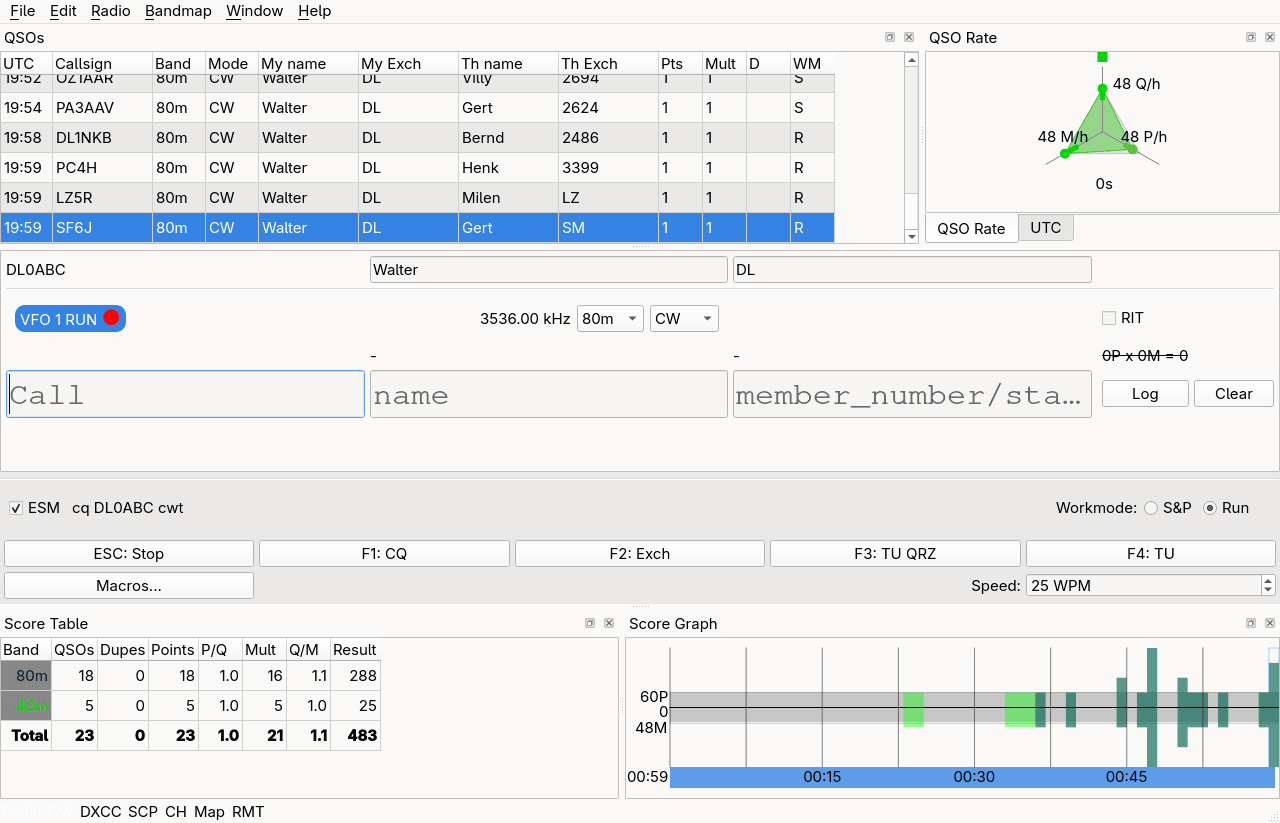
- Rapid keyboard-oriented entry of contest contacts with support for the popular Enter Sends Message workflow.
- Calculates points, multipliers and the overall score, with figures available both per band and across the complete log.
- Displays QSO rate, points and multipliers graphically to help operators follow their contest performance.
- Send and receive QTC traffic for contests such as Worked All Europe DX Contest.
- Export completed log data in Cabrillo, ADIF and CSV formats or generate a call history file.
- Look up information about entered callsigns using DXCC data, Super Check Partial data and locally maintained call history information.
- Use previous contest call history to predict the likely exchange for a callsign as it is entered.
- Receive spots from a DX cluster or local CW skimmer and present spotted stations in a dedicated list.
- Define different CW macros for running and search-and-pounce operating styles.
- Synchronise band and mode information with a transceiver through the Hamlib network protocol.
- Transmit CW macros through either the Hamlib daemon or cwdaemon.
- Show the currently worked station using HamDXMap integration.
- Supports operating workflows including bandmap facilities and single-operator two-VFO operation.
Website: github.com/ftl/hellocontest
Support:
Developer: Florian Thienel
License: MIT License
Hello Contest is written in Go. Learn Go with our recommended free books and free tutorials.
Related Software
| Ham Radio | |
|---|---|
| WSJT-X | Basic amateur radio communication using very weak signals |
| Tucnak | Ham radio VHF/HF contest logbook |
| QLog | Amateur radio logbook |
| Dire Wolf | AX.25 packet modem/TNC and APRS encoder/decoder |
| Qtel | Qt EchoLink client |
| wfview | Controls icom ham radios |
| Flrig | Transceiver control program |
| Fldigi | Modem program for most of the digital modes |
| TrustedQSL | Tools for digitally signing Amateur Radio QSO records |
| klog | General purpose ham radio DX logging support |
| CQRLOG | Advanced ham radio logger |
| Xastir | X11 graphical APRS client |
| ADIF Multitool | Validate, modify and convert ham radio log files |
| AetherSDR | Linux-native client for FlexRadio Systems transceivers |
| Xlog | Logging program for amateur radio operators |
| PyQSO | Contact logging tool for amateur radio operators |
| Not1MM | Ham radio contest logger |
| JS8Call | Software using the JS8 digital mode |
| FreeDV | Desktop application for amateur radio operators |
| CHIRP | GUI tool for programming ham radios |
Read our verdict in the software roundup.
 Explore our carefully curated directory of recommended free and open source software, covering every major software category. Explore our carefully curated directory of recommended free and open source software, covering every major software category.The directory forms part of our extensive collection of articles for Linux enthusiasts. It includes hundreds of detailed reviews, together with free and open source alternatives to proprietary software from companies such as Google, Microsoft, Apple, Adobe, IBM, Cisco, Oracle, and Autodesk. LinuxLinks also covers interesting projects worth exploring, Linux-compatible hardware, free programming books and tutorials, and much more. Know a useful free and open source Linux application that we haven’t covered? Tell us about it using our submission form. |
Please read our Comment Policy before commenting.