

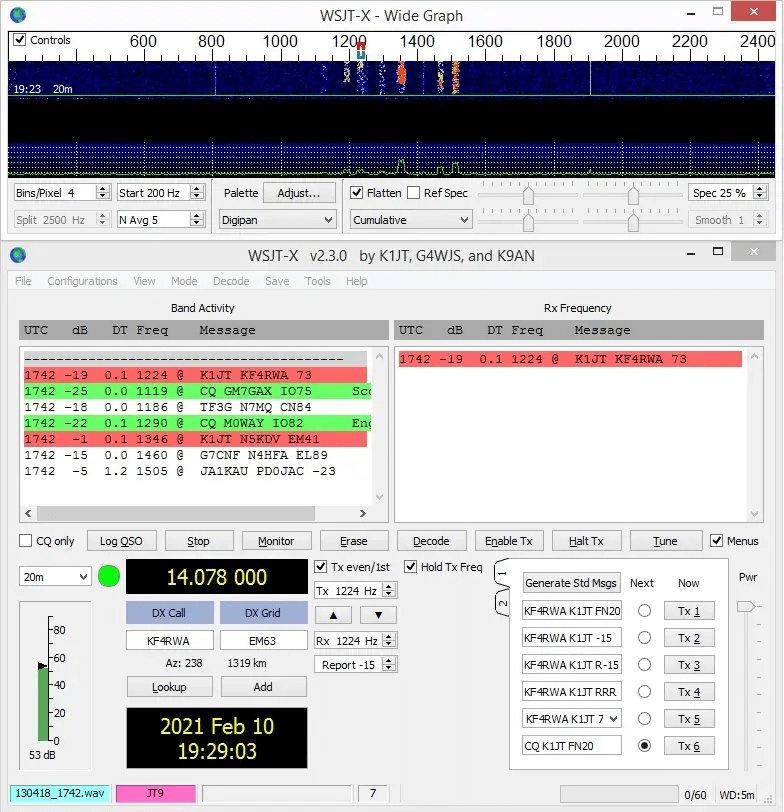
WSJT-X is a computer program designed to facilitate basic amateur radio communication using very weak signals. The first four letters in the program name stand for “Weak Signal communication by K1JT,” while the suffix “-X” indicates that WSJT-X started as an extended branch of an earlier program, WSJT, first released in 2001.
WSJT-X implements amateur radio communication protocols or “modes” called FT4, FT8, JT4, JT9, JT65, QRA64, ISCAT, MSK144, and WSPR, as well as one called Echo for detecting and measuring your own radio signals reflected from the Moon.
These modes were all designed for making reliable, confirmed QSOs under extreme weak-signal conditions.
JT4, JT9, and JT65 use nearly identical message structure and source encoding (the efficient compression of standard messages used for minimal QSOs). They use timed 60-second T/R sequences synchronized with UTC. JT4 and JT65 were designed for EME (“moonbounce”) on the VHF/UHF/microwave bands. JT9 is optimized for the MF and HF bands. It is about 2 dB more sensitive than JT65 while using less than 10% of the bandwidth. Q65 offers submodes with a wide range of T/R sequence lengths and tone spacings; it is highly recommended for EME, ionospheric scatter, and other weak signal work on VHF, UHF, and microwave bands.
FT4 and FT8 are operationally similar but use T/R cycles only 7.5 and 15 s long, respectively. MSK144 is designed for Meteor Scatter on the VHF bands. These modes offer enhanced message formats with support for nonstandard callsigns and some popular contests.
FST4 and FST4W are designed particularly for the LF and MF bands. On these bands their fundamental sensitivities are better than other WSJT-X modes with the same sequence lengths, approaching the theoretical limits for their rates of information throughput. FST4 is optimized for two-way QSOs, while FST4W is for quasi-beacon transmissions of WSPR-style messages. FST4 and FST4W do not require the strict, independent time synchronization and phase locking of modes like EbNaut.
WSJT-X is free and open source software.
Website: wsjt.sourceforge.io
Support:
Developer: Joe Taylor
License: GNU General Public License v3.0
WSJT-X is written in C++, Fortran, Python and C. Learn C++ with our recommended free books and free tutorials. Learn Fortran with our recommended free books and free tutorials. Learn Python with our recommended free books and free tutorials. Learn C with our recommended free books and free tutorials.
Related Software
| Ham Radio | |
|---|---|
| WSJT-X | Basic amateur radio communication using very weak signals |
| Tucnak | Ham radio VHF/HF contest logbook |
| QLog | Amateur radio logbook |
| Dire Wolf | AX.25 packet modem/TNC and APRS encoder/decoder |
| Qtel | Qt EchoLink client |
| wfview | Controls icom ham radios |
| Flrig | Transceiver control program |
| Fldigi | Modem program for most of the digital modes |
| TrustedQSL | Tools for digitally signing Amateur Radio QSO records |
| klog | General purpose ham radio DX logging support |
| CQRLOG | Advanced ham radio logger |
| Xastir | X11 graphical APRS client |
| ADIF Multitool | Validate, modify and convert ham radio log files |
| AetherSDR | Linux-native client for FlexRadio Systems transceivers |
| Xlog | Logging program for amateur radio operators |
| PyQSO | Contact logging tool for amateur radio operators |
| Not1MM | Ham radio contest logger |
| JS8Call | Software using the JS8 digital mode |
| FreeDV | Desktop application for amateur radio operators |
| CHIRP | GUI tool for programming ham radios |
Read our verdict in the software roundup.
 Explore our comprehensive directory of recommended free and open source software. Our carefully curated collection spans every major software category. Explore our comprehensive directory of recommended free and open source software. Our carefully curated collection spans every major software category.This directory is part of our ongoing series of informative articles for Linux enthusiasts. It features hundreds of detailed reviews, along with open source alternatives to proprietary solutions from major corporations such as Google, Microsoft, Apple, Adobe, IBM, Cisco, Oracle, and Autodesk. You’ll also find interesting projects to try, hardware coverage, free programming books and tutorials, and much more. Discovered a useful open source Linux program that we haven’t covered yet? Let us know by completing this form. |
Please read our Comment Policy before commenting.