

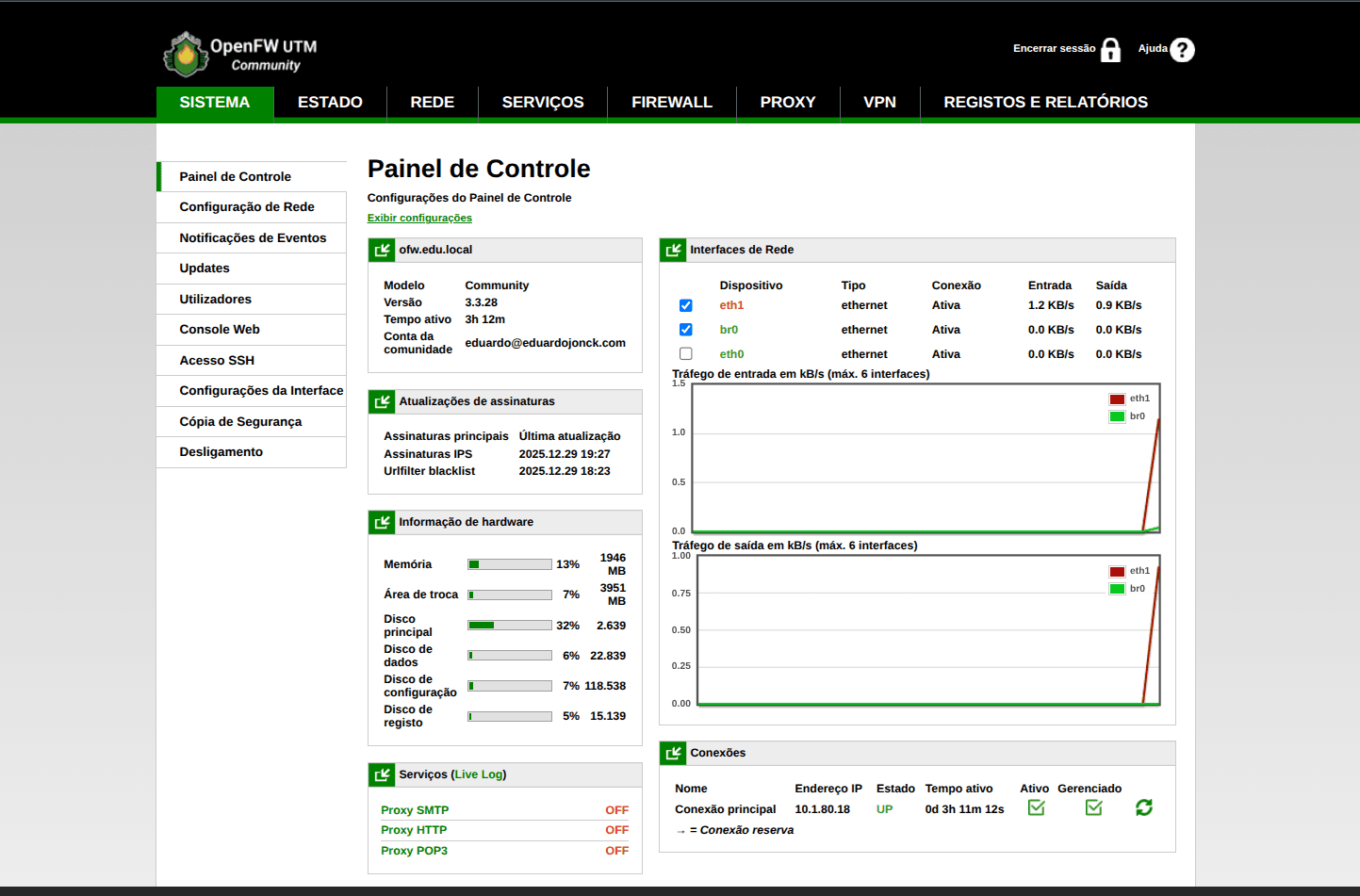
OpenFW UTM Community is a Linux security distribution that transforms x86_64 hardware into a Unified Threat Management appliance.
The distribution is a fork of Endian Firewall UTM Community. It combines firewall, routing, VPN, intrusion prevention, proxy and network monitoring facilities within a centralised web interface.
This is free and open source software.
Key Features
- Stateful firewall powered by iptables.
- Inline intrusion detection and prevention.
- GeoIP-based traffic filtering.
- Standard and custom network zones with multi-LAN support.
- IEEE 802.1Q VLAN network segmentation.
- Network Address Translation and port forwarding.
- Transparent HTTP and HTTPS proxy with web content filtering.
- OpenVPN, IPsec and WireGuard virtual private networks.
- Multi-WAN connectivity with automatic failover.
- Traffic prioritisation and bandwidth control through Quality of Service.
- DHCP, DNS, NTP, Dynamic DNS and policy-based routing services.
- Active Directory and LDAP authentication.
- Live network monitoring, reports and event management.
- Extensible through add-ons and Docker CE containers.
| Working state: | Active |
| Desktop: | None (web-based administration) |
| Init Software: | SysVinit |
| Package Management: | RPM |
| Release Model: | Fixed |
| Platforms: | x86_64 |
| Home Page: | OpenFW UTM Community |
| Developer: | Eduardo Jonck |
| This article is part of our Big List of Active Linux Distributions and Open Source Operating Systems. |
What's a Linux distribution ("distro")? |
| A distro provides the user with a desktop environment, preloaded applications, and ways to update and maintain the system. Each distro makes different choices, deciding which open source projects to install and provides custom written programs. They can have different philosophies. Some distros are intended for desktop computers, some for servers without a graphical interface, and others for special uses. Because Linux is an open source operating system, combinations of software vary between Linux distros. |
Please read our Comment Policy before commenting.