

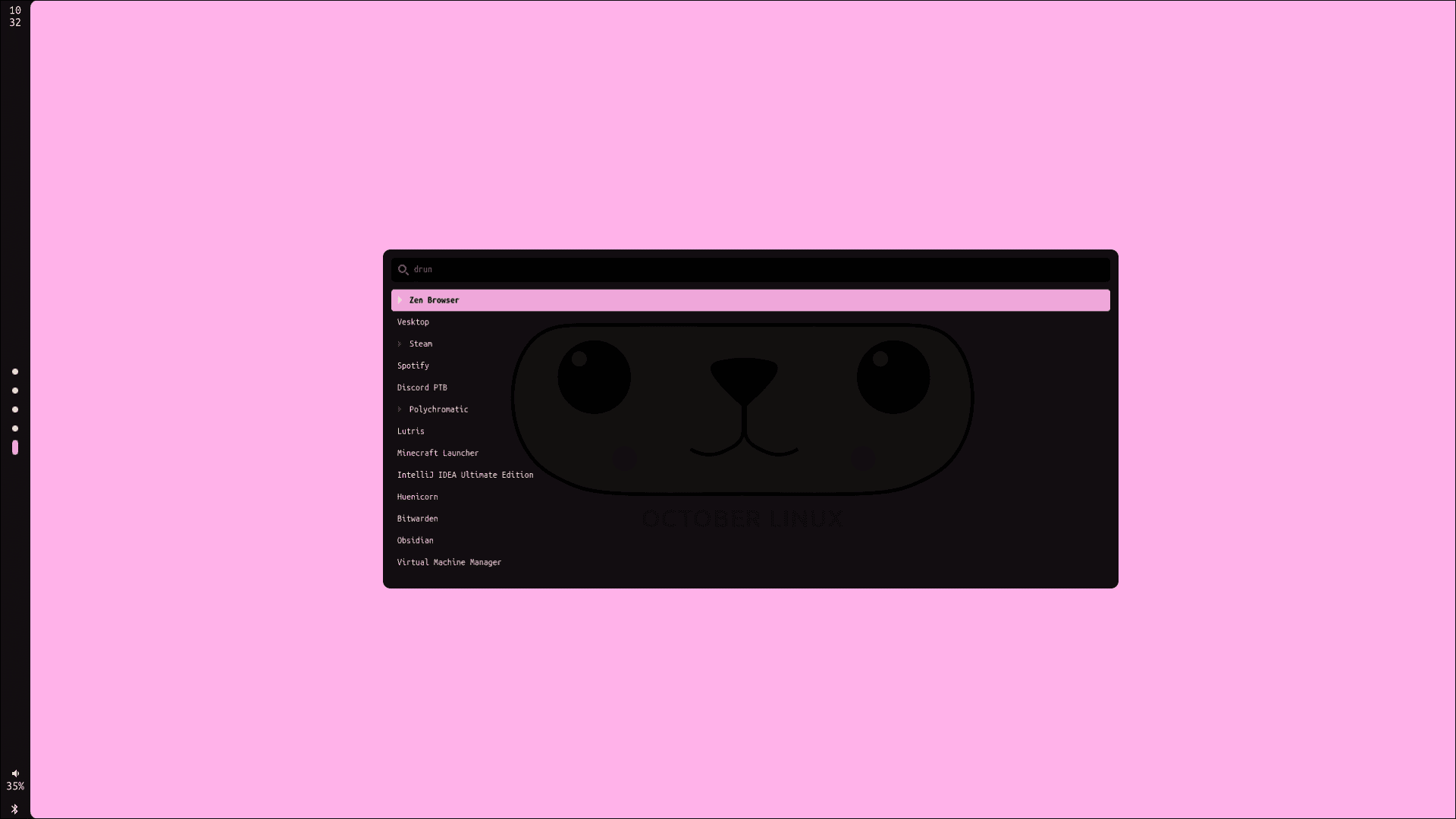
October Linux is an Arch-based Linux distribution designed to combine the minimalist philosophy of Arch Linux with a preconfigured desktop experience. It features the Hyprland Wayland compositor, a Quickshell panel, and the Wofi application launcher.
The distribution’s desktop configuration provides a consistent visual appearance, with colours that automatically adapt to the selected wallpaper. Keyboard shortcuts are available for managing windows, switching workspaces, launching applications, capturing screenshots, and controlling the desktop.
October Linux uses a custom installer that automates deployment through a JSON configuration file. Users can define disk partitions, user accounts, system locale, timezone, package mirrors, and additional software before installation. The installer supports GPT partition tables and both ext4 and Btrfs filesystems. Installation requires an internet connection to retrieve packages.
The distribution also includes octoberctl, a command-line utility for managing wallpapers, changing the lock screen profile picture, and updating the desktop configuration. Hyprland customisations can be stored separately from the default configuration, allowing users to retain their changes when updating the supplied desktop settings.
| Working state: | Active |
| Desktop: | Hyprland |
| Init Software: | systemd |
| Package Management: | Pacman |
| Release Model: | Rolling |
| Platforms: | x86_64 |
| Home Page: | a href="https://octoberlinux.org/">octoberlinux.org |
| Developer: | Elliott Fournier-Robert and Arianne |
| This article is part of our Big List of Active Linux Distributions and Open Source Operating Systems. |
What's a Linux distribution ("distro")? |
| A distro provides the user with a desktop environment, preloaded applications, and ways to update and maintain the system. Each distro makes different choices, deciding which open source projects to install and provides custom written programs. They can have different philosophies. Some distros are intended for desktop computers, some for servers without a graphical interface, and others for special uses. Because Linux is an open source operating system, combinations of software vary between Linux distros. |
Please read our Comment Policy before commenting.