
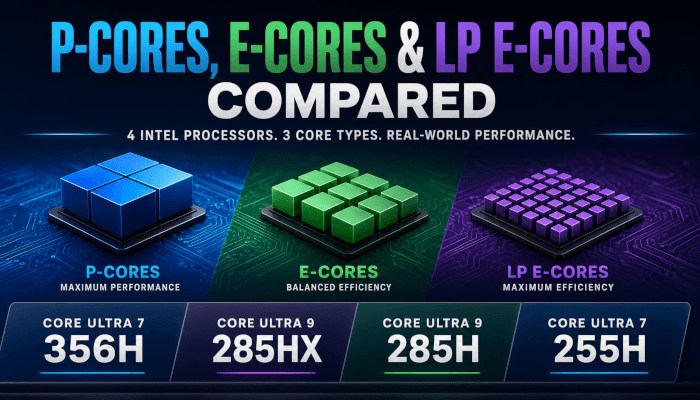
Intel’s modern mobile processors use a hybrid design that combines different types of CPU cores for different workloads. Performance-cores are designed for demanding single-threaded tasks, Efficient-cores add throughput for heavily threaded work, and Low Power Efficient-cores handle lighter background activity with lower power demands.
That sounds straightforward enough, but the balance between these core types varies significantly between processors. An LP E-Core in one processor may not behave like an LP E-Core in another.
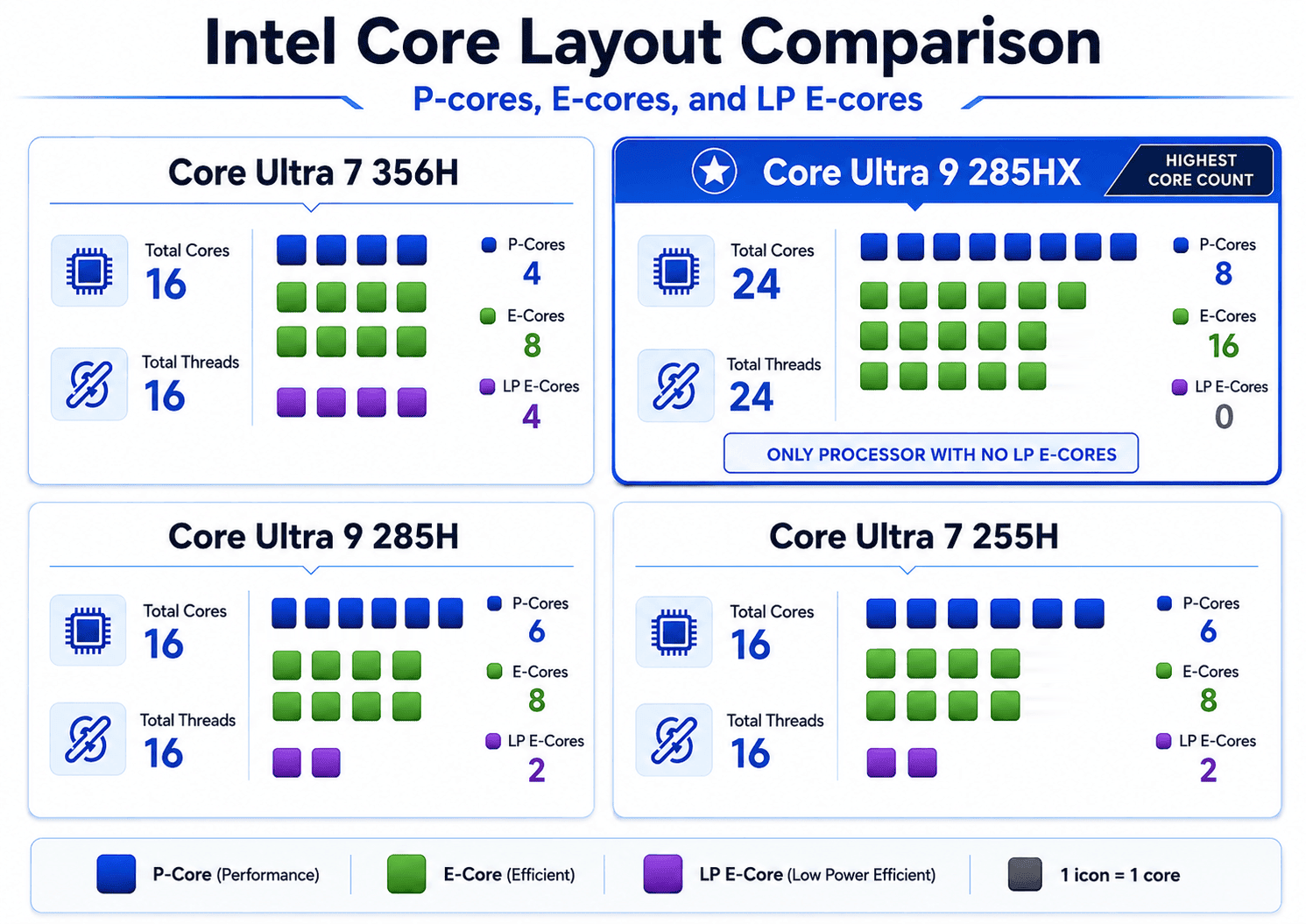
In this article, I compare the P-Cores, E-Cores, and LP E-Cores of four Intel processors: the Core Ultra 7 356H, Core Ultra 9 285HX, Core Ultra 9 285H, and Core Ultra 7 255H. The aim is to see how each core type performs in isolation, how well each processor scales when all cores are used, and whether Intel’s LP E-Cores behave like useful compute resources or simply low-power background cores.
The Core Ultra 7 356H powers the MINISFORUM M2 Intel Panther Lake Mini PC, while the Core Ultra 9 285HX is found in the Minisforum MS-02 Ultra 285HX Mini Workstation. The Core Ultra 9 285H sits inside the Bosgame M7 Mini PC, and the Core Ultra 7 255H is used in the ASRock Industrial NUC BOX-255H Mini PC.
The Core Ultra 9 285HX is included as an important point of contrast. Unlike the other three processors, it doesn’t have LP E-Cores, so it’s not a three-tier P-Core, E-Core, and LP E-Core design. Instead, it relies on a much stronger P-Core and E-Core configuration.
I’ve run three benchmarks on each processor. Coremark and smallpt can make use of all cores, while Crafty is a single-core benchmark. This makes the tests useful in different ways: Coremark and smallpt show how the processors scale, while Crafty highlights the strength of individual core types.
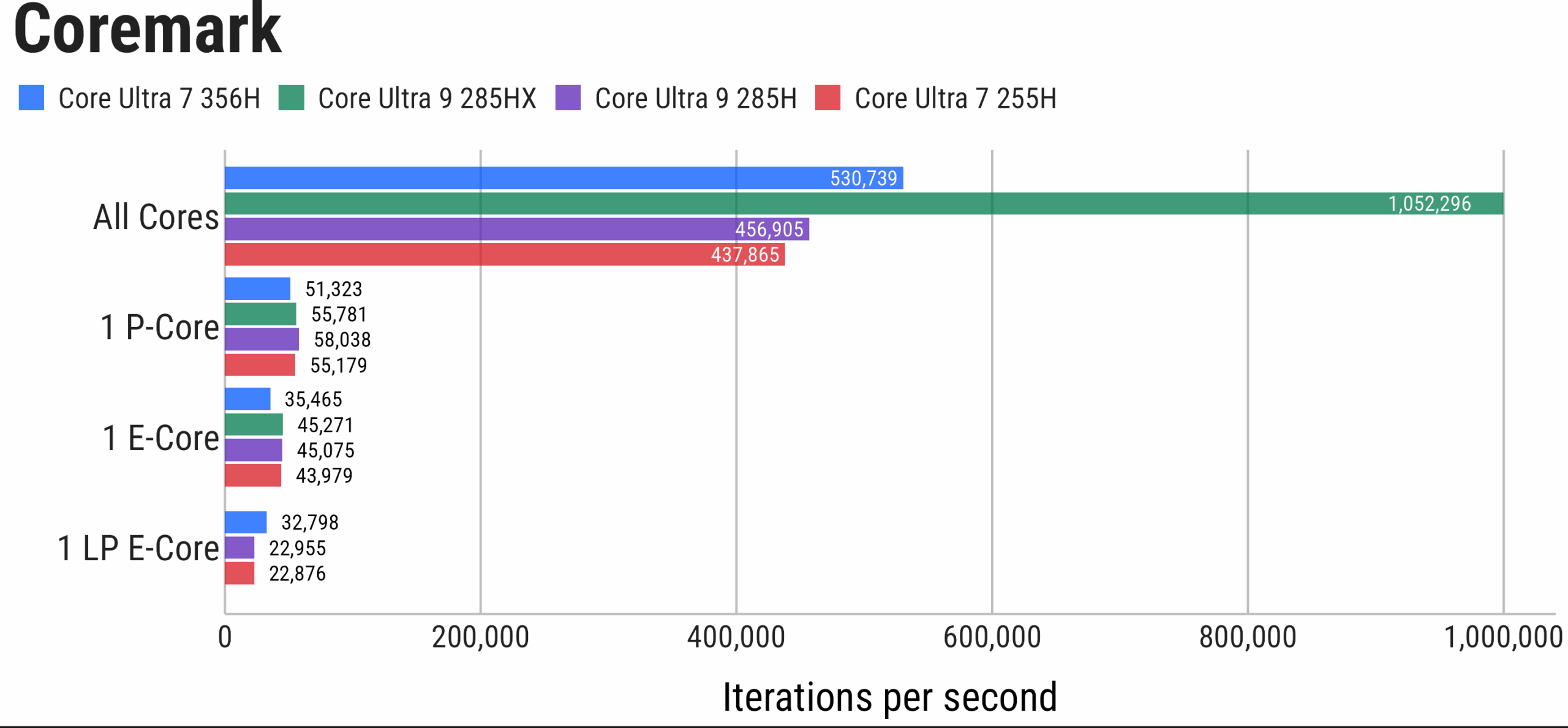
Coremark scales across all cores, and the Core Ultra 9 285HX dominates this benchmark. Its score of 1,052,296 iterations/sec is almost exactly double the Core Ultra 7 356H’s 530,739, and well over twice the scores of the 285H and 255H. This is the clearest all-core result in the article.
The 285HX’s advantage is not primarily about LP E-Cores, because it doesn’t have any. It wins because it has far more high-performance throughput available from its P-Cores and E-Cores. In a benchmark that rewards total multi-threaded muscle, that wider core configuration gives it a huge lead.
The Core Ultra 7 356H is the more interesting result. It finishes comfortably second in the all-core test even though its single P-Core score is the weakest of the four processors. Its P-Core reaches 51,323 iterations/sec, behind the 285H at 58,038, the 285HX at 55,781, and the 255H at 55,179.
The explanation lies in the 356H’s LP E-Core result. Its single LP E-Core scores 32,798 iterations/sec, far ahead of the 285H’s 22,955 and the 255H’s 22,876. More importantly, the 356H’s LP E-Core reaches about 92.5% of its own E-Core score. On the 285H and 255H, the LP E-Cores reach only around 51% to 52% of their E-Core results.
That’s a striking difference. On the 356H, the LP E-Core sits close to the E-Core. On the 285H and 255H, the LP E-Core is far more limited.
The Core Ultra 9 285H and Core Ultra 7 255H are closely matched in the all-core result: 456,905 versus 437,865. The 285H is only about 4.3% faster, so in Coremark they’re broadly in the same class despite the difference in branding.
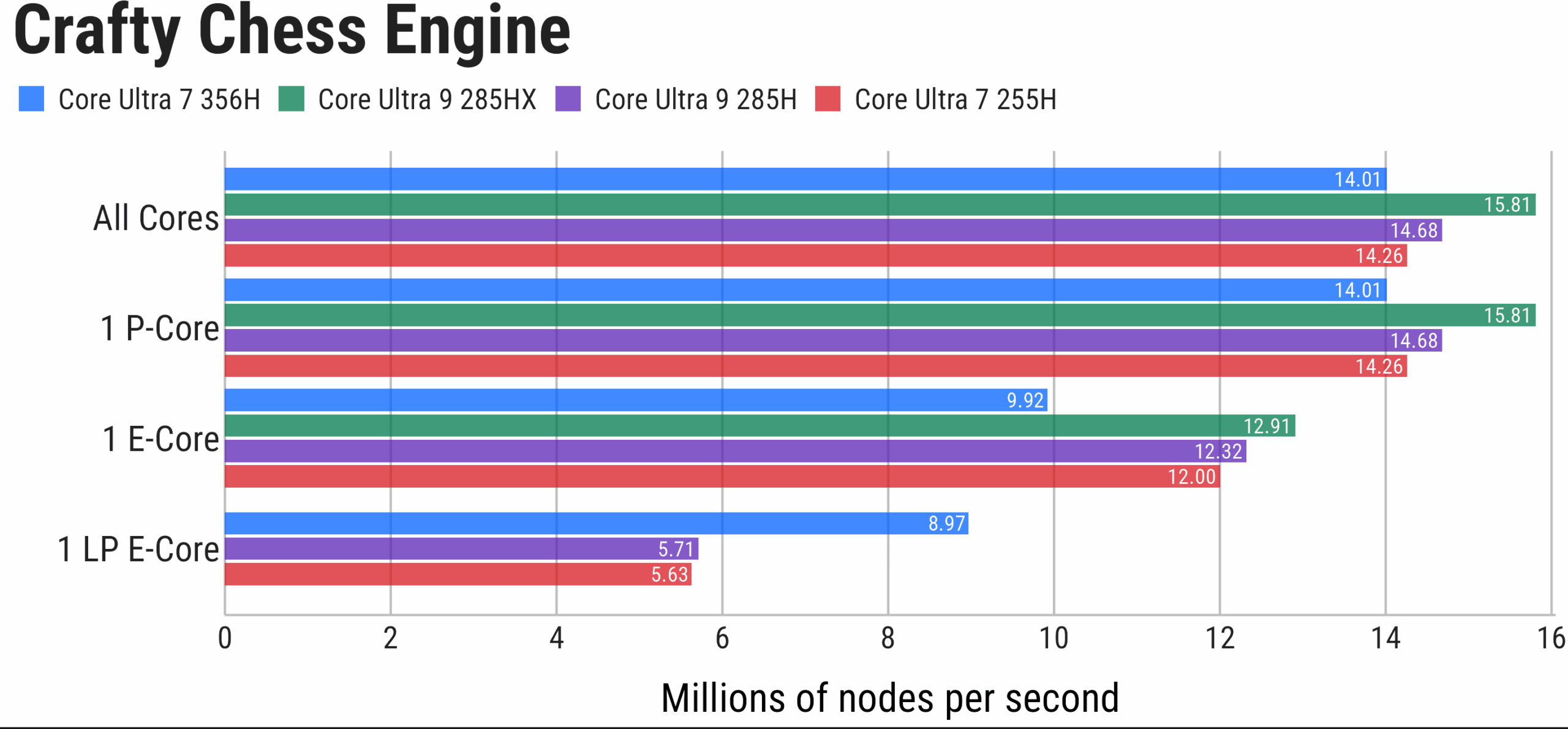
Crafty is a single-core benchmark, so the “All Cores” and “1 P-Core” results are identical for each processor. It’s useful for judging the strength of individual core types, but not total CPU throughput.
The 285HX has the strongest P-Core result, reaching 15.81 million nodes/sec. It’s ahead of the 285H at 14.68, the 255H at 14.26, and the 356H at 14.01. The 285HX leads, but the gap is much smaller than its advantage in the all-core Coremark result. It’s about 12.8% faster than the 356H and about 7.7% faster than the 285H.
The 285H and 255H are again close on their P-Cores, with the 285H less than 3% ahead. The 356H is last, but only narrowly behind the 255H. In this single-threaded chess workload, its P-Core remains competitive.
The E-Core results show a clearer divide. The 285HX leads with 12.91 million nodes/sec, followed closely by the 285H at 12.32 and the 255H at 12.00. The 356H trails more noticeably at 9.92, reinforcing that its standard E-Cores are its weakest area in these tests.
The LP E-Core result again changes the character of the 356H. It scores 8.97 million nodes/sec, compared with 5.71 for the 285H and 5.63 for the 255H. The 356H’s LP E-Core reaches about 90% of its own E-Core result. By contrast, the 285H and 255H LP E-Cores are less than half as fast as their E-Cores.
Crafty therefore confirms the same architectural pattern as Coremark. The 356H doesn’t have the strongest P-Cores or E-Cores, but its LP E-Core is far more capable than the LP E-Cores in the 285H and 255H.
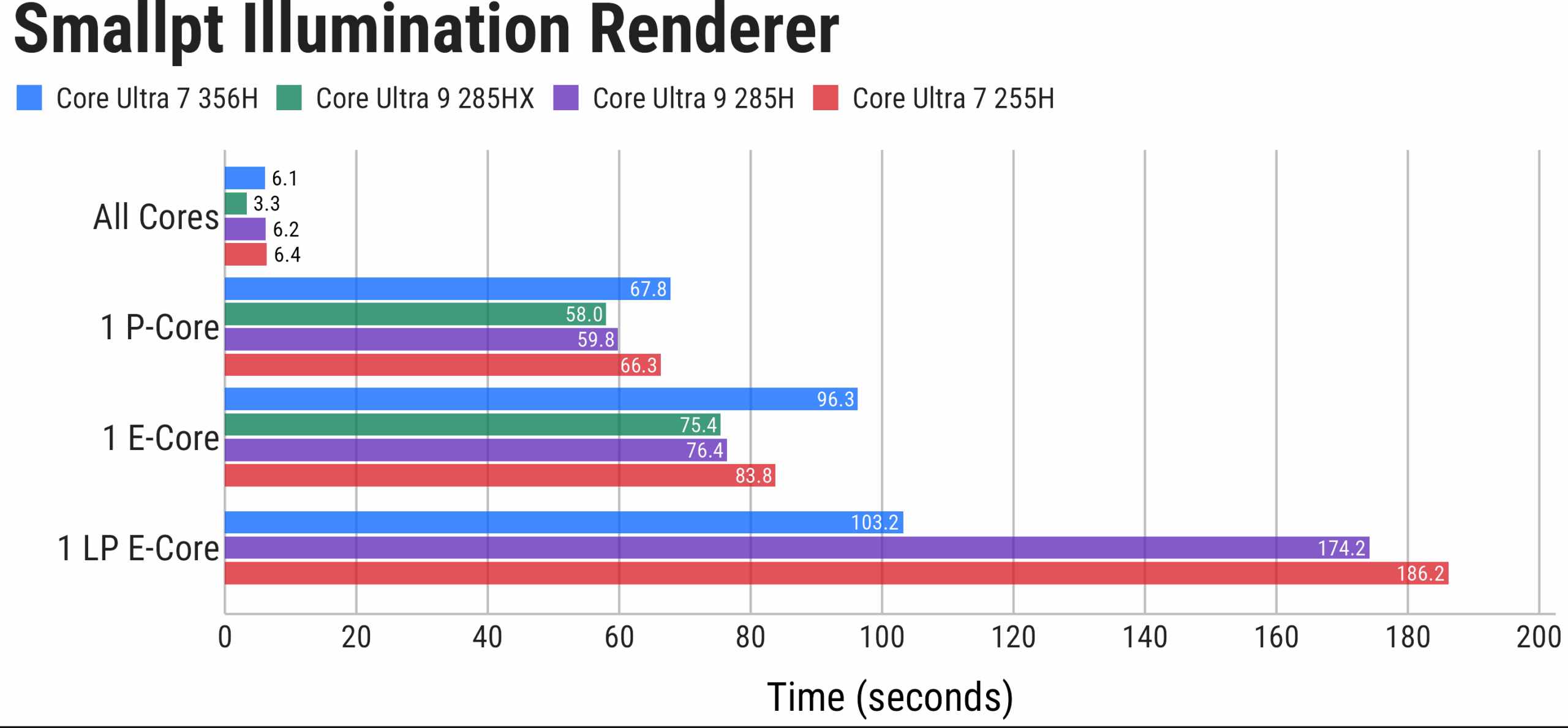
Smallpt reports time in seconds, so lower is better.
In the all-core result, the 285HX is again in a different class. It completes the test in 3.3 seconds, while the 356H, 285H, and 255H are tightly grouped at 6.1, 6.2, and 6.4 seconds respectively. The 285HX is therefore roughly twice as fast as the rest in this fully threaded rendering workload.
The 356H’s all-core result is another good showing. It narrowly beats the 285H and 255H, despite not having the strongest individual P-Core or E-Core. As with Coremark, the result suggests its stronger LP E-Core contributes meaningfully when all cores are used.
On a single P-Core, the 285HX is fastest at 58.0 seconds, followed closely by the 285H at 59.8 seconds. The 255H takes 66.3 seconds, while the 356H takes 67.8 seconds. This is a more pronounced gap than in Crafty, and it shows the 356H’s P-Core falling further behind the 285HX and 285H.
The 285H’s P-Core is only 1.8 seconds slower than the 285HX in Smallpt. That’s important because it shows the 285HX’s huge all-core lead comes much more from having greater total compute resources than from a dramatically faster individual P-Core.
The E-Core results favour the 285HX and 285H. The 285HX completes the test in 75.4 seconds, the 285H in 76.4 seconds, the 255H in 83.8 seconds, and the 356H in 96.3 seconds. This is the weakest showing for the 356H’s E-Core, taking about 28% longer than the 285HX’s E-Core.
The LP E-Core result is the most revealing part of this chart. The 356H completes Smallpt in 103.2 seconds, only slightly behind its E-Core. The 285H takes 174.2 seconds on its LP E-Core, while the 255H takes 186.2 seconds. On those two processors, the LP E-Cores are more than twice as slow as the E-Cores.
That makes the distinction very clear. On the 285H and 255H, the LP E-Cores look suited to light background work rather than heavy compute. On the 356H, the LP E-Core behaves much more like a useful small compute core.
Summary
The Core Ultra 9 285HX is the standout processor for heavy multi-threaded workloads. It has no LP E-Cores, but that doesn’t hurt it in these benchmarks. Its P-Core and E-Core resources give it commanding all-core leads in Coremark and smallpt.
The Core Ultra 9 285H is strong in lightly threaded work and often has the best or near-best single P-Core result among the processors with LP E-Cores. But its all-core performance is far below the 285HX and only modestly ahead of the 255H.
The Core Ultra 7 255H is surprisingly close to the 285H in several places. Its Coremark all-core score is only slightly lower, its Crafty P-Core result is close, and its E-Core numbers aren’t far behind. The gap between the Core Ultra 9 285H and Core Ultra 7 255H is not as large as the model names might suggest.
The Core Ultra 7 356H is the most unusual processor in the comparison. Its P-Cores and E-Cores are not the strongest, but its LP E-Core is vastly better than the LP E-Cores in the 285H and 255H. In these benchmarks, the 356H’s LP E-Core sits much closer to its E-Core than expected.
That’s the key finding from these results. “LP E-Core” doesn’t mean the same thing across these processors. On the 285H and 255H, the LP E-Cores are much slower than the E-Cores. On the 356H, the LP E-Core behaves more like a useful compute resource than a token low-power background core.
The 285HX should also be treated separately. It’s not a three-tier P-Core, E-Core, and LP E-Core design like the other chips. Its story is simpler: powerful P-Cores, strong E-Cores, no LP E-Cores, and enormous all-core throughput.
Please read our Comment Policy before commenting.
Look, it’s nice to use AI graphics, but AI apparently can’t count…
For your…
285HX the graphic shows 18 e-core blocks, there should be 16.
285H 5 p-core blocks, there should be 6.
255H 5 p-core blocks, there should be 6, and 10 e-core blocks, there should be 8.