

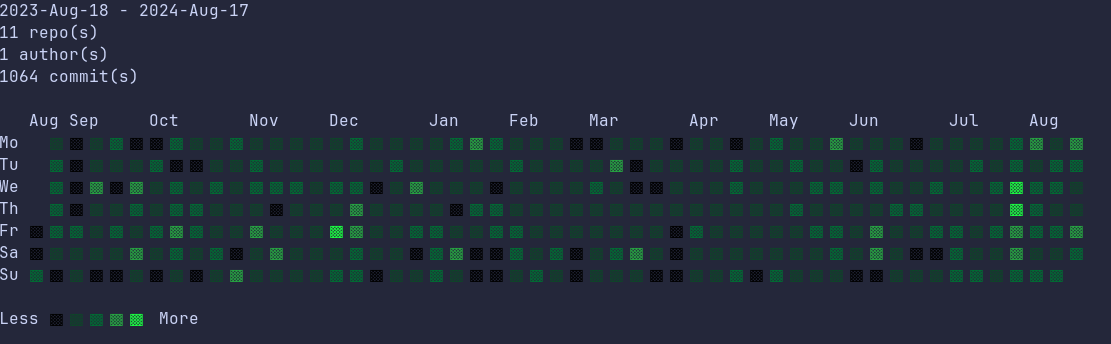
git-heatmap visualises activity from the commit history of a local Git repository. Its output provides an at-a-glance view of when work took place, rather than forcing users to infer patterns from a long list of commit dates.
A contribution heatmap can be useful for understanding periods of concentrated development and breaks in activity. The utility works from data already stored in Git and does not require the repository to be hosted on GitHub or another forge.
A calendar display is a compact way to show patterns that can be hard to see in a chronological commit log. It can reveal busy periods and stretches with few recorded commits, but it should not be treated as a measure of work quality or total effort: one commit may represent a very different amount of work from another. As with other contribution calendars, it counts recorded activity rather than estimating code complexity, development effort or the importance of a particular change. The visualisation is therefore best read alongside other repository history reports.
This is free and open source software.
Key Features
- Generates an activity heatmap from the history of a local Git repository.
- Shows how commit activity is distributed across dates.
- Offers visual customisation of the generated heatmap.
- Uses commit history from Git itself rather than relying on a hosted service.
- Provides a command-line workflow suitable for local repository inspection.
Website: codeberg.org/WyndFTW/git-heatmap
Support:
Developer: Wynd
License: GNU General Public License v3.0
git-heatmap is written in Rust. Learn Rust with our recommended free books and free tutorials.
Related Software
| Git Tools for Diff Review and Repository History | |
|---|---|
| difftastic | Structural diff tool that compares files based on their syntax |
| git-filter-repo | Quickly rewrite git repository history |
| onefetch | Displays information about a local Git repository |
| git-stats | Local git statistics including GitHub-like contributions calendars |
| diff-so-fancy | Attractive diffs with diff-highlight and more |
| BFG Repo-Cleaner | Clean unwanted data from Git repository history |
| git-delta | Viewer for git and diff output |
| gitlogue | Cinematic Git commit replay tool |
| git-quick-stats | Access various statistics in a git repository |
| git-who | Command-line Git analysis tool |
| git-standup | Recall what you did on the last working day |
| git-of-theseus | Analyze how a Git repo grows over time |
| git-sizer | Compute various size metrics for a git repository |
| diffnav | Git diff pager based on delta but with a file tree, à la GitHub |
| critique | Terminal UI for reviewing git diffs |
| git-big-picture | Visualization tool for Git repositories |
| hercules | Gain advanced insights from Git repository history |
| keifu | TUI that visualizes Git commit graphs |
| git-fame | Git repository collaborators sorted by contributions |
| needle | Highlights GitHub PRs |
| mergiraf | Git merge driver |
| git-history | Analyze Git history using SQLite |
| ec | Terminal Git mergetool |
| diffr | Word-by-word diff highlighting utility |
| git-scope | Fast TUI dashboard to view the git status of all your repositories |
| mamediff | Manages unstaged and staged Git diffs |
| deadbranch | Keep Git repositories tidy |
| GitTop | Lightweight desktop client for GitHub notifications |
| git-heatmap | Generates a customizable heatmap |
Read our verdict in the software roundup.
 LinuxLinks helps you discover the best free and open source software for Linux. Explore our extensive collection of recommended applications, including alternatives to popular proprietary software. We also publish software reviews, Linux tutorials, hardware reviews, free programming books and articles covering the wider open source community. Browse our Linux resources to discover more. Know a useful free and open source Linux application we haven't covered? Suggest a program for inclusion. Has your software been featured on LinuxLinks? Display one of our Featured on LinuxLinks badges on your website or GitHub README. |
Please read our Comment Policy before commenting.