
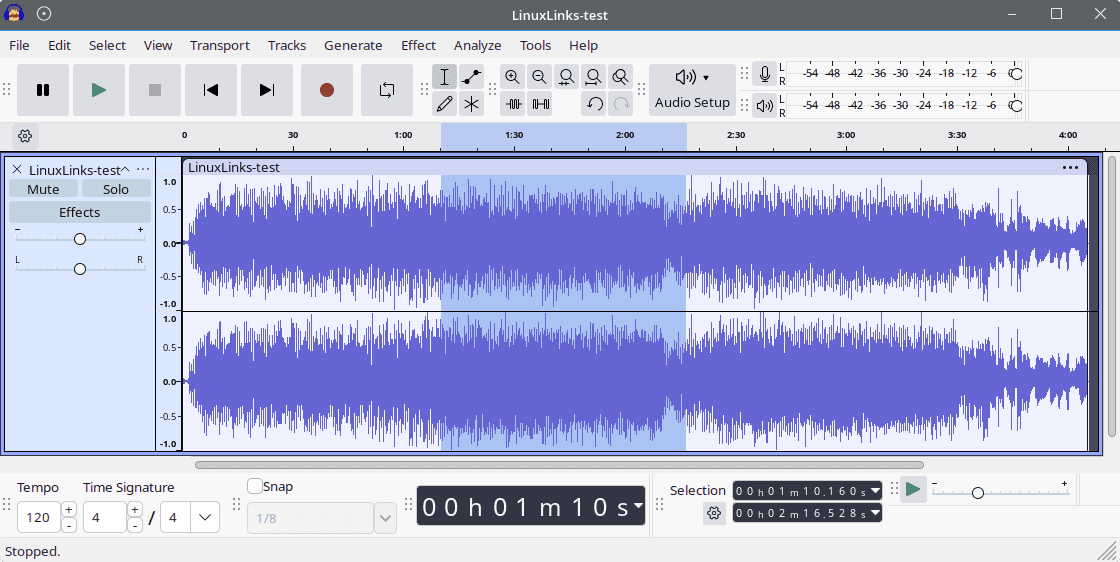
Audacity is a popular multitrack audio editor and recorder. It can record live audio, edit existing recordings, combine multiple tracks, apply effects and export finished work in a wide range of audio formats.
Audacity 4 introduced a redesigned Qt interface together with a new clip-editing model. Clips can be selected and manipulated individually or in groups, moved between compatible tracks, trimmed, time-stretched and split without the restrictions imposed by older releases.
The program remains particularly attractive for podcast editing, digitising analogue recordings, general-purpose audio work and tasks where a full digital audio workstation would be unnecessary.
This is free and open source software.
Key Features
- Record from microphones, mixers and other audio devices with support for multichannel recording hardware.
- Edit multiple tracks with cut, copy, paste, trimming, splitting, time stretching and unlimited undo and redo.
- Select, group and manipulate multiple clips together, including moving clips between mono and stereo tracks.
- Flexible recording workflow with recording from arbitrary timeline positions, lead-in recording, Punch and Roll, latency compensation and per-track input monitoring.
- Built-in effects, generators and analysis tools with support for realtime effects.
- Supports VST3, Nyquist and LV2 plugins on Linux.
- Spectrogram view offers detailed frequency visualization together with spectrum-analysis tools.
- Imports and exports common formats including WAV, AIFF, FLAC, MP3 and Ogg Vorbis, with additional formats available through FFmpeg.
- Export multiple tracks or labelled regions to separate files.
- Workspaces provide configurable interface layouts, with Modern, Classic and Music layouts supplied.
- Toolbars and panels can be moved, docked, floated, shown or hidden.
- Light, dark and high-contrast themes with configurable accent, track and clip appearance.
- Sample-accurate waveform editing is available when zoomed to individual samples.
- Label tracks help annotate sections of a recording and organize editing and export workflows.
- Project recovery helps protect work following an unexpected interruption.
- Cross-platform support – runs on Linux, macOS, and Windows.
Website: www.audacityteam.org
Support:
Developer: Audacity Team
License: GNU General Public License v3.0
Audacity is written in C++. Learn C++ with our recommended free books and free tutorials.
Related Software
| Audio Editors | |
|---|---|
| Audacity | Multi-track audio editor and recorder |
| SoX | Swiss Army knife of sound processing programs |
| LosslessCut | Swiss army knife of lossless video/audio editing |
| Tenacity | Cross-platform multi-track audio editor/recorder; fork of Audacity |
| Auto-Editor | Automatically edit video and audio |
| audapolis | Editor for spoken-word media with transcription |
| Kwave | Sound editor built on the KDE Frameworks 5 |
| AudioMass | Edit and manipulate audio directly in your browser |
| Cecilia | Audio signal processing environment aimed at sound designers |
| GWC | Gnome Wave Cleaner |
| Snd | An advanced sound editor modeled loosely after Emacs |
| Reco | Audio recording app designed for elementary OS |
| pxtone collab | Sample-based music editor |
| Sound Recorder | Straightforward way to record and play audio with simple interface |
| mp3splt | Command-line tool to split mp3, ogg vorbis and FLAC files without decoding |
| MorphEdit | Browser-based desktop audio editor for trimming, effects, mixing, and more |
| WaveSurfer | Tool for sound visualization and manipulation |
| Sweep | Audio editor and live playback tool |
| mhWaveEdit | Simple and fast sound editor |
| EKO | Graphical sound editor for recording, cutting, effects and waveform editing |
Read our verdict in the software roundup.
 Explore our carefully curated directory of recommended free and open source software, covering every major software category. Explore our carefully curated directory of recommended free and open source software, covering every major software category.The directory forms part of our extensive collection of articles for Linux enthusiasts. It includes hundreds of detailed reviews, together with free and open source alternatives to proprietary software from companies such as Google, Microsoft, Apple, Adobe, IBM, Cisco, Oracle, and Autodesk. LinuxLinks also covers interesting projects worth exploring, Linux-compatible hardware, free programming books and tutorials, and much more. Know a useful free and open source Linux application that we haven’t covered? Tell us about it using our submission form. |
Please read our Comment Policy before commenting.
Still my go-to audio editor for many, many years.
Audacity was great. That said each new release has more and more problems, at least on Linux OS’s. Software must be added. It often doesn’t support headphones It also only support Alsa not Pipewire. I have not got it to work on any Linux OS that has went to Pipewire. The sound system will not find Audacity.
The is problem no other program does quite what Audacity does or supports the number of sound files audacity does. Ocenaudio comes about the closest, but still only has limited functions compared to Audacity.