
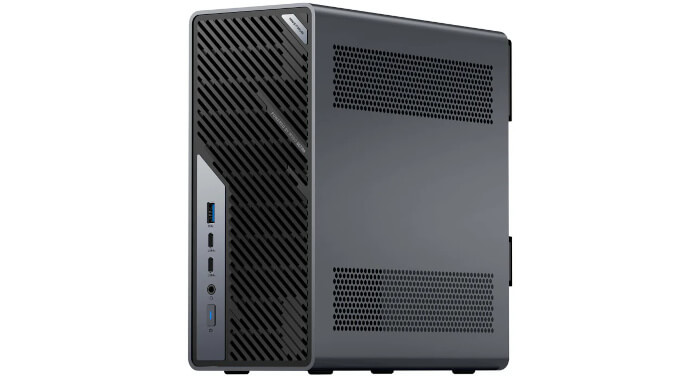
This is a series looking at the Minisforum MS-02 Ultra 285HX Mini Workstation running Linux. In this series, I’ll put this machine through its paces from a Linux perspective, comparing it with other systems, including desktops, to show how it really stacks up.
The Minisforum MS-02 Ultra is very different from a conventional mini PC. It’s a compact workstation and mini-server class machine built around the Intel Core Ultra 9 285HX processor. The model I’m testing offers far more expansion than a typical mini PC, including PCIe expansion, 4 M.2 NVMe slots, an internal 350 W power supply, 10GbE and 2.5GbE networking, and dual 25GbE ports.
The Core Ultra 9 285HX uses Intel’s hybrid architecture, combining 8 Performance-cores and 16 Efficient-cores. The P-cores deliver the strongest single-threaded performance, while the E-cores provide substantial multi-threaded throughput for heavily parallel workloads. Unlike the Core Ultra 9 285H, the 285HX does not include any Low Power Efficient-cores. It exposes 24 cores and 24 threads, so each core maps to a single logical CPU.
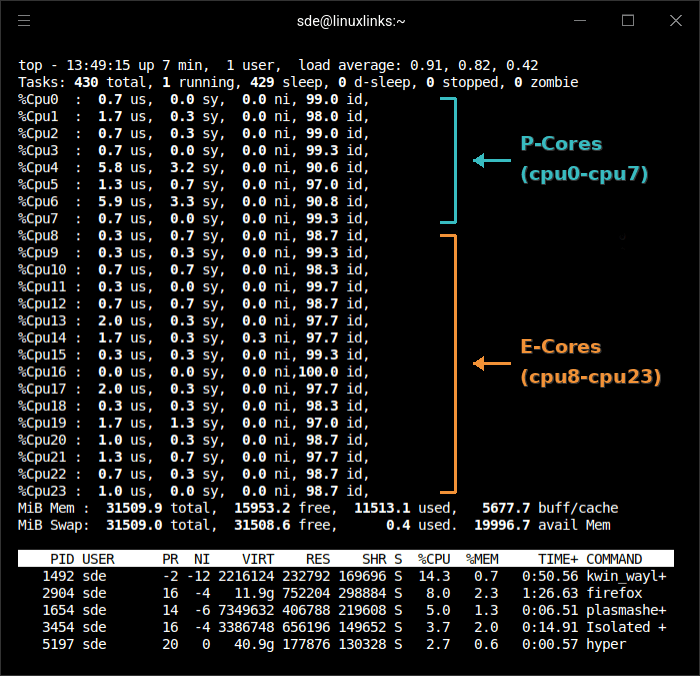
My annotated image is supported by the lscpu command, which reports the maximum clock frequency for each core type.
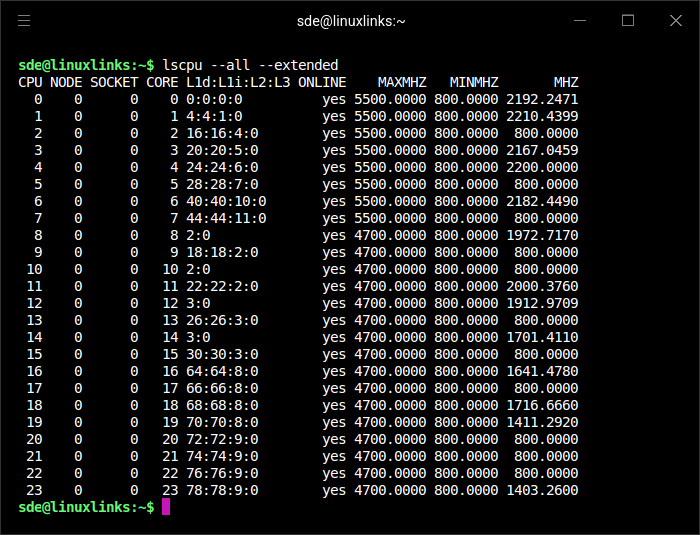
I’m interested in measuring the performance difference between the P-cores and E-cores in the Core Ultra 9 285HX. The BIOS lets me disable specific cores, but it’s a fairly blunt approach. It also doesn’t let me disable all the P-cores; at least one P-core has to remain enabled. A simpler and more flexible method is to use the taskset utility, which lets a process run on selected CPU cores without changing the BIOS configuration.
I’ll start with Crafty, the chess engine benchmark available in the Phoronix Test Suite. It’s a useful first test because Crafty is single-threaded, so it only uses one CPU core. That makes the results much easier to interpret, as each run can be pinned to a specific core type and compared directly.
I can run the Crafty benchmark separately on a P-core, and on an E-core.
$ taskset -c 0 phoronix-test-suite benchmark crafty
$ taskset -c 8 phoronix-test-suite benchmark crafty
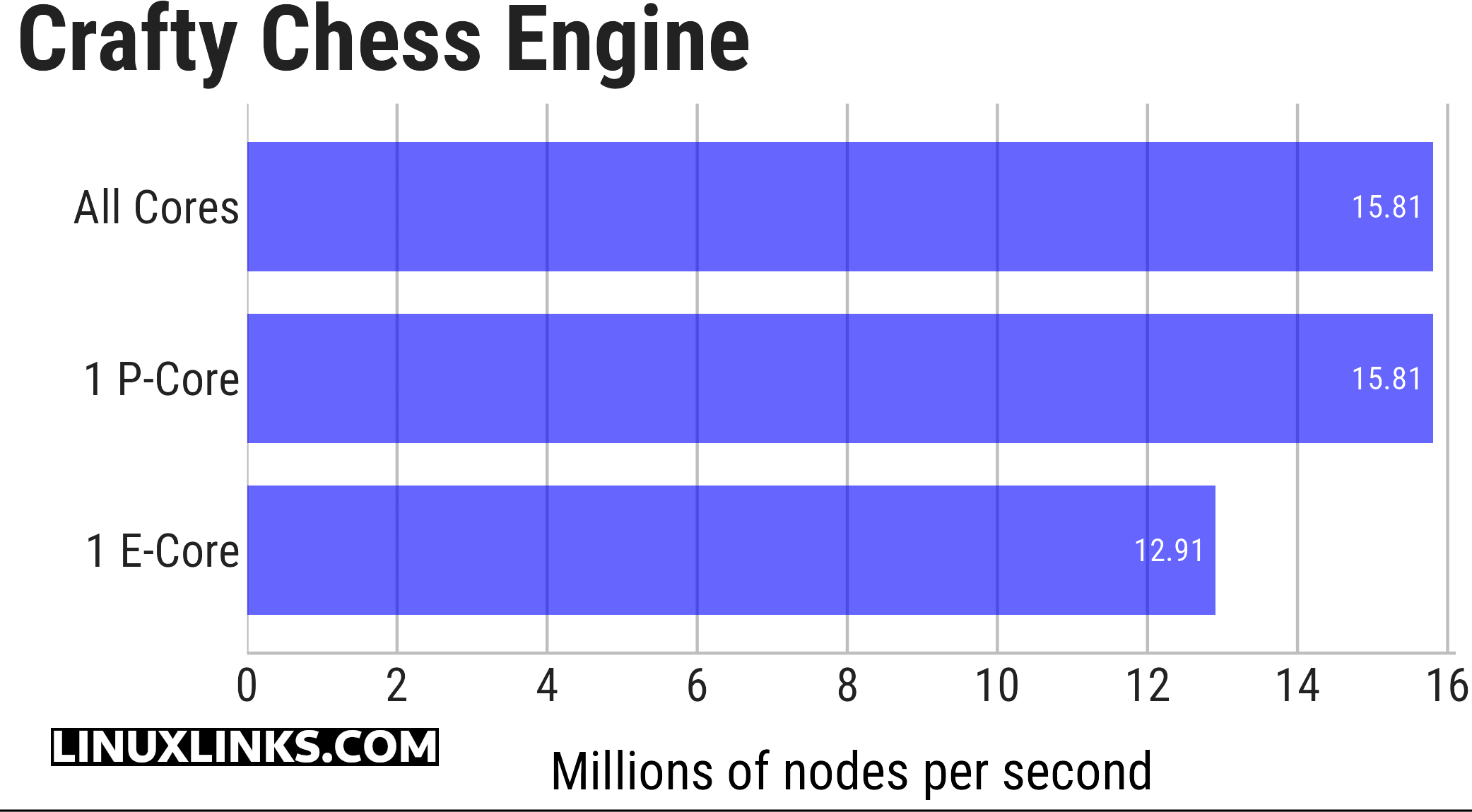
Crafty is a single-threaded benchmark, and the Core Ultra 9 285HX result makes that obvious. Allowing the benchmark to run on all cores produces 15.81 million nodes per second, exactly the same result as restricting it to one P-Core. In this workload, the extra cores don’t improve throughput; performance is effectively determined by the fastest available core.
The 1 E-Core result is still strong at 12.91 million nodes per second. That’s about 82% of the P-Core result, so the E-Core is clearly slower, but not dramatically so for this particular workload.
Compared with the Core Ultra 9 285H, the 285HX is faster across both comparable core types. Its 1 P-Core score of 15.81 is up from 14.68 on the 285H, a gain of about 7.7%. Its 1 E-Core score of 12.91 is up from 12.32, a smaller but still useful improvement of about 4.8%.
Overall, this is a strong result for the 285HX, but it’s also a reminder that Crafty is measuring fast per-core performance rather than total processor throughput. The 285HX’s advantage over the 285H is clear, especially on the P-Core, but this benchmark doesn’t show the full benefit of the 285HX’s much larger core count.
Let’s take the results for Coremark, a benchmark that can use all of the Core Ultra 9 285HX’s cores.
$ taskset -c 0 phoronix-test-suite benchmark coremark
$ taskset -c 8 phoronix-test-suite benchmark coremark
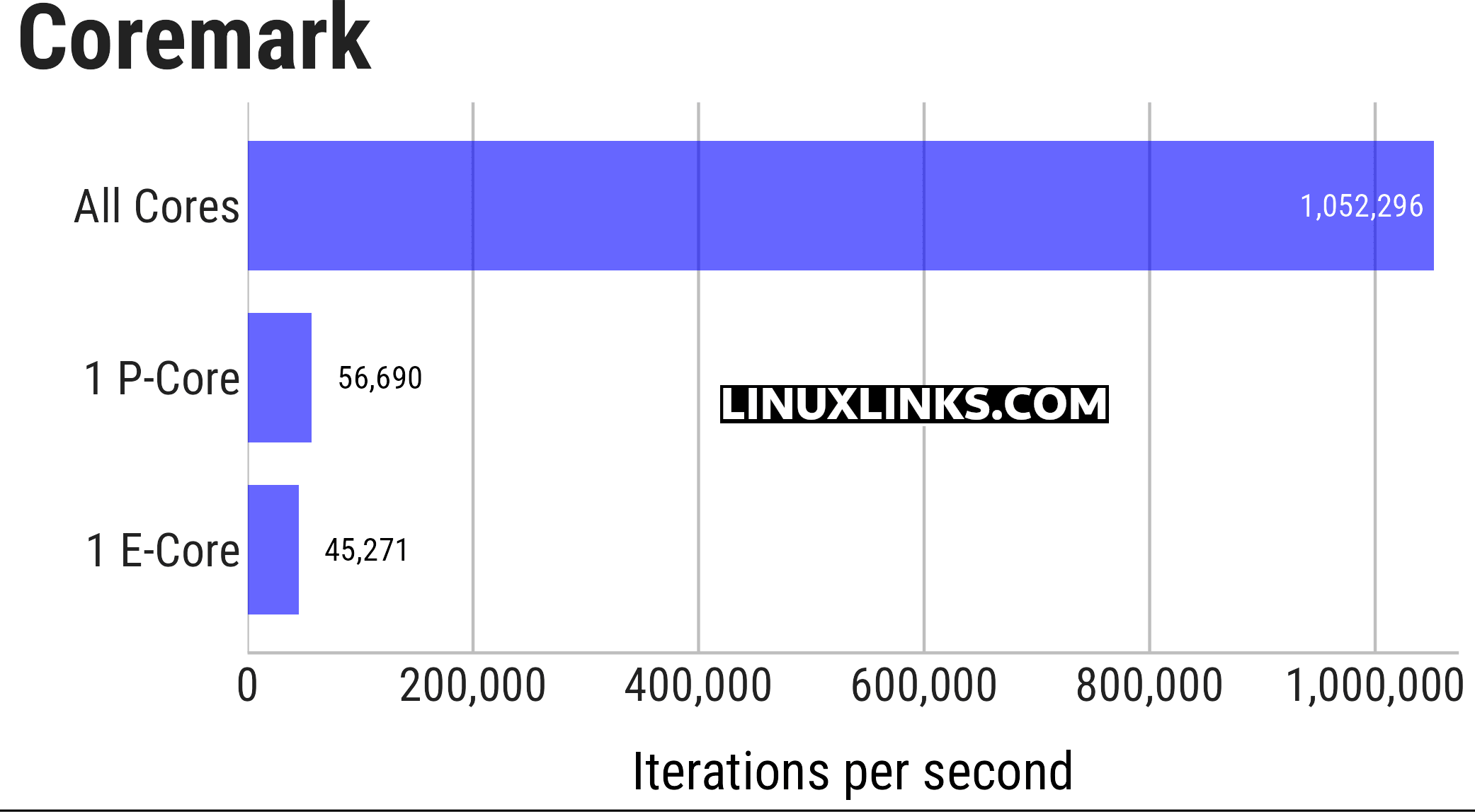
CoreMark gives the Core Ultra 9 285HX a chance to show its real advantage. The all-core score of 1,052,296 iterations/sec is more than 2.3× faster than the Core Ultra 9 285H’s score of 456,905, so this is a clear win for the 285HX in heavily threaded workloads.
The interesting point is that the win doesn’t come from better single-core performance. The 285HX’s 1 P-Core score of 56,690 is actually slightly behind the 285H’s 58,038. The E-Core result is almost identical too: 45,271 for the 285HX versus 45,075 for the 285H. So per-core performance is broadly the same, with the 285H even holding a tiny P-Core lead.
The 285HX pulls away because it has far more performance available when all cores are active.
The 285H also has 2 LP E-Cores. A single LP E-Core scores 22,955, which is roughly half the performance of a standard E-Core. The 285HX doesn’t have LP E-Cores, so its core mix is more focused on higher-throughput cores. For CoreMark, that makes the 285HX the much stronger processor overall, even though its individual P-Core isn’t faster.
I’ll also perform a similar exercise with the smallpt benchmark.
$ taskset -c 0 phoronix-test-suite benchmark smallpt
$ taskset -c 8 phoronix-test-suite benchmark smallpt
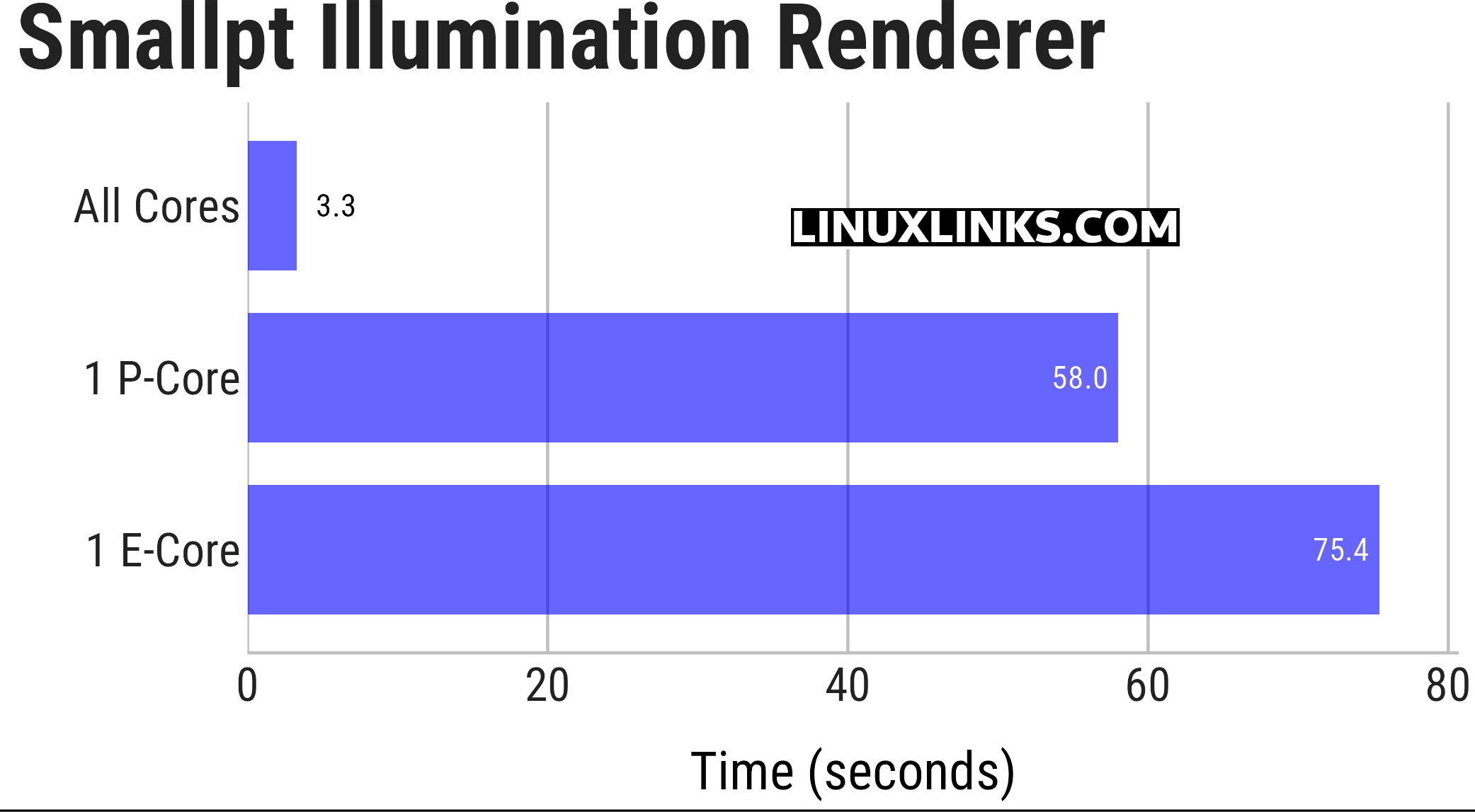
Smallpt is time-based, so lower is better. The Core Ultra 9 285HX finishes in 3.3 seconds using all cores, versus 58.0 seconds on 1 P-Core and 75.4 seconds on 1 E-Core. That’s a huge all-core uplift, with the full processor around 17.6× faster than a single P-Core.
Compared with the Core Ultra 9 285H, the 285HX is strongest in the all-core result: 3.3 seconds versus 6.2 seconds, so it’s about 1.9× faster. Single-core results are much closer. The 285HX’s 1 P-Core result is only slightly faster than the 285H’s 59.8 seconds, and its 1 E-Core result is also only marginally ahead of the 285H’s 76.4 seconds.
The 285H also has 2 LP E-Cores. Its 1 LP E-Core result of 174.2 seconds shows how much slower those cores are for this workload. The key takeaway is that the 285HX’s big win comes from its much stronger all-core throughput, not a major single-core advantage.
Complete list of articles in this series:
| Minisforum MS-02 Ultra 285HX | |
|---|---|
| Introduction | Introduction to the series and interrogation of the machine |
| Benchmarks | Benchmarking the Minisforum MS-02 Ultra 285HX Mini Workstation |
| Power | Testing and comparing the power consumption |
| Dual channel memory | Assessing the impact of adding a second SO-DIMM |
| Cores | Benchmarking cores under Linux |
| BIOS | In the world of computing, BIOS, which stands for Basic Input/Output System, plays a crucial role |
| Btrfs | Advanced, modern copy-on-write (CoW) file system for Linux |
| Intel processors | P-Cores, E-Cores and LP E-Cores Compared Across 4 Intel Processors |
| More articles will be published next week | |
Please read our Comment Policy before commenting.
One thing I’m curious about is why Intel omitted the LP E-Cores entirely on the HX part. Is it simply because this class of processor is expected to live in higher-power systems where idle/light-load efficiency matters less, or is there a die/packaging reason behind it?