
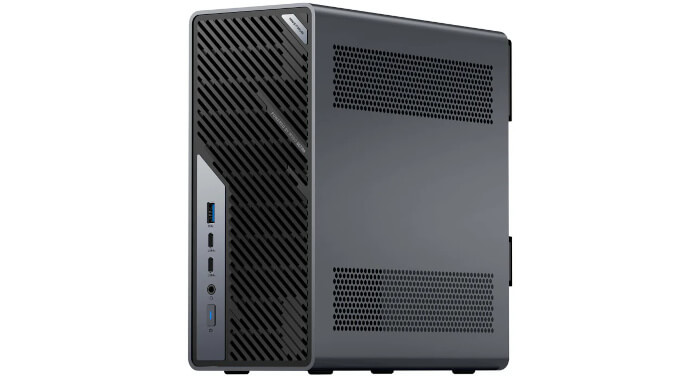
This is a new series looking at the Minisforum MS-02 Ultra 285HX Mini Workstation running Linux. In this series, I’ll put this machine through its paces from a Linux perspective, comparing it with other systems, including desktops, to show how it really stacks up.
The Minisforum MS-02 Ultra 285HX is a compact workstation powered by Intel’s Core Ultra 9 285HX, a 24-core processor. It targets AI, media, development, and workstation workloads in a small 4.8L chassis. Key strengths include PCIe 5.0 expansion, USB4 V2, dual 25GbE networking, and support for up to 256GB DDR5 memory. Its upgrade-friendly design makes it a flexible mini workstation for creators, engineers, and homelab users.
For this article in the series, I’ve benchmarked the Minisforum MS-02 Ultra using a range of tests, most of them run with the Phoronix Test Suite. I’ve compared its results against nine other systems, comprising mini PCs and two Intel desktop systems powered by Core i5-10400 and Core i5-12400 processors.
The Intel N100 machine is included as a useful low-cost baseline. It shows what an inexpensive mini PC can deliver, making it easier to judge how much extra performance the higher-specification systems provide and whether that additional speed, responsiveness, and headroom justify their higher price for your workloads.
Each system is tested with the same software stack and configured as consistently as possible to ensure fair comparisons. Power-saving features are disabled where possible during benchmarking, and where the BIOS offers a Power Limit mode, Performance Mode is selected. I also apply every reasonable performance-enhancing measure: the performance governor is used for all tests, background processes are kept to a minimum, and no Wayland session is running except where required for graphics benchmarks.
I begin with benchmarks that concentrate specifically on processor performance.
$ phoronix-test-suite benchmark smallpt
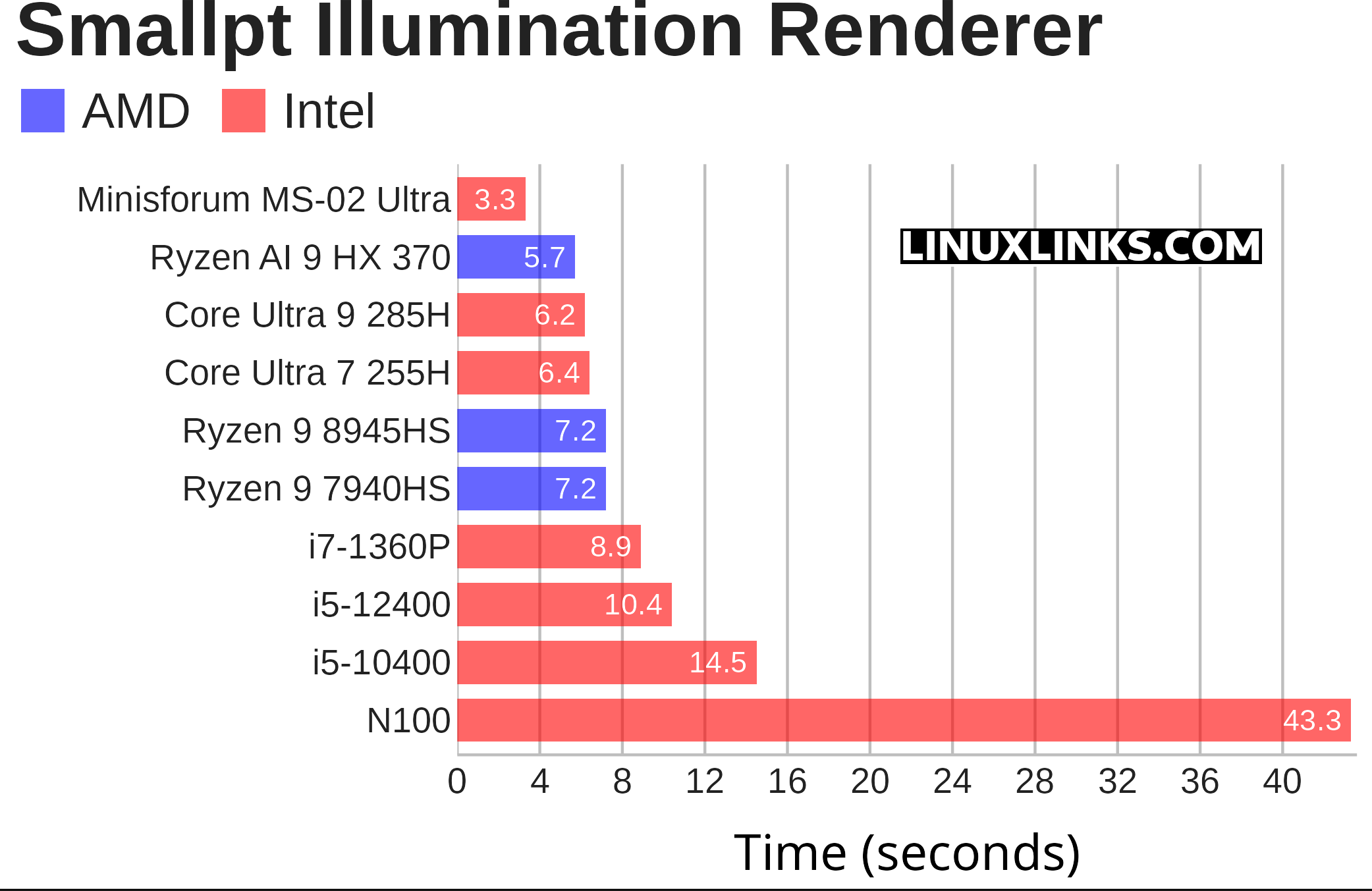
Smallpt is a C++ global illumination renderer written in fewer than 100 lines of code. It performs unbiased Monte Carlo path tracing and supports multi-threading via OpenMP. As this benchmark can use all CPU cores, processors with more cores complete the test considerably quicker.
In this CPU rendering benchmark, lower is better. From the MS-02 Ultra’s perspective, this is a very strong result: at 3.3 seconds, the Core Ultra 9 285HX system finishes the Smallpt render well ahead of everything else in the chart. It’s about 42% quicker than the Ryzen AI 9 HX 370, 47% quicker than the Core Ultra 9 285H, and more than 13× faster than the Intel N100.
It wins hands down because this is a pure CPU rendering workload, and the 285HX is a much heavier-class processor than the H/HS/U-class chips below it. The 285HX has 24 cores, 24 threads, 8 performance cores, 16 efficient cores, up to 5.5GHz boost, 36MB Smart Cache, 40MB L2 cache, and a 160W maximum turbo power rating. That gives it far more sustained compute headroom than the 285H, 255H, Ryzen AI 9 HX 370, and older mobile chips in the comparison.
The 285HX result is especially telling. Despite having a similar name, the Core Ultra 9 285H is a 16-thread chip with a lower 115W maximum turbo power rating, while the 285HX is a 24-thread HX-class chip with a 160W maximum turbo power rating. That’s why the MS-02 Ultra doesn’t just edge ahead, it almost halves the render time versus the 285H system.
$ phoronix-test-suite benchmark compress-pbzip2
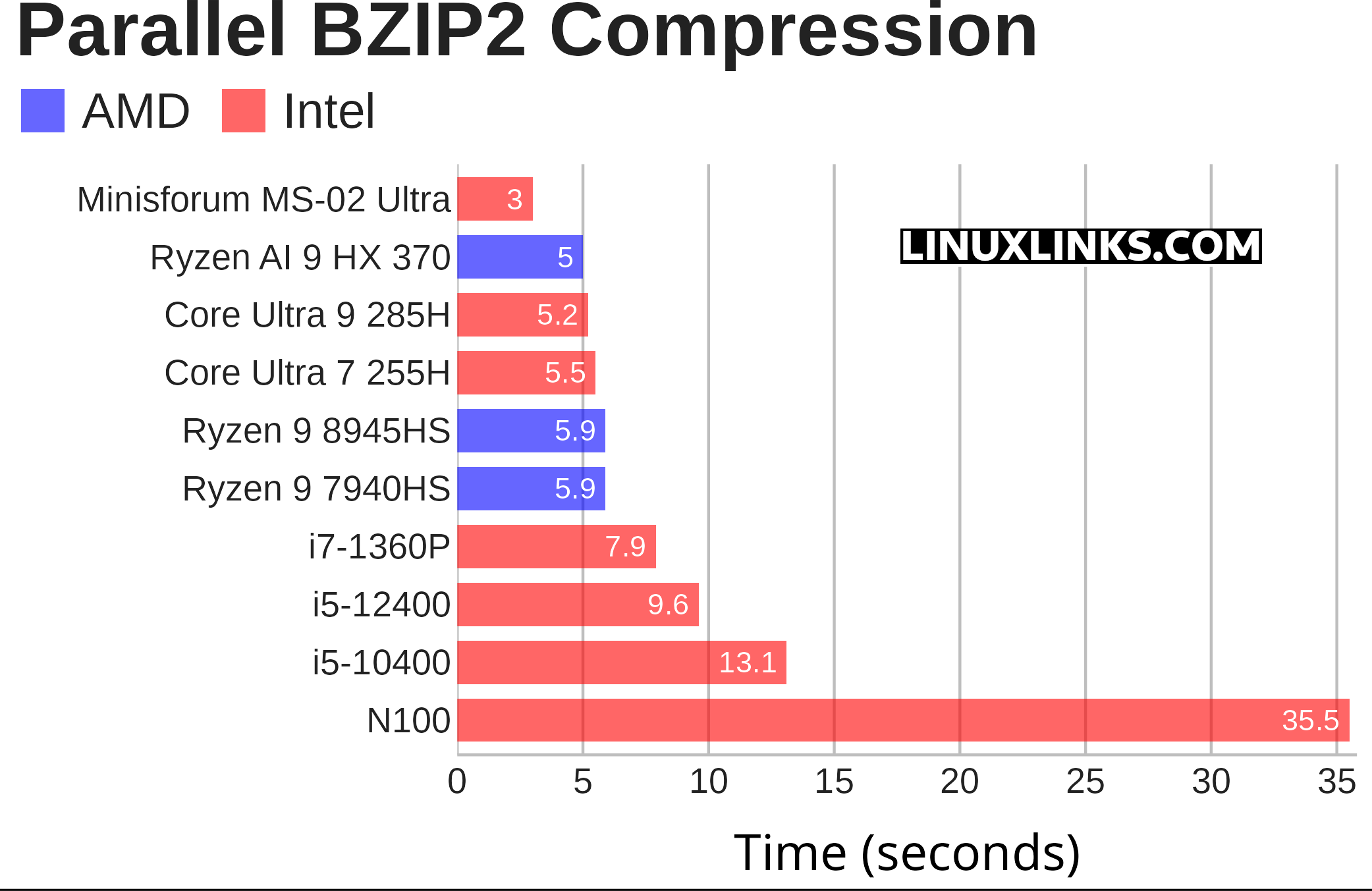
pbzip2 is a parallel implementation of the bzip2 block-sorting file compressor that uses pthreads and achieves near-linear speedup on SMP machines. This test measures the time needed to compress a file (a .tar package of the Linux kernel source code) using BZIP2 compression. Like the smallpt benchmark, this test can use all available CPU cores.
The MS-02 Ultra posts a 3.0 second result, which puts it well clear of the rest of the field. The nearest challenger, the Ryzen AI 9 HX 370, takes 5.0 seconds, so the MS-02 Ultra cuts the runtime by 40%.
That’s a bigger gap than you’d expect from normal generational improvement. Most of the stronger mobile-class chips cluster between 5.0 and 5.9 seconds, while the MS-02 Ultra sits in its own tier. In throughput terms, it’s about 1.7× faster than the Core Ultra 9 285H, almost 2× faster than the Ryzen 9 8945HS/7940HS, and nearly 12× faster than the N100.
Parallel BZIP2 is a good test for sustained multi-threaded compression, not just quick burst performance. The MS-02 Ultra wins because it can keep more compression work in flight and sustain that pace without falling back into the same performance band as the lower-power systems.
The most telling comparison is with the Core Ultra 9 285H at 5.2 seconds. Same broad Intel generation, similar branding, but a very different class of machine. The MS-02 Ultra’s 285HX implementation turns that into a decisive lead rather than a small advantage.
$ phoronix-test-suite benchmark openssl
OpenSSL is an open-source cryptography toolkit best known for implementing TLS, and historically SSL, protocols. This test profile makes use of the built-in “openssl speed” benchmarking capabilities.
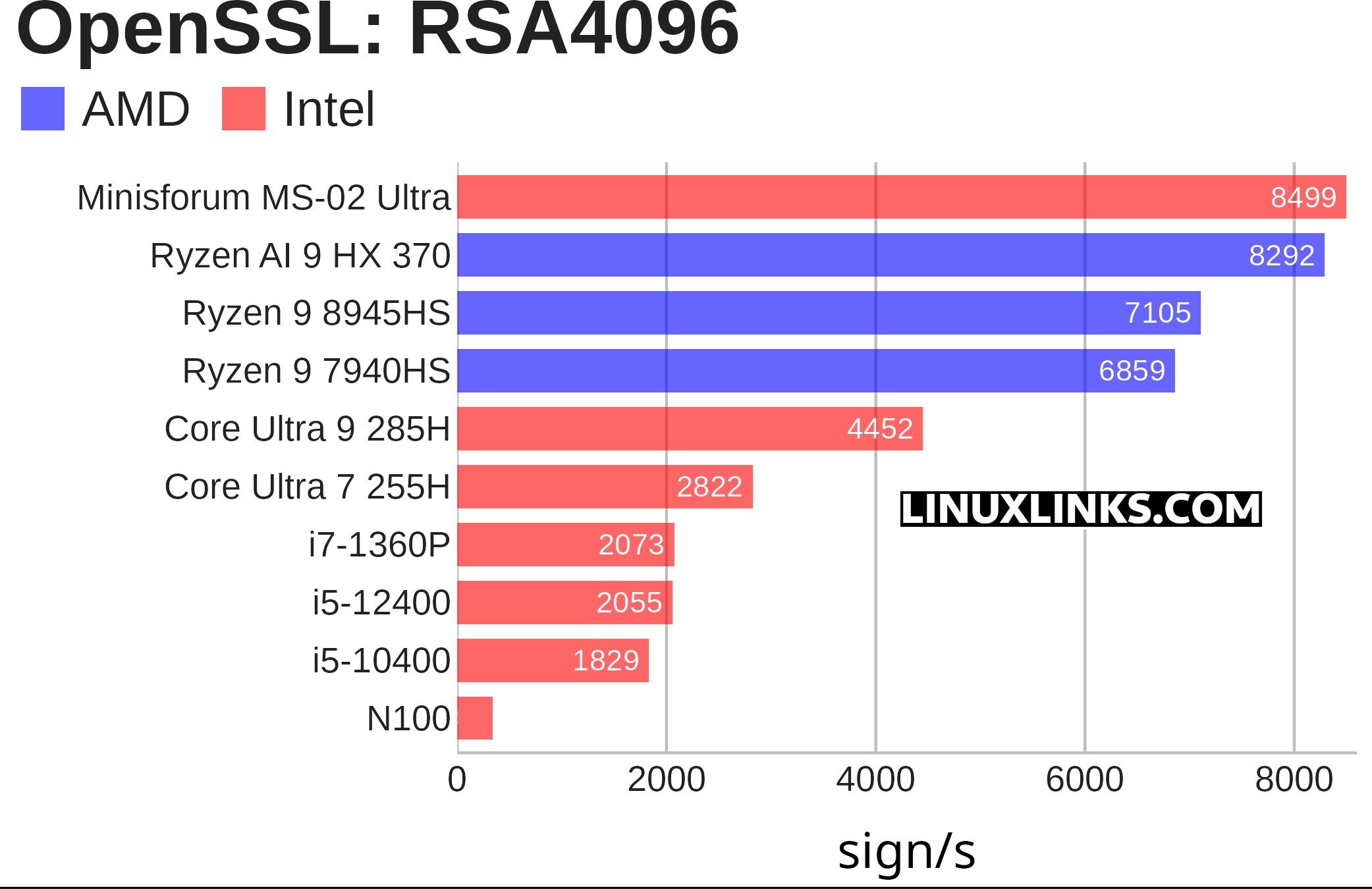
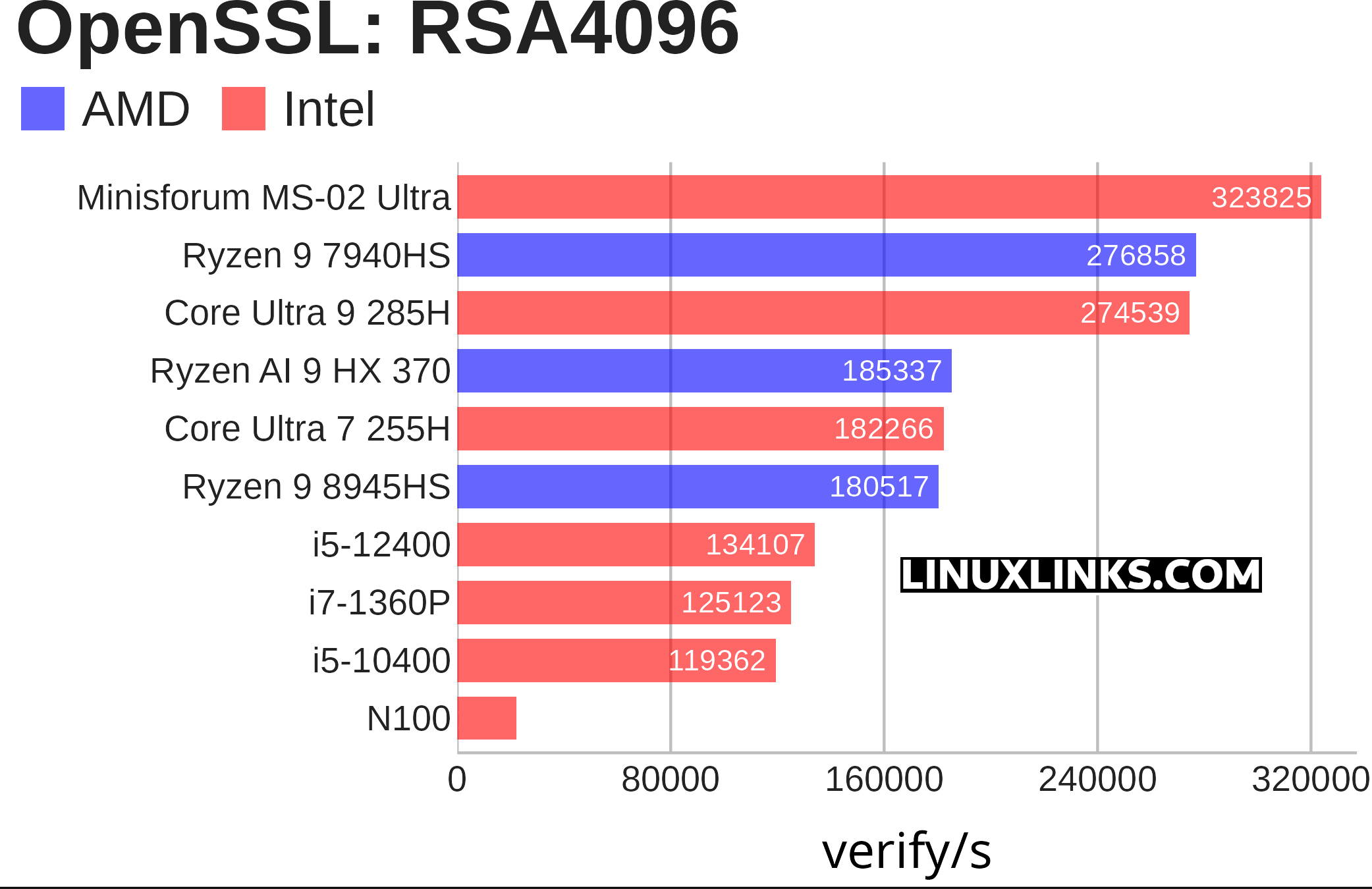
There are various algorithms that can be used for this benchmark. I focused on the RSA-4096 algorithm, since it serves as a good representative example for the other options. This benchmark includes two charts: one for signing speeds and another for verification speeds.
In OpenSSL RSA4096, the MS-02 Ultra leads both tests: 323,825 verify/s and 8,499 sign/s. Verification shows a clear advantage over the Ryzen 9 7940HS and Core Ultra 9 285H, while signing is closer, with the Ryzen AI 9 HX 370 just behind. The 285HX excels where cryptographic throughput scales with sustained CPU muscle.
$ phoronix-test-suite benchmark coremark
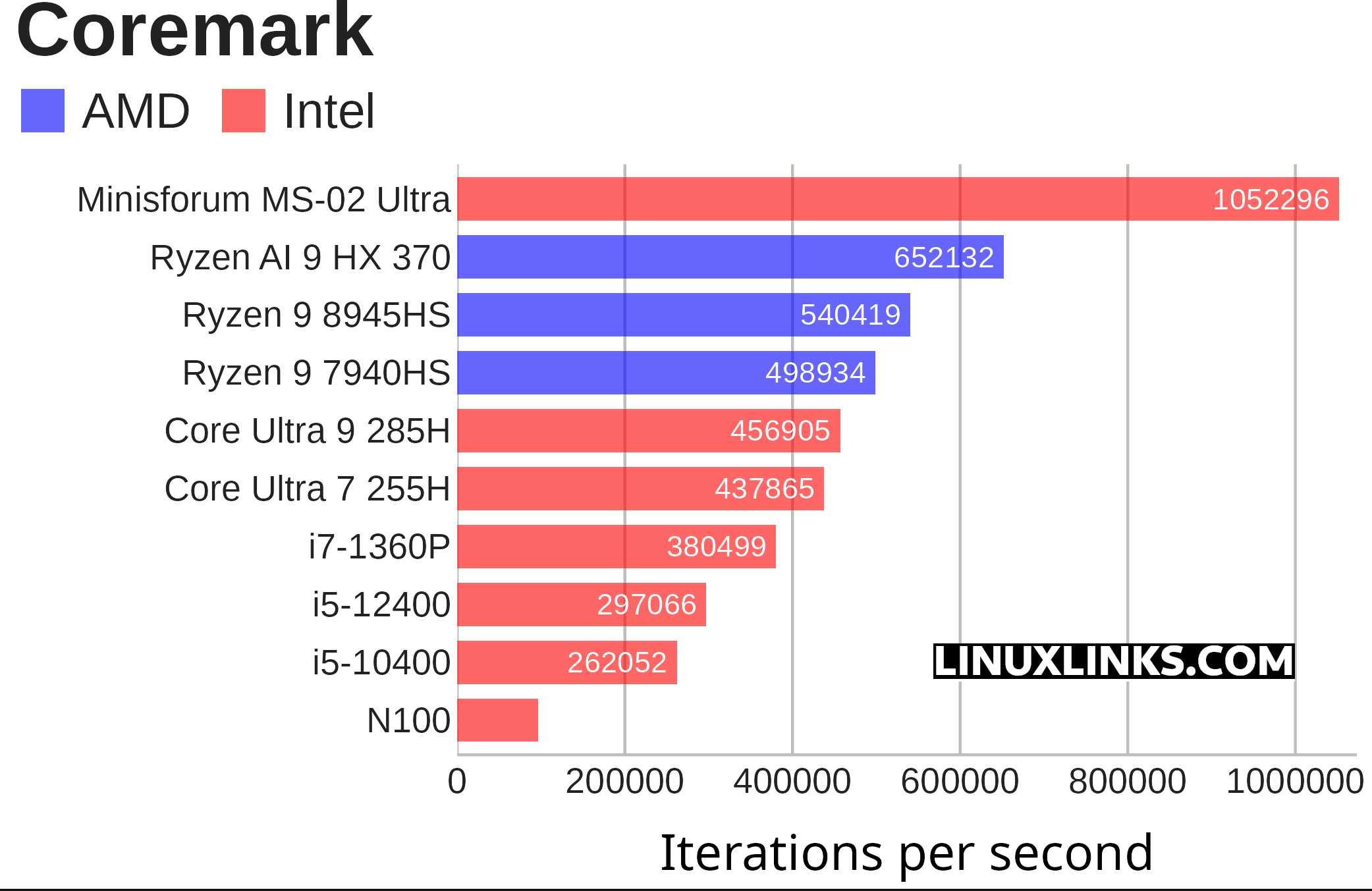
CoreMark is a benchmark that measures the performance of central processing units (CPU) used in embedded systems. It’s built around list processing, matrix manipulation, state-machine logic, and CRC, so it mostly stresses integer execution, branches, cache behavior, compiler output, and how well the CPU sustains clocks under load.
The MS-02 Ultra dominates CoreMark with 1,052,296 iterations per second, putting it in a class of its own. It’s around 61% faster than the Ryzen AI 9 HX 370 and more than 2.3× faster than the Core Ultra 9 285H. This benchmark rewards broad CPU throughput, so the 285HX’s extra headroom translates into a huge lead. The MS-02 Ultra is about 11× faster than the N100 in CoreMark.
$ phoronix-test-suite benchmark crafty
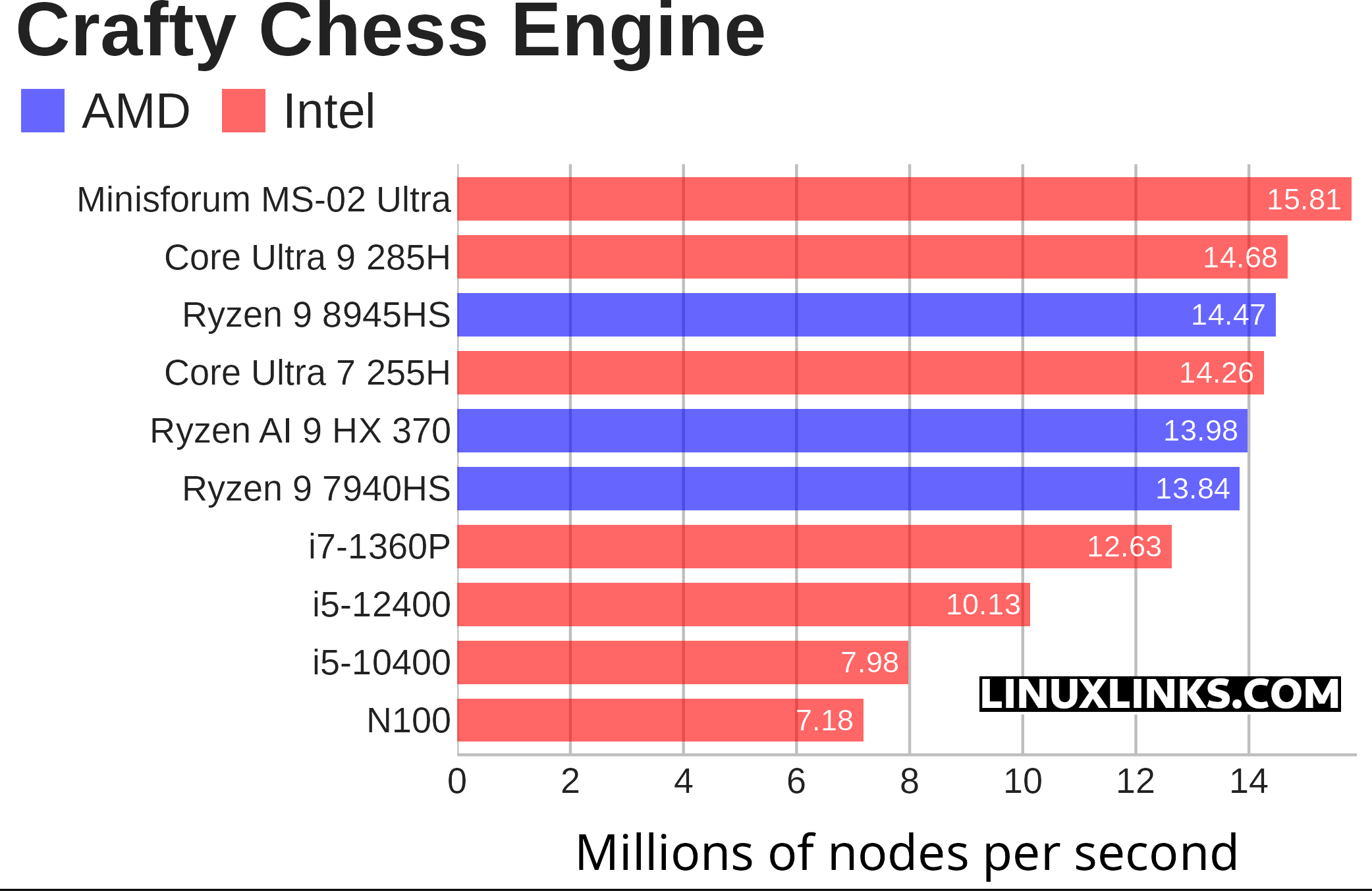
Crafty is a chess program directly derived from Cray Blitz, winner of the 1983 and 1986 World Computer Chess Championships. Crafty is a single-core benchmark.
Crafty is single-core, so the MS-02 Ultra’s lead is much narrower than in the heavily threaded tests. It still finishes top at 15.81 million nodes/s, around 8% ahead of the Core Ultra 9 285H and 13% ahead of the Ryzen AI 9 HX 370.
The result shows strong per-core performance rather than brute-force core count. The N100 also does respectably, reaching 7.18 million nodes/s, only a little behind the older i5-10400. It’s nowhere near the 285HX, but for a low-power budget chip, its single-core showing isn’t embarrassing.
Pages in this article:
Page 1 – Introduction / Processor
Page 2 – Graphics
Page 3 – Memory
Page 4 – Disk and Summary
Complete list of articles in this series:
| Minisforum MS-02 Ultra 285HX | |
|---|---|
| Introduction | Introduction to the series and interrogation of the machine |
| Benchmarks | Benchmarking the Minisforum MS-02 Ultra 285HX Mini Workstation |
| Power | Testing and comparing the power consumption |
| Dual channel memory | Assessing the impact of adding a second SO-DIMM |
| Cores | Benchmarking cores under Linux |
| BIOS | In the world of computing, BIOS, which stands for Basic Input/Output System, plays a crucial role |
| Btrfs | Advanced, modern copy-on-write (CoW) file system for Linux |
| Intel processors | P-Cores, E-Cores and LP E-Cores Compared Across 4 Intel Processors |
| More articles will be published next week | |
Please read our Comment Policy before commenting.
All those cores really help, but how many are being used for normal desktop use?
It’s a workstation not a desktop.