

smem2 is a command line utility for Linux that reports process and system memory usage with a focus on proportional set size (PSS), giving a more realistic picture of shared memory use than RSS alone.
It reads live data from procfs, can generate reports for processes, users, mappings, and the whole system, and also works as a Python library for scripted use.
This is free and open source software.
Key Features
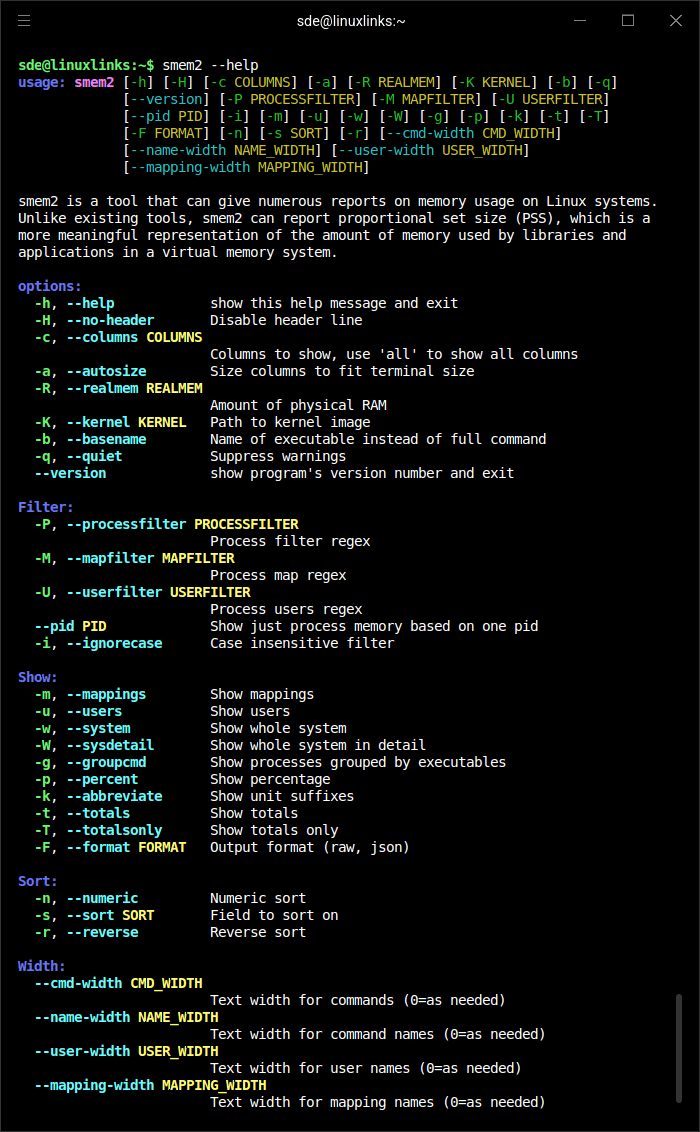
- Reports memory usage for processes, users, mappings, and the whole system.
- Shows proportional set size, unique set size, resident set size, and swap figures.
- Supports filtering by process, mapping, user, or specific PID.
- Offers totals, percentages, human-readable units, and configurable columns.
- Exports output in raw text or JSON format.
- Can be run with uvx or pipx, installed with pip, or imported as a Python library.
- Includes Docker support for running the tool and its test suite.
Website: github.com/slhck/smem2
Support:
Developer: Werner Robitza
License: GNU General Public License v2.0
smem2 is written in Python. Learn Python with our recommended free books and free tutorials.
Related Software
| Process Memory Tools | |
|---|---|
| ps_mem | Accurately reports memory usage of programs |
| pscircle | Visualizes Linux processes in a form of radial tree |
| psrecord | Record the CPU and memory activity of a process |
| smem2 | Reports on memory usage on Linux systems |
| process-mem | Display memory used by processes |
| process-map | Visualize the virtual memory of a process |
| Smemstat | Reports the physical memory usage |
| mstat | Measure memory usage of a program over time |
| alram | Helps when available memory is below threshold, with optional task killer |
Read our verdict in the software roundup.
 Explore our carefully curated directory of recommended free and open source software, covering every major software category. Explore our carefully curated directory of recommended free and open source software, covering every major software category.The directory forms part of our extensive collection of articles for Linux enthusiasts. It includes hundreds of detailed reviews, together with free and open source alternatives to proprietary software from companies such as Google, Microsoft, Apple, Adobe, IBM, Cisco, Oracle, and Autodesk. LinuxLinks also covers interesting projects worth exploring, Linux-compatible hardware, free programming books and tutorials, and much more. Know a useful free and open source Linux application that we haven’t covered? Tell us about it using our submission form. |
Please read our Comment Policy before commenting.