

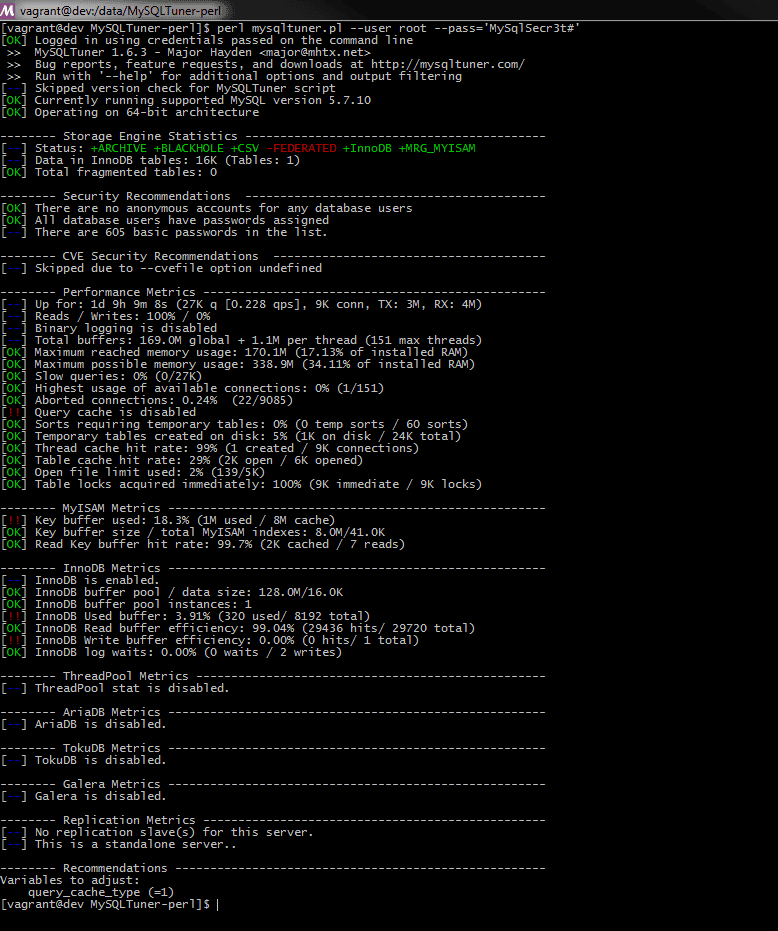
MySQLTuner is a Perl script that examines a running MySQL-compatible database server and turns its configuration and runtime statistics into practical observations and recommendations.
It is intended as an aid to database administrators rather than an automatic tuning system. The script collects server and operating-system information, evaluates a large number of indicators and highlights areas that deserve investigation. Its recommendations still require administrator judgement, particularly because changing one database setting can improve one workload while making another worse.
This is free and open source software.
Key Features
- Supports MySQL, MariaDB and Percona Server installations.
- Examines memory allocation, buffers, caches and overall server resource usage.
- Analyses query activity, connections, temporary tables, joins and other performance indicators.
- Checks InnoDB configuration and workload statistics.
- Evaluates replication, Galera and clustered environments where supported.
- Inspects operating-system memory, swap, storage and other host-level information.
- Provides a weighted database health assessment spanning performance, security and resilience.
- Checks TLS configuration, certificate state and encrypted connection settings.
- Audits authentication settings and highlights obsolete or insecure authentication choices.
- Examines schema design issues such as missing primary keys and problematic column definitions.
- Can compare structured output from earlier runs to expose workload and growth trends.
- Provides capacity-planning information for memory, storage growth and identifier exhaustion.
- Can produce suggested SQL and configuration changes while leaving application of those changes to the administrator.
- Supports structured machine-readable output for integration with external administration systems.
Website: github.com/major/MySQLTuner-perl
Support:
Developer: MySQLTuner contributors
License: GNU General Public License v3.0
MySQLTuner is written in Perl. Learn Perl with our recommended free books and free tutorials.
Related Software
| MySQL Tools | |
|---|---|
| DBeaver | Universal database tool |
| phpMyAdmin | MySQL web administration tool |
| NocoDB | Build databases as spreadsheets |
| MySQL Workbench | Complete visual database design tool |
| mycli | Command line interface for MySQL, MariaDB, and Percona |
| gh-ost | GitHub's Online Schema Migrations for MySQL |
| Beekeeper Studio | Cross-platform SQL editor and database manager |
| usql | Command-line database client |
| sqlit | lazygit of SQL databases |
| Harlequin | Easy, fast, and beautiful database client for the terminal |
| DbGate | Database manager for MySQL, PostgreSQL, MongoDB |
| Percona Toolkit | Essential command-line utilities for MySQL |
| SQuirreL SQL Client | Graphical SQL client written in Java |
| Adminer | Full-featured tool for managing content in MySQL database |
| dblab | Interactive client for PostgreSQL, MySQL, SQLite3, and more |
| Antares | SQL client based on Electron.js and Vue.js |
| XtraBackup | Backup utility for MySQL |
| innotop | Real-time, advanced investigation tool |
| SQLCheck | Detects common SQL anti-patterns |
| Skeema | Manage MySQL and MariaDB schema changes |
| Sequeler | Native Linux SQL client built in Vala and Gtk |
| orchestrator | High availability and replication management tool |
| OmniDB | Collaborative environment For database management |
Read our verdict in the software roundup.
 Explore our carefully curated directory of recommended free and open source software, covering every major software category. Explore our carefully curated directory of recommended free and open source software, covering every major software category.The directory forms part of our extensive collection of articles for Linux enthusiasts. It includes hundreds of detailed reviews, together with free and open source alternatives to proprietary software from companies such as Google, Microsoft, Apple, Adobe, IBM, Cisco, Oracle, and Autodesk. LinuxLinks also covers interesting projects worth exploring, Linux-compatible hardware, free programming books and tutorials, and much more. Know a useful free and open source Linux application that we haven’t covered? Tell us about it using our submission form. |
Please read our Comment Policy before commenting.